Posted on 07/16/2021 10:24:45 AM PDT by Capt. Tom
As another summer is upon us, white sharks are returning to feed in Massachusetts waters. Since 2009, DMF biologists (and collaborators) have been examining the movement ecology, behavior, natural history, and population dynamics of this species through its Shark Research Project. To date, agency staff have tagged more than 230 white sharks with a variety of high-tech tags to study their fine- and broad-scale movements. Most of these sharks were tagged off Cape Cod, but others were tagged off New York, New Jersey, South Carolina, and Florida. The sharks ranged in total length from 4.0-17.5 ft and were comprised of juveniles, subadults, and adults of both sexes.
The agency has been working with SMAST student and Atlantic White Shark Conservancy (AWSC) researcher Megan Winton to estimate the abundance and relative density of white sharks off Cape Cod from photographic mark-recapture, aerial survey, and acoustic telemetry data. To date, Megan and her team have cataloged more than 500 individual white sharks over the study period (2014–2018). She is now conducting her analyses and hopes to have the study completed by the end of the year.
Building on work conducted to date and in light of the growing presence of white sharks in our nearshore waters, DMF is intensifying its research to understand the predatory behavior of this species with particular emphasis on public safety. The aggregation of white sharks off the coast of Cape Cod is one of only a handful of “hotspots” in the world and unique along the east coast of the US. As such, the state of Massachusetts and, in particular, the towns on Cape Cod are faced with a growing potential for negative interactions between this species and people utilizing our coastal waters. This potential has already been manifested by an increase in attacks on humans—the most recent causing fatal injury to a boogie boarder off Wellfleet in September, 2018. Therefore, intensive research on the local movements and behavior of white sharks while in Cape Cod waters is warranted. Specifically, we need to know where, when, and how these sharks hunt seals, the frequency of feeding events, and environmental factors that drive the predatory behavior of these animals.
To do this, DMF is using a variety of tagging methods:
• The existing acoustic receiver array has been expanded to fill gaps around Cape Cod and to include the majority of towns along the Massachusetts coastline. With more than 200 acoustic receivers in our coastal waters, the Commonwealth is well equipped to examine the local movements of this species as well as others, including striped bass.
• We have also expanded our tagging and survey efforts into Cape Cod Bay where charter captains and private vessels have reported more frequent encounters with this species in recent years. Our work to date indicates that these fish tend to be smaller juveniles.
• DMF is now working with Bryan Legare, a Center for Coastal Studies researcher and PhD student at UMass Amherst, to examine the nearshore movements of white sharks as they relate to habitat. To do so, Bryan has deployed two gridded acoustic arrays off Head of the Meadow Beach (Truro) and Nauset Beach (Orleans), and he has intensively mapped both these areas. These arrays allow for the fine-scale tracking of white sharks to examine how they might be using habitat characteristics, like water depth and tide, to hunt their prey.
• Five real-time acoustic receivers are now being deployed off popular Outer Cape swimming beaches including: Newcomb Hollow and Lecounts (Wellfleet), Head of the Meadow (Truro), Nauset Beach (Orleans), and North Beach (Chatham). While our standard acoustic receivers must be retrieved at the end of the season for data collection, these “live” receivers send notifications immediately to beach managers and lifeguards when acoustically-tagged white sharks are detected close to these beaches.
• We are using a new tag technology called acceleration datalogging camera tags (see figure) on white sharks to record very fine-scale movements at sub-second intervals, including tailbeat frequency, amplitude, body posture, and swimming depth. These data will be used to examine swimming patterns (e.g., traveling, resting, hunting, foraging, mating), bioenergetics, and, ultimately, provide estimates of the intensity of white shark predation on gray seals.
• Direct observations of nearshore behavior are now being collected using a fixed aerial camera system, which was tested in Orleans in 2020.
• Real-time satellite tags are also being attached to white sharks for the first time using a new tool developed by the Woods Hole Oceanographic Institution. These tags can now be affixed without exposing the shark to unnecessary capture and invasive handling.
• Working with AWSC researchers, we are developing a near real-time white shark forecast model based on sightings, detections from acoustic buoys, and the results of habitat association models.
These efforts are being conducted with funding and logistical support from the AWSC, the state, and external grants. Collectively, this information can provide valuable information for science-based decision-making as it relates to public safety. For example, in a study just published in the journal Wildlife Research (Winton et al., 2021), AWSC and DMF researchers found that white sharks off Cape Cod spend almost half their time at depths <15 feet deep where there is a high potential for overlap with recreational water users. These results have clear implications for shark-related public safety practices in the region. This research, strengthened by strong collaborations, will continue to produce new, cutting-edge information about the white shark in the North Atlantic and, specifically, off the coast of Massachusetts.
By Greg Skomal, PhD, Senior Biologist, and Shark Research Project Leader
You ever get a shark or bear on ya you tell ‘em that....I’m sure it’ll help. LOL!
Heh, great post, made me smile...:)
I had a chance to spend several hours with the USS Indianapolis’ Ship’s Doctor.
Once we got to know each other, he talked, I listened. It had an effect on me.

Heh, I went striper fishing on a boat a buddy and I chartered out of Wells Harbor yesterday, just a few hours after this photo was taken.
We were fishing near a group of rocks jutting out of the ocean just offshore, and the Captain said "That's Seal Island, you can see one right there..."
My first thought was, yeah. I don' t want to fall overboard here!
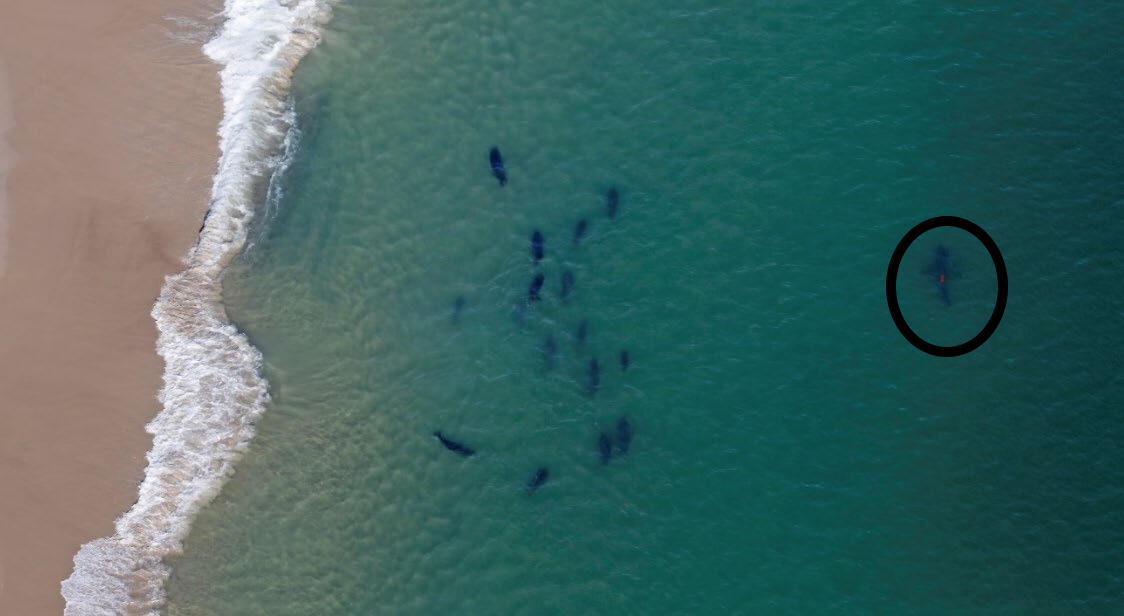
It’s a white alright.
If they leave that whale carcass in that area the chances of another white showing up is pretty good.-Tom
Sent info to shark expert ID friend last night ;he e-mailed me back this AM.
“Hi Tom,
Yes. I confirmed it was a white. Originally reported as Porbeagle. Whale washed ashore this evening.
Thanks, xxxxx”
Yikes, hanging out on shore well South in Brewster this am. No shelter sightings :)
Are you out playing golf? -Tom
Wow. Didn’t think the photo resolution would support my blowing it up enough to see that tag... but I could make it out!
Good job.
Dr. Skomal MDMF is mixing in a few new exotic tags to get different information on the white sharks.- Tom
Those are some serious "negative interactions"!
Shark Lives Matter
And there would be many more now if our water wasn't so cold for many people. -Tom
Yikes, hanging out on shore well South in Brewster this am. No shelter sightings :)
No golf, sore shoulder ;(
“Yikes, hanging out on shore well South in Brewster this am. No shelter sightings :)”
They are looking for you now on the Cape Cod Bay side.
John sent this out last night.-Tom
~~~~~~~~~~~~~~~~~~~~~~~~~~~~~~~~~~~~~~~~~~~~~~~~~~~~~~~~~~~~
Few more white sharks spotted in Cape Cod Bay today before the boomers ⛈ rolled in. If you have a sighting please remember to report it. Use
@sharktivity
or email me directly: MassSharks@gmail.com
Disclaimer: Opinions posted on Free Republic are those of the individual posters and do not necessarily represent the opinion of Free Republic or its management. All materials posted herein are protected by copyright law and the exemption for fair use of copyrighted works.