Carrying troops and munitions along with five or so actual warships. The ships had orders to use the force at their disposal if the Confederates resisted them.
This was a deliberate provocation and it was seen as an attack by the confederates. The shelling of fort Sumter began an hour after the Harriet Lane was spotted in the channel.


DiogenesLamp:
"The shelling of fort Sumter began an hour after the Harriet Lane was spotted in the channel." As per usual, our FRiend DiogenesLamp is disoriented & confused.
In fact:
- April 8 -- after notification from Pres. Lincoln, Jefferson Davis orders Fort Sumter be "reduced" if not surrendered.
- April 9 -- Confederate cabinet endorsed Davis' order to "reduce" Fort Sumter, only opposed by Secretary of State Toombs' accurate prediction:
"...will lose us every friend at the North.
You will only strike a hornet's nest. ...
Legions now quiet will swarm out and sting us to death.
It is unnecessary.
It puts us in the wrong.
It is fatal."
- April 11 -- during the day Confederate emissaries again demanded Fort Sumter's immediate surrender, but Maj. Anderson again asked for a delay.
- April 11 -- around sunset the small Union revenue cutter Harriet Lane arrived, outside Charleston harbor.
- April 12 -- around 1:00 AM, Confederates again demanded Maj. Anderson's immediate surrender.
Anderson again asked for a delay. - April 12 -- around 3:00 AM the civilian passenger ship Baltic, commanded by Capt. Fox, arrived, outside Charleston Harbor.
- April 12 -- 4:30 AM, before dawn, Confederates opened fire on Fort Sumter.
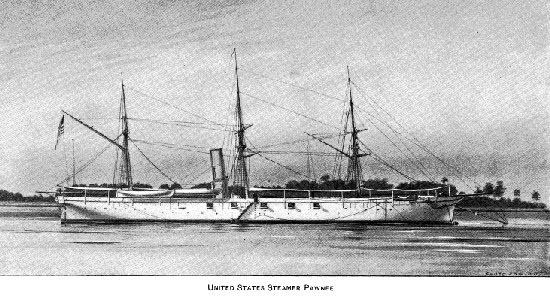
- April 12 -- 6:00 AM a major Union sloop of war, USS Pawnee arrived 10 miles outside Charleston Harbor.
So Jefferson Davis' order to "reduce" Fort Sumter had nothing to do with the number of, or arrivals of, the alleged Union "war fleet".
USRC Harriet Lane, arrived at sunset April 11:

Unarmed civilian passenger ship SS Baltic, Capt Fox commanding, arrived around 3:00 AM April 12:

Major Union warship USS Pawnee with 10 large guns arrived 10 miles off shore at 6:00 AM April 12: