Posted on 11/18/2020 2:48:35 PM PST by MtnClimber
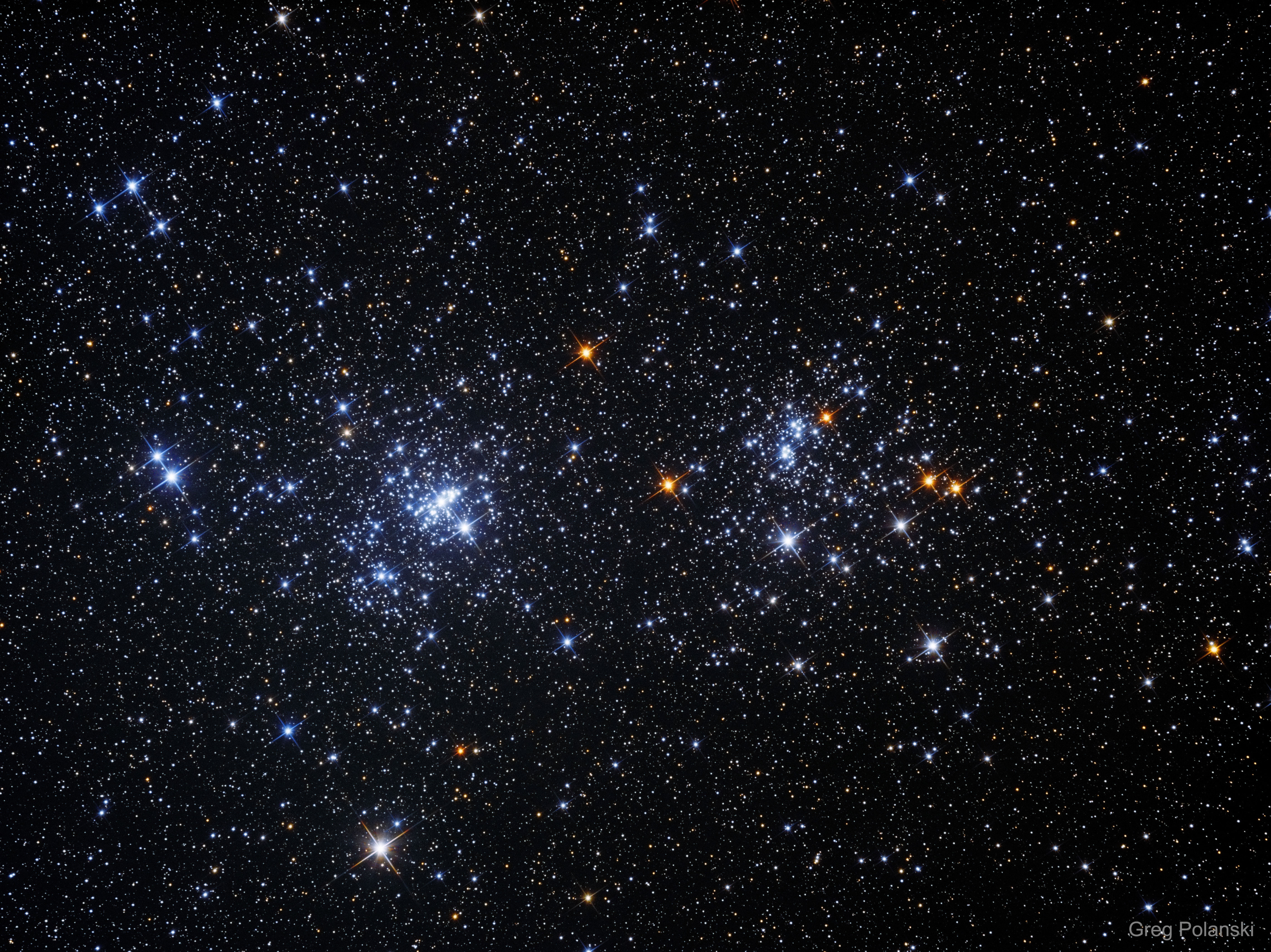
Explanation: Most star clusters are singularly impressive. Open clusters NGC 869 and NGC 884, however, could be considered doubly impressive. Also known as "h and chi Persei", this unusual double cluster, shown above, is bright enough to be seen from a dark location without even binoculars. Although their discovery surely predates recorded history, the Greek astronomer Hipparchus notably cataloged the double cluster. The clusters are over 7,000 light years distant toward the constellation of Perseus, but are separated by only hundreds of light years. In addition to being physically close together, the clusters' ages based on their individual stars are similar - evidence that both clusters were likely a product of the same star-forming region.
For more detail go to the link and click on the image for a high definition image. You can then zoom by moving the magnifying glass over an area and then clicking. The side bars will move the zoomed area over the photograph.
Pinging the APOD list.
The NASA scientists have hidden two cats in today’s Explanation.
Those cats are “physically close”.
(easier to find than a cat in a woodpile)
Clusters look like this...

“For more detail go to the link and click on the image”
I can’t find the detail I want: the angular field of view.
Also, I’ve looked at that double cluster through a 6” telescope and guarantee you there aren’t any orange stars.
I think the orange stars are strange too. NASA used another photographer’s photo for today’s picture. Maybe the photo had some kind of color filtering done to it.
I like viewing the Double Double in Lyra.
Disclaimer: Opinions posted on Free Republic are those of the individual posters and do not necessarily represent the opinion of Free Republic or its management. All materials posted herein are protected by copyright law and the exemption for fair use of copyrighted works.