
Posted on 04/22/2020 2:43:55 PM PDT by Diana in Wisconsin
Many hummingbirds spend the winter in Central America or Mexico, and migrate north to their breeding grounds in the southern United States as early as February, and to areas further north later in the spring.
Hummingbirds fly by day when nectar sources such as flowers are more abundant. Flying low allows the birds to see, and stop at, food supplies along the way. They are also experts at using tail winds to help reach their destination faster and by consuming less energy and body fat. Research indicates a hummingbird can travel as much as 23 miles in one day.
During migration, a hummingbird's heart beats up to 1,260 times a minute, and its wings flap 15 to 80 times a second. To support this high energy level, a hummingbird will typically gain 25-40% of their body weight before they start migration in order to make the long trek over land, and water.
The first arrivals in spring are usually males. Some, however, do not migrate, in areas like California and the upper Pacific coast.
We are now monitoring the Spring 2020 hummingbird migration with the help of our viewers as they submit their first hummingbird sightings.
Ruby-throated hummingbirds are moving northward quickly, with the front line of the migration appearing in Missouri, southern Illinois, Kentucky, Indiana, Ohio, Maryland, and Virginia. First sighting reports of Ruby-throats have just been received from New York and Maine. Seeing delays due to continued snow in some areas.
Black-chinned hummers are advancing through central and western Texas into Oklahoma and New Mexico, Utah and further west.
Rufous are being spotted through California and Washington up into southern British Columbia in places like Victoria and Whistler. And we have had reports from Juneau, Alaska ... It is our northernmost hummingbird sighting of 2020.
Broad-tailed hummingbirds are being sighted during their migration through New Mexico and into Colorado, as far north as Boulder, Golden, Loveland and Fort Collins.
Calliope sighting reports are being received in several areas, many in the greater Spokane area in eastern Washington, and up into Canada
Anna's stay year-round in locations along the West Coast, and we have recieved multiple reports of their current locations.
Allen's are being spotted in California, from San Diego in the south, northward up into the Oakland area.
The Current Migration Map
Shown below is our current map of hummingbird sightings in 2020 across the U.S. and Canada, as reported by our website viewers.
Here are some points to note about the posting of reports:
We do not publish names or e-mail addresses or exact physical address on our map, just a city and state, and sighting details.
Sightings posted to the map do not represent exact locations, addresses or coordinates; sightings are often placed on the map near center-city.
Due to the volume of sightings reported, our limited staff, and our inability to fit all sightings on our map, we are not able to post every report. When the number of sighting reports overwhelm the staff, priority is given to posting sightings along the leading edge of the migration.
In situations where multiple sightings are reported for a single location, only one sighting will be placed on the map.
I thought I saw one zip past my window earlier this afternoon at my getaway place just south of Wisconsin border, but I wasn’t sure. So I dug the feeder out of the shed and hung it up. After looking at the map at the link I think I was right. Still haven’t seen a Purple Martin yet.
You watch.
Gracious! Have you ever had a hummie feed from your hand?
It’s magical.
I just put my feeders up and I’ve seen one little green hummer...hopefully more will come.....
I always hope to get dozens and dozens of hummers but its still hit and miss around here...
What’s the bag limit on hummingbirds?
I pulled a dead one out of the grill of my Ford Ranger one time.
We put our feeders out just today (SE TX).
By late this afternoon we saw several (Ruby Throated) fighting over one of the feeders.
It takes a while for them to figure out that there are MULTIPLE feeders, spread pretty far apart.
Sweet hummers.
So sweet!
I guess I need to look for a red bottle cap :)
We had a hummer get trapped in a spider web, in the corner of our garage, one summer.
By the time we found it and were able to rescue it, it was extremely weak.
I put it in a shoe box and removed all of the spider web with a wet q-tip. I put a tiny bowl ful of nectar in the box. It gained enough energy overnight to fly off, the next morning, thankfully.
No,but once when I was wearing a floral blouse, one checked me out up close and personal. I just stood stil! as it zipped all around me neck g out the garden on my blouse. At one point we were nose to nose. It was a most delightful and memorable experience.
We’ve been getting Ruby Throated and some mainly green (possibly female Ruby Throats?) at our feeders for several weeks now..many will hang out here for the season.
I get a lot of those two birds and a handful of Hummingbirds each season. The Orioles will nest in our big Maple in the house yard, so it's fun to (secretly) watch them build their awesome nests and fill it with eggs and then babies. I don't know where the Grosbeaks nest, but they hang around a good part of the summer, too.

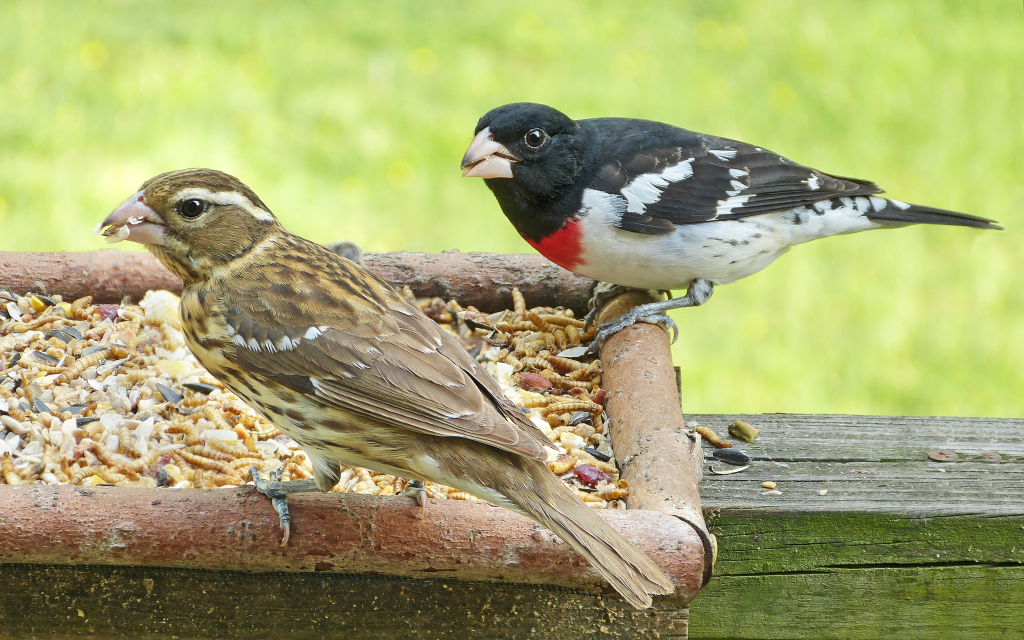
Once in a great while we get to see an Indigo Bunting.

Other than that, we get all of the every-day Midwest Birds at some point. But, much to Beau's dismay, hardly any wild turkey. An unsuccessful Turkey Hunt this past week. :(

It was so kind of you to save the hummie from the spider web. Ya done good! Bless you!
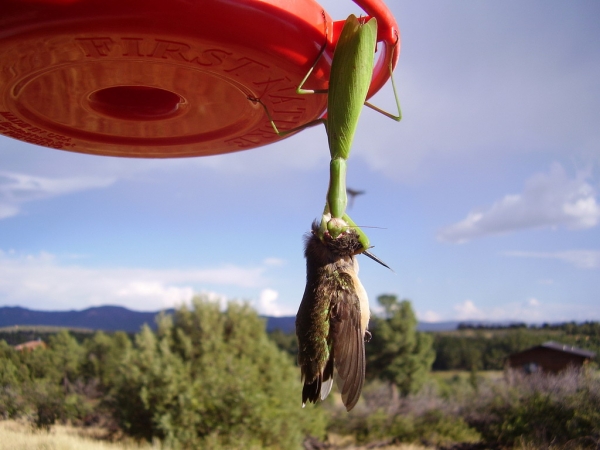
I've never seen this in person, but I used to belong to a hummie forum; and these pix came from one of the posters on the site.So, I believe them to be plausible.

I used to experiment a lot to find out what are the best hummie attractants. I found that having a convenient keychain Photon micro-blacklight handy at a garden center is very helpful. When you shine it on the flower blossom, it gives you a better perspective what the hummie sees when s/he approaches the flower blossom.

Using the blacklight, I found that the Gartenmeister Fuchsia is a great hummie attractant. They seem to love it. I used to plant tons and tons of Morning Glories...and they didn't seem to like them as much as the Gartenmeister Fuchsia.
Disclaimer: Opinions posted on Free Republic are those of the individual posters and do not necessarily represent the opinion of Free Republic or its management. All materials posted herein are protected by copyright law and the exemption for fair use of copyrighted works.