Posted on 09/07/2019 2:12:04 PM PDT by simpson96
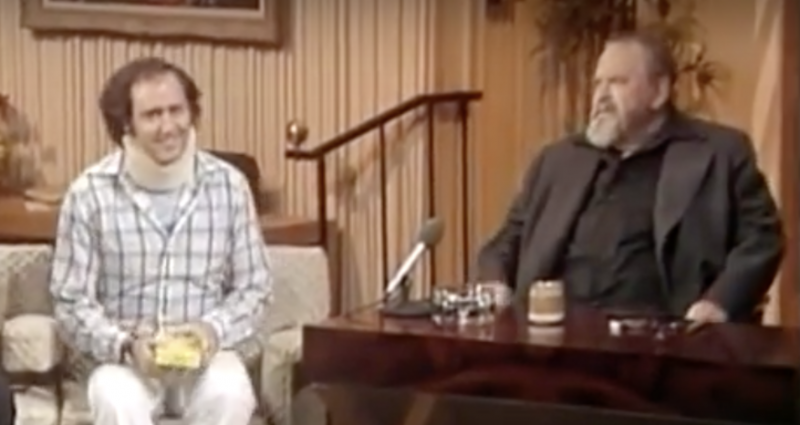
Guest-hosting the Merv Griffin Show in June of 1982, Welles describes Taxi as a show that has "kept television from being a criminal felony" just before bringing Kaufman on for a chat. He heaps praise on Kaufman's performance as Latka, adding, "I want to know why it is that you go and wrestle with people when you can act so well." Kaufman had shown up wearing a neck brace, an accessory signifying the end of his stint as a professional wrestler, one of the many inexplicable but somehow compelling choices in a short career that blurred the lines between comedy, performance art, and life itself.
Andy Kaufman is interviewed by Orson Welles - 1982
(Excerpt) Read more at youtube.com ...
Two geniuses! One had a longer run than the other, unfortunately.
Orson did most of the talking almost to fill in the air from Kaufman’s short replies. Kaufman just looked like an innocent who was happy to be there. You get to see how Orson’s mind works and how he understood TV and characters. Sometimes I think he was too analytical and assumed that the audience was on his level — where he would write 24 pages of direction for a scene — as in the movie Touch of evil. Usually the studio would cut his movies down and, despite his long winded directions and artistic touch, that is what I appreciate the most. Either the movie speaks or it dies mute... no long terminal Orson Welles movies if I can help it.
Kaufman was very talented, and very unusual. However, challenging pro wrestlers was foolish. They may be choreographed, but what they do requires real fitness, strength, and training.
Welles himself crossed lines and blurred boundaries: Witness how much Citizen Kane was a one-man creation.
He narrated the original version of Tales of Mystery and Imagination by Edgar Allen Poe, by The Alan Parsons Project.
That recording did not appear in 1976, but was released in 1986.
Theme song from Taxi, “Angela’s Theme” is one of the most beautiful songs ever.
I first saw Touch of Evil at a Vitaphone Theater (film society), as a new print.
It was amazing. I can somewhat agree about his approach. Studio interference is often detrimental to art, but some artists need a good editor.
There can always be a “director’s cut” version. But Welles thinks the Lady From Shanghai was too short, and others the studio took liberties with by shortening. I think there is usually a little voice that says “This is too long” or “I wish this would keep going” in long movies, but it is a rare thing if it is the latter.
What’s weird is that I lived through that time but I don’t remember ever watching an episode of Taxi, let alone hearing the theme song. I should check it out.
The Kaufman wrestling thing was all a gag. He and Lawler had worked it out. He did enough training, and practice. He never got hurt. It was 100% kayfabe. Kaufman requested the ambulance from the mat, he paid for it. He and Lawler were. All an act. An act that made wrestling national and Vince McMahon rich. But an act all the same.
Performance art of the highest order. The only person who has equaled that level since ? Donald Trump. I miss Kaufman.
Was the guest before Kaufman actor Ron Glass from Barney Miller?
It was.
He was great. He had his legs crossed like a man too. When did males start crossing their legs like the ladies?
Here is one of my favorite stories about Kaufman from Tony Danza, regarding Kaufman's alter-ego Tony Clifton.
Kaufman would show up at the beginning of the week, pick up his script and then show up for the taping of the show. No rehersals - they would have a stand-in to hit the marks, etc. Andy never messed up during the show.
“Tony Clifton” would be at every rehearsal and would want to run through things numerous times! Tony Clifton had his own contract! The other actors had to refer to him as Tony.
Disclaimer: Opinions posted on Free Republic are those of the individual posters and do not necessarily represent the opinion of Free Republic or its management. All materials posted herein are protected by copyright law and the exemption for fair use of copyrighted works.