If you're referring to duplicate "gravitationally lensed" images of galaxies, not at all sure, but they may have taken most of them into account.
What is Gravitational Lensing?
When astronomers refer to lensing, they are talking about an effect called gravitational lensing. Normal lenses such as the ones in a magnifying glass or a pair of spectacles work by bending light rays that pass through them in a process known as refraction, in order to focus the light somewhere (such as in your eye).Gravitational lensing works in an analogous way and is an effect of Einstein's theory of general relativity – simply put, mass bends light. The gravitational field of a massive object will extend far into space, and cause light rays passing close to that object (and thus through its gravitational field) to be bent and refocused somewhere else. The more massive the object, the stronger its gravitational field and hence the greater the bending of light rays - just like using denser materials to make optical lenses results in a greater amount of refraction.
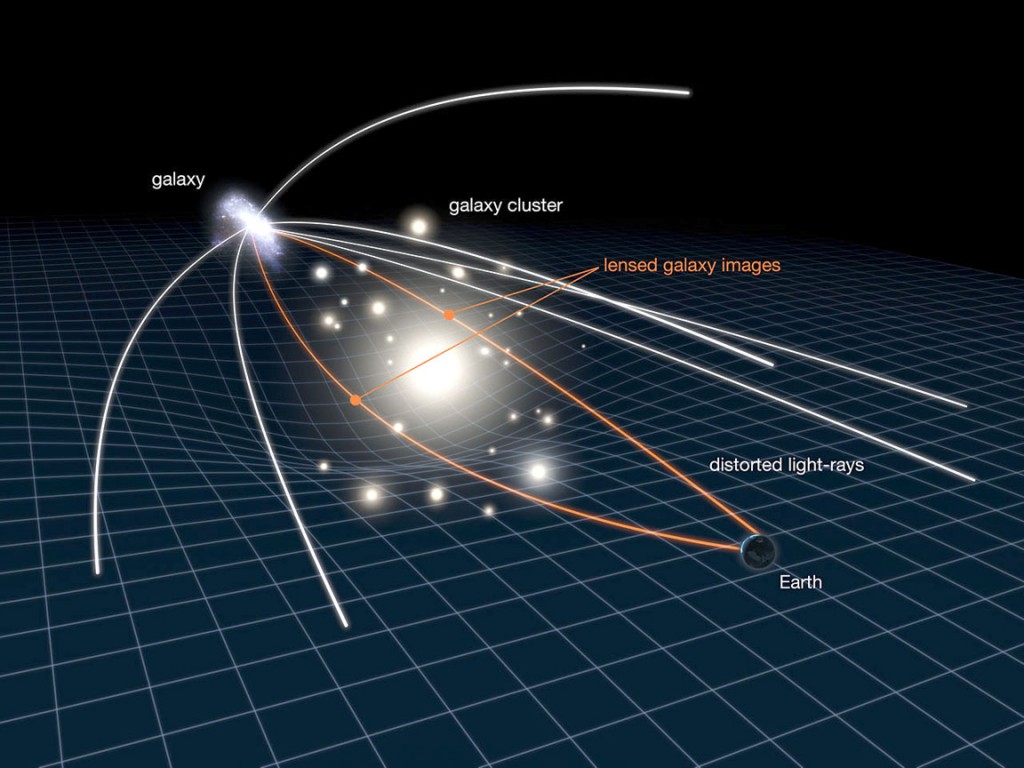
Image: NASA/ESA
Gravitational lensing happens on all scales – the gravitational field of galaxies and clusters of galaxies can lens light, but so can smaller objects such as stars and planets. Even the mass of our own bodies will lens light passing near us a tiny bit, although the effect is too small to ever measure.
So what are the effects of lensing? The kind of lensing that cosmologists are interested in is apparent only on the largest scales – by looking at galaxies and clusters of galaxies. When astronomers take a telescope image of a part of the night sky, we can see many galaxies on that image. However, in between the Earth and those galaxies is a mysterious entity called dark matter. Dark matter is invisible, but it does have mass, making up around 85% of the mass of the Universe. This means that light rays coming towards us from distant galaxies will pass through the gravitational field of dark matter and hence will be bent by the lensing effect.
Dark matter is found wherever 'normal' matter, such as the stuff that makes up galaxies, is found. For example, a large galaxy cluster will contain a very great amount of dark matter, which exists within and around the galaxies that make up that cluster. Light coming from more distant galaxies that passes close to a cluster may be distorted – lensed – by its mass. It is the dark matter in the cluster that does almost all of the lensing as it outweighs regular matter by a factor of six or so. The effects can be very strong and very strange; the images of the distant, lensed galaxies are stretched and pulled into arcs as the light passes close to the foreground cluster. This can be seen in the image below of the famous Abell 2218 cluster. The real galaxies are not this shape – they are usually elliptical or spiral shaped – they just appear this way because of lensing.
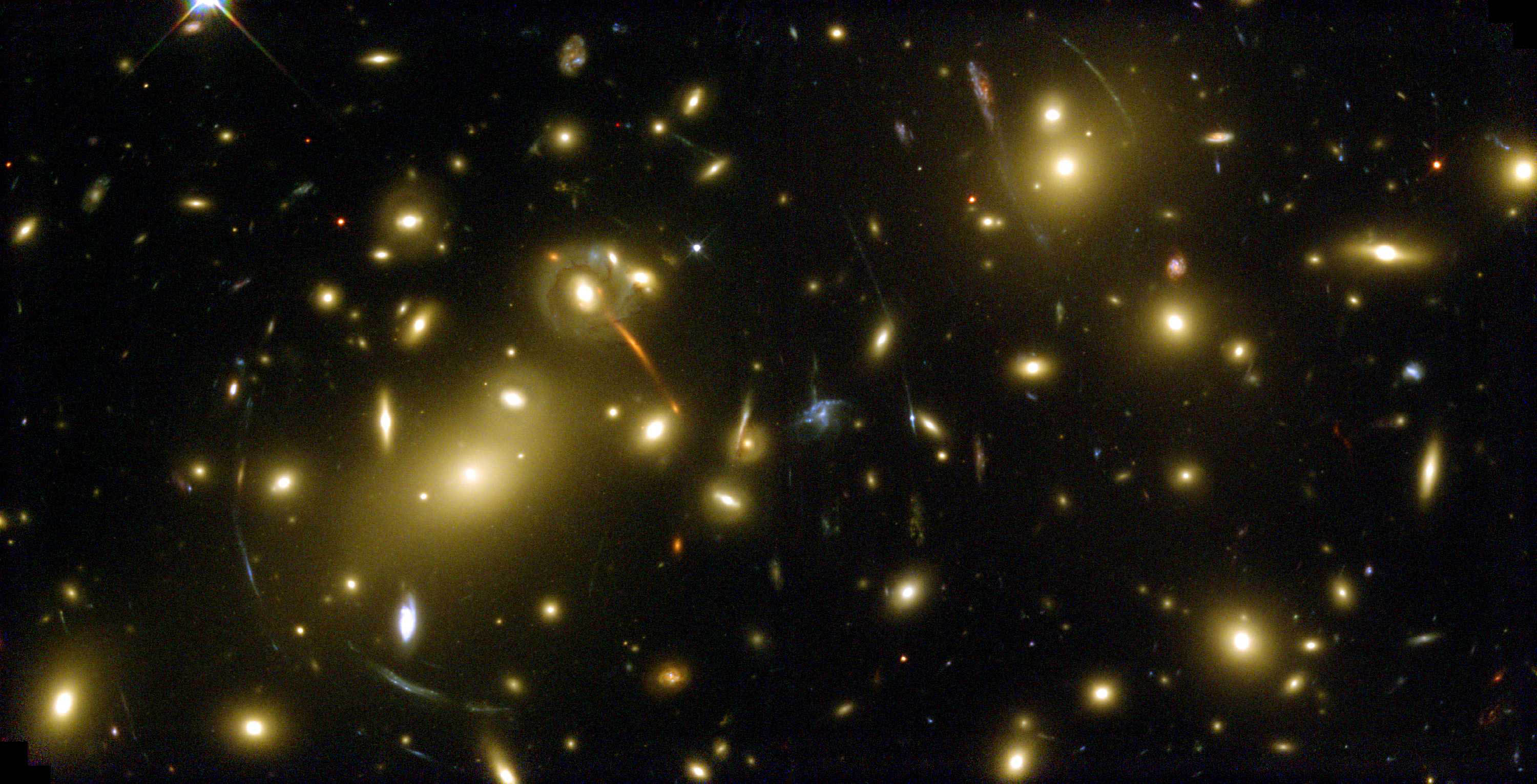
Image: NASA/ESA
This strange shape distortion comes from the fact that galaxies are large objects, and the light rays leaving one side of the galaxy (e.g. the left hand side from our point of view) will pass through a different part of space than the light rays leaving the other side (e.g. the right hand side). The light rays will therefore pass through different parts of the dark matter's gravitational field and will be bent in slightly different ways. The net effect of this is a distortion to the shape of the galaxy image, which can in some cases be very severe. Another interesting effect that can occur due to lensing is the formation of multiple images of the same galaxy. This occurs because light rays from a distant galaxy that would otherwise diverge may be focused together by lensing. From the point of view of an observer on the Earth, it looks as if two very similar light rays have travelled along straight lines from different parts of the sky. You can see this in the orange lines in the schematic above - we can see more than one image of the same galaxy in different places. Lensing can also act like a magnifying glass, allowing us to see images of galaxies that would otherwise be too faint to see.
An example of multiple images is shown below in an image from the Hubble Space Telescope. There are 3 images of the same galaxy, and 5 images of a type of galaxy called a quasar. The images are not the same shape or size because each image will have passed through a different region of space on its journey to us, and hence will have been distorted differently. A technique known as spectroscopy is used to determine which images came from the same galaxy.
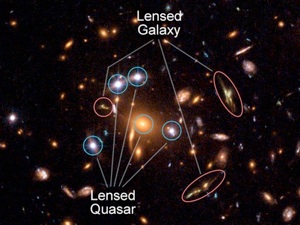
Image: NASA/ESA, K Sharon (Tel Aviv University), E. Ofek (Caltech)
source:
http://www.cfhtlens.org/public/what-gravitational-lensing