
Posted on 12/26/2018 3:34:03 PM PST by Rebelbase
Thomas Cole is known primarily as the father of the Hudson River School of landscape painting. Cole enjoyed the patronage of several prominent businessmen in New York City, and they would have been particularly interested in his depictions of the seemingly limitless resources of the country’s interior—the profusion of timber and the extensive network of rivers and lakes that would enable them to make their fortunes. They believed that settlement of the land would have nothing but beneficial effects.
It is Cole’s skill as an artist that enables him both to create an image that would both appeal to his patrons in its depiction of abundant resources and express his own concern about the effects of settlement on the land. In Cole’s Home in the Woods, a father returns home to the family cabin in the White Mountains of New Hampshire, bringing with him a fresh catch that will serve as the family’s dinner. The family has cleared the land themselves—the chopped-down trees and sawn logs are prominent in the foreground of the painting. And it is through this detail that Cole reveals his stance on the settlement of unspoiled land in the country’s interior. In his 1836 “Essay on American Scenery,” Cole lamented the “ravages of the axe” that were destroying the wilderness as early as the 1830s.
In Home in the Woods, the ravages of the axe are prominently represented in the foreground. The artist clearly contrasts the area around the cabin, shorn of trees and littered with the family’s belongings, with the pristine mountains in the background. He seems to warn the viewer that, as more and more people arrive, these unspoiled places will disappear.
Home in the Woods was commissioned by the American Art-Union, a subscription society founded by a group of New York businessmen in 1840. The goal of this organization was to educate and enlighten American citizens by exposing them to fine art. Members of the union joined by paying five dollars per year, for which they received minutes of annual meetings, a print based on a work of fine art, and a lottery ticket which put them in the running to win a work of original art. In 1847, the American Art-Union commissioned Thomas Cole to produce a work for addition to their catalogue. At the annual meeting that year, George Dwight of Springfield, Massachusetts, won Home in the Woods by lottery.


When I think of Cole....I also think of Asher Durand’s painting “Kindred Spirts” that depicts Cole with his friend, William Cullen Bryant...painted a year after Cole’s death.
"He is the painter of scenes from the American Revolution. He also painted the Declaration of Independence. Much of the image of that event is fictional as far as artistic license goes, but he is the artist who gave us the images we live off now. Those are the images of our past. The painting of the Declaration of Independence is his major contribution.
/arc-anglerfish-arc2-prod-tronc.s3.amazonaws.com/public/KOCFBLR76JBENDFUV2YUP3RUYM.jpg)


he was a painter with a fun imagination and a laudable ability to paint representational art.
http://www.google.com/search?q=thomas+cole+paintings&sa=X&oi=image_result_group&tbm=isch
Naturally, this is my favorite of his:
http://www.google.com/search?q=thomas+cole+architect%27s+dream&sa=X&oi=image_result_group&tbm=isch
Thomas Cole: Artist, Romantic, Anti-Jacobin
http://www.freerepublic.com/focus/chat/3638399/posts
Thomas Cole: The Course of Empire
http://www.explorethomascole.org/tour/items/63/series/
Subsidence of the Waters (the Deluge)
http://www.google.com/search?q=thomas+cole+the+deluge&sa=X&oi=image_result_group&tbm=isch
and the earlier contemporary, Francis Danby’s “Deluge” is an old fave:
http://www.johncoulthart.com/feuilleton/2011/09/12/danbys-deluge/
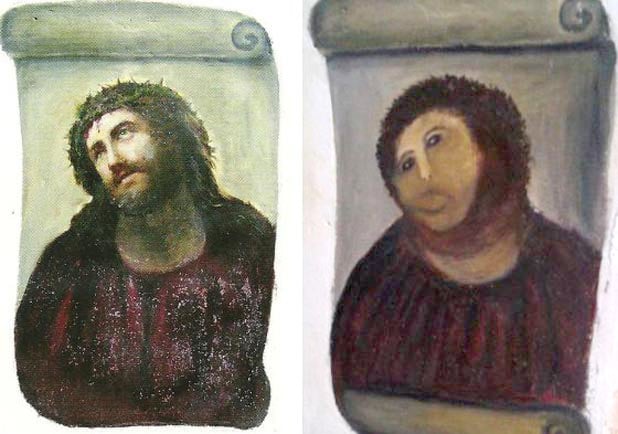
But there was a successful unintended consequence.
Botched Restoration of Jesus Fresco Miraculously Saves Spanish Town
I agree! Much better!
“Cat saves man from fire” little known Rockwell painting.
Disclaimer: Opinions posted on Free Republic are those of the individual posters and do not necessarily represent the opinion of Free Republic or its management. All materials posted herein are protected by copyright law and the exemption for fair use of copyrighted works.