To: BostonNeocon
If you believe that “The South didn’t care about states’ rights”, you should ponder why the South established a Confederate system of government, echoing the failed “Articles of Confederation”, with sovereign States associated via a weak central government. I view the Civil War as being about States’ rights ...to have and extend slavery. The two are inextricably linked; it’s foolish to argue one over the other.
“The South was controlled by a semi-aristocratic clique of slaveholders who sought to oppress the Northern white working class.” I’ll go along with the clique of semi-aristocrats leading the South into perdition, but I doubt they gave a thought to northern industrial labor. The aristocrats tended to be deeply in debt, land and slave rich but cash poor, and determined to find outlets for the slaves they already had in profusion. Even in Washington’s day, in states like South Carolina and Virginia there were far more slaves than productive enterprise for their labor. Preserving the value of slave capital required relocating slaves into the “Deep South”; once this zone too was saturated, Old South slaveholders wanted to outplace operations into the West and Caribbean, or liquidate their capital stock of human beings by selling into those markets. The expansion of slave territory was the desperate need of the greedy bastards, and States’ Rights to maintain and expand slavery was their key issue.
To: Chewbarkah
My little town in Alabama is at the Falls of the Tallapoosa river.
We started our first textile mill in 1845 and had several more built in the 1850s. We even had an armory making Enfield carbine rifles by the time the war started. The only armory, incidentally, never to have been burned to the ground by the Union Army. They did stop making the rifles in mid-1865, as no one was buying anymore!
Another fellow, from New Hampshire, named Daniel Pratt, who the town of Prattville is named after, started his mills in the 1840s.
In other words, industrialization WAS coming to the South, and textile mills producing cotton cloth were undercutting everyone up North because they were so close to the cotton product they used.
If the war and succession had not happened, the South would have industrialized as much as the North had.
Kind of sad that the hotter heads prevailed. I often wonder what would have come of this area if the peacemakers prevailed. My people down here were Whigs and Unionists (the Nation—not labor groups). They thought the Succession was a disaster, even though they fought for it out of honor and loyalty.
51 posted on
08/25/2017 3:48:37 PM PDT by
Alas Babylon!
(RE THAT GIVES OTHERS REMOTE DESKTOP ACCESS)
To: Chewbarkah
The expansion of slave territory was the desperate need of the greedy bastards, and States’ Rights to maintain and expand slavery was their key issue. I've seen the "expansion" argument a lot, and I have recently discovered there is a serious problem with it; It wasn't possible.
The only crop that made slavery profitable was cotton. Here is a modern map of cotton growing in the United States.
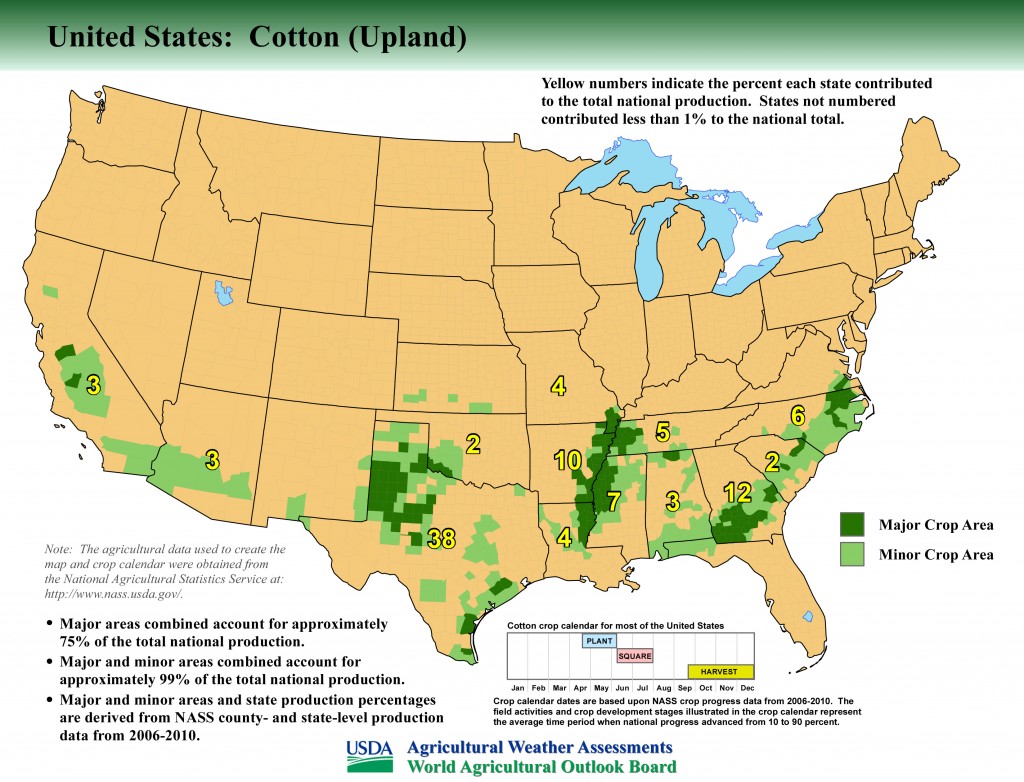
Other than a tiny bit in Kansas, Cotton wouldn't grow in the Western states above Oklahoma. The Cotton you see growing in California, Nevada, New Mexico and West Texas all grow as a result of modern irrigation systems that simply weren't possible in the 19th century.
What does this mean? Well as near as I can tell, it meant that it wasn't possible for any significant degree of slavery to expand into the territories. The territories would not support a profit making system based on slavery.
Did the Cotton people in the South know this back in 1860? If they knew their agriculture, they probably did. So what was actually at stake here with this "expansion" business?
Control of Congress, and therefore Control of Commerce, especially the international commerce.
54 posted on
08/25/2017 3:58:04 PM PDT by
DiogenesLamp
("of parents owing allegiance to no other sovereignty.")
FreeRepublic.com is powered by software copyright 2000-2008 John Robinson