To: Chewbarkah
The expansion of slave territory was the desperate need of the greedy bastards, and States’ Rights to maintain and expand slavery was their key issue. I've seen the "expansion" argument a lot, and I have recently discovered there is a serious problem with it; It wasn't possible.
The only crop that made slavery profitable was cotton. Here is a modern map of cotton growing in the United States.
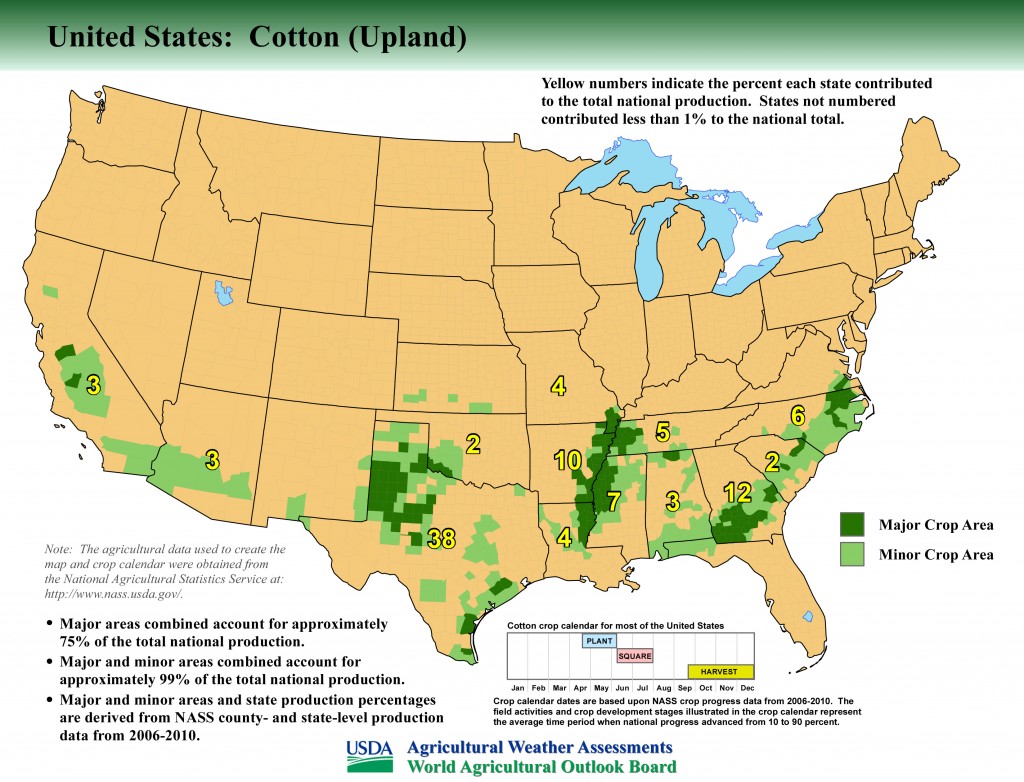
Other than a tiny bit in Kansas, Cotton wouldn't grow in the Western states above Oklahoma. The Cotton you see growing in California, Nevada, New Mexico and West Texas all grow as a result of modern irrigation systems that simply weren't possible in the 19th century.
What does this mean? Well as near as I can tell, it meant that it wasn't possible for any significant degree of slavery to expand into the territories. The territories would not support a profit making system based on slavery.
Did the Cotton people in the South know this back in 1860? If they knew their agriculture, they probably did. So what was actually at stake here with this "expansion" business?
Control of Congress, and therefore Control of Commerce, especially the international commerce.
54 posted on
08/25/2017 3:58:04 PM PDT by
DiogenesLamp
("of parents owing allegiance to no other sovereignty.")
To: DiogenesLamp
Evaluating causes of the Civil War is like containing a balloon — squeeze one place and it bulges out elsewhere. Ultimately its all the same old slavery balloon. Control of commerce and control of Congress ... to what end? To make slavery secure and profitable? What sort of commerce did they mean to control? Agricultural products made by slaves? Certainly there was constant angst over tariff rates and the required form of payment, which left the South bereft of hard money and dependent on Northern banks. The failure to anticipate the rise of Indian/Egyptian production and the resulting cotton glut suggests a fairly limited view of international trade.
A modern crop map is not evidence of what people thought or wanted to happen in the 1850’s, nor that their plans would be economically successful. They did know that cotton agriculture ruined land and required new territory.
The crop many wanted to move into was sugar, production of which tended to high mortality, and thus constant demand for new slaves and tropical territory. Filibustering, mentioned elsewhere in this thread, started almost with the founding (Burr and even Hamilton had visions of filibuster grandeur; the latter was smart enough not to act on it)Purpose of filibustering: slave-produced sugar. The US blocked such expansion. But an independent South could empty its excess slaves into the Caribbean Basin profitably (in theory, though a sugar glut would have wrecked that soon enough).
To: DiogenesLamp; BroJoeK; DoodleDawg
What does this mean? Well as near as I can tell, it meant that it wasn't possible for any significant degree of slavery to expand into the territories. The territories would not support a profit making system based on slavery.
The Greeks and Romans didn't grow much cotton either. I guess that means they didn't have slaves?
Seriously, slaves could be applied to other crops than cotton. They could also be used in mining, lumbering, grazing, construction, shipping, and manufacturing.
The ancients used slaves for many of those purposes. I'm pretty sure that New World slaveowners, many of whom knew Latin and Greek, were aware of that.
P.S. Cotton was being grown in Arizona something like 5000 years ago. Not much, probably, but some. In the Old World, the Egyptians were using irrigation to grow cotton at around the same time.
I don't get it -- the mechanical cotton harvester was supposedly just around the corner in 1865, but irrigation technology was beyond the means of 19th century man?
The truth is that cotton growing wasn't necessary for slavery to exist and slaveowners knew that. But if they absolutely wanted or needed to grow cotton in dry areas where the temperatures were suitable for cotton production, they'd find a way.
89 posted on
08/26/2017 12:01:27 PM PDT by
x
FreeRepublic.com is powered by software copyright 2000-2008 John Robinson