It seems to me that if you understand it properly, it shouldn't be very difficult to poke some holes in it if it has any.

I've been doing that for years.
So have other people.
You don't appear to notice.
Posted on 08/25/2017 10:16:25 AM PDT by SurfConservative
There's an old saying that "he who distinguishes well teaches well." In other words, if one's going to talk about an important subject, one should be able to define his terms and tell the difference between two things that are not the same.
This wisdom, unfortunately, is rarely embraced by modern pundits arguing about the causes of the American Civil War. A typical example can be found in this article at the Huffington Post in which the author opines: "This discussion [over the causes of the war] has led some people to question if the Confederacy, and therefore the Civil War, was truly motivated by slavery."
Did you notice the huge logical mistake the author makes? It's right here: "...the Confederacy, and therefore the Civil War...."
The author acts as if the mere existence of the Confederacy inexorably caused the war that the North initiated in response to it. That is, the author merely assumes that if a state secedes from the United States, then war is an inevitable result. Moreover, she also wrongly assumes that the motivations behind secession were necessarily the same as the motivations behind the war.
But this does not follow logically at all. If California, for example, were to secede, is war therefore a certainty? Obviously not. The US government could elect to simply not invade California in response.
Moreover, were war to break out, the motivations behind a Californian secession are likely to be quite different from the motivations of the US government in launching a war. For the sake of argument, let's say the Californians secede because they couldn't stand the idea of being in the same country with a bunch of people they perceive to be intolerant rubes. But, what is a likely reason for the US to respond to secession with invasion? A US invasion of California is likely to be motivated by a desire to extract tax revenue from Californians, and to maintain control of military bases along the coast.
It ends of a bit of a cliff-hanger: "What did the Court actually decide?" I may have to go get the book to find out. But it appears from what Fehrenbacher is saying that the decision the justices voted on was not the decision that Taney eventually released.
From what I gathered, the gist is that Taney added a lot of text to the opinion in rebuttal to critics. The implication being that this was a bit unethical and disingenuous. I doubt the rest of the Court would have tolerated it if it greatly fell outside the scope of their own positions. About the only thing I saw in that excerpt that looked interesting in the context of law is that John Marshall might have rendered a decision in another case that conflicts with Taney's position.
John Marshall would of course be regarded as an authority that had more intimate knowledge regarding the intentions of the delegates who wrote the Constitution.
It might be interesting to look up that case (American Insurance company v. Canter) and see what was Marshall's thinking.
Washington produced Whiskey and I would suppose he used his slaves to do it, yet if you read Washington's discussion of slavery you get the impression that his was an enterprise that could barely keep itself in profit, and he devoted some time to discussing his efforts at finding things sufficiently profitable to cover his costs of keeping them.
Slaves would have been used for planting and harvesting that grain.
A practical cotton harvesting machine might have been 80 years in the future, but the grain planting/harvesting machinery was already developed at this time.
Jeez dude, the Asbergers aside don't you ever get tired of looking stupid?
If it doesn't bother you, why should it bother me?
That was already happening. Slave owners thought it was their right to take their slaves anywhere they wanted to, especially to the territories.
They weren't going to be stopped by what Northerners thought. And the Northerners weren't going to stand for it. That's one reason why there was a war. So, no, concern for Northern opposition wouldn't have -- and didn't -- stopped slaveholders from trying to expand their territory.
But you just confuse the heck out of people. Some of the time you're talking about some hypothetical state when the country already split apart and the CSA was rolling in money. Now you're talking about another part of history, apparently before the Civil War. Very confusing.
Ok buddy boy, you’re going to get it spades then you freakin’ loon.
Their legal argument for this is actually pretty good. If congress does not have the power to prohibit something within a state, how can they prohibit it within a territory? Ugly or not, in that era, owning slaves was considered a right. To deprive someone of their rights was unconstitutional.
They weren't going to be stopped by what Northerners thought. And the Northerners weren't going to stand for it. That's one reason why there was a war.
No it wasn't.
But you just confuse the heck out of people. Some of the time you're talking about some hypothetical state when the country already split apart and the CSA was rolling in money.
I said no such thing, and it is irritating to find that people constantly attribute to me things which I never said or intended. I said the CSA would have been rolling in money if Lincoln hadn't launched a war against them, and it is precisely because they would have been rolling in money that Lincoln did launch his war against them.
If you are confused it is because of your adamant opposition to contemplating the ideas which I put before you. You don't want to understand my points because you don't want to agree with them.
If you are so sensitive to getting a verbal rock thrown at you, perhaps you shouldn't engage in verbal rock fights?
You are going against the 10th Amendment (1791) and a state's right to outlaw slavery. You are going against the Northwest Ordinance (1787) and the Missouri Compromise 1820. You are right there with Roger B. Taney and his Dred Scott decision. That's a surprising stance for somebody to take today. But in your case, why am I not surprised?
No it wasn't.
Conflict over the territories was a big reason for Lincoln's election. Lincoln's election was a big reason for secession. And the secessionists started the war, so in that sense, of course conflict over the territories was one reason for the war.
I said no such thing, and it is irritating to find that people constantly attribute to me things which I never said or intended. I said the CSA would have been rolling in money if Lincoln hadn't launched a war against them, and it is precisely because they would have been rolling in money that Lincoln did launch his war against them.
My point was that it was hard to figure out what time period you were talking about. It's also hard to figure out how what you say you said differs in substance from what I said you said.
You don't want to understand my points because you don't want to agree with them.
You've presented your cock-eyed view hundreds of times, so I don't think I missed overall theory. But just what your argument is at any specific moment is harder to say. Maybe sometimes I get into the middle of a discussion and miss the beginning, but sometimes you change topics without telling anybody.
Jeez, you really are dumb, aren’t you? What I meant was if you don’t find telling the whole world you’ve got Aspergers and you don’t mind the verbal brick bats and cahoots coming at you, then pal, I’ll have a field throwing them at you. I don’t have a thick skin, heck I’m Irish, we have hard heads.
No I am not. All states effectively gave up that right when they agreed to article IV section 2.
A state can abolish all of it's own laws that perpetuate slavery, but due to the nature of the federal compact, they can't do anything about other state's laws which hold people in bondage. To point out the fact that they are bound by the agreement that they signed does not call into question their other rights under article 10.
You are going against the Northwest Ordinance (1787) and the Missouri Compromise 1820.
Effectively Null and Void because of Article IV, Section 2.
So long as slaves were legally regarded as property, you could not prohibit them within the jurisdiction of the Constitution.
You are right there with Roger B. Taney and his Dred Scott decision. That's a surprising stance for somebody to take today.
Most people nowadays do not even understand the word "objectivity" let alone exhibit any. Under the legal paradigm in place at that time, Judge Taney was right. I don't have to agree with the outcome to recognize that the legal support behind his ruling is pretty solid.
It's like the "Separate but Equal" doctrine created by the Plessey court. It was legally valid for a certain time period, and it is pointless to pretend it wasn't. Current law is interpreted to mean that pretty much anyone born an American is a "natural born citizen", which you and I both know is garbage, but unfortunately that is how most people nowadays interpret the law.
Pretending it isn't accomplishes nothing.
Conflict over the territories was a big reason for Lincoln's election.
Conflict over the territories was about wielding political power in congress.
Lincoln's election was a big reason for secession.
The Southern power block realized they would never be able to protect themselves from the majority coalition against them, so they just decided the only solution was to get out of the system that was rigged against them.
And the secessionists started the war, so in that sense, of course conflict over the territories was one reason for the war.
Lincoln started the war, and this is something that I have only realized in the last couple of years. A friend told me that he started it years ago, but only in the last two years have I figured out the "why?" and "how?" The South didn't need a war. Only the North needed a war. The South would have been just fine without a war. They would have become prosperous and they would have likely gained the territories that in our timeline were destined to be part of the Union.
My point was that it was hard to figure out what time period you were talking about. It's also hard to figure out how what you say you said differs in substance from what I said you said.
Well then let me repeat. The South would have been rolling in money without a war. The South would have been prosperous and likely expanded their territory and economic influence, without a war.
The South did not need a war. The South did not want a war. The North did need a war, and Lincoln very much wanted a war. He was told by many people that if he did what he was going to do, there would be a bloody civil war, and he was advised several times not to do it.
You've presented your cock-eyed view hundreds of times, so I don't think I missed overall theory.
So what is my "cock-eyed" theory? If you can repeat it back to me, then perhaps I can see if you do have it right.
It seems to me that if you understand it properly, it shouldn't be very difficult to poke some holes in it if it has any.
:)
LOL! Ok. Ok. You win. LOL!
According to that, a state must return runaway slaves to their masters from other states.
That doesn't mean that slave masters can bring their slaves to other states and territories and expect to have them work for no pay.
In that case, it wouldn't be inappropriate for courts to declare that a slave had been made free.
So long as slaves were legally regarded as property, you could not prohibit them within the jurisdiction of the Constitution.
So our Constitution imposed slavery on all the states?
Most legal authorities at the time disagreed with that.
The Constition wouldn't have been ratified, nor would it have had the high reputation that it has had, if it made slavery universal throughout the country.
It seems to me that if you understand it properly, it shouldn't be very difficult to poke some holes in it if it has any.
I've been doing that for years.
So have other people.
You don't appear to notice.
That's the reason why the Dred Scot decision was so heinous, it effectively meant that not only could southerners take their human chattel anywhere they pleased with total impunity but that northerners had to constitutionally be complicit in the disposition of those slaves. It robbed northern states of self-determinism - the very thing that DegenerateLamp whines endlessly about.
No wonder he is so enthralled by it.
So long as they are bound by the laws of other states.
That doesn't mean that slave masters can bring their slaves to other states and territories and expect to have them work for no pay.
Washington did it. So did a lot of other people at that time. It is in fact implicit in the agreement.
In that case, it wouldn't be inappropriate for courts to declare that a slave had been made free.
The Court cannot circumvent a constitutional requirement, except by Judicial Activism, and then only if the executive branch lets them get away with it.
So our Constitution imposed slavery on all the states?
Pretty much. So long as they were required to return slaves, slavery would necessarily exist in their states. Of course the courts got around this by declaring that states didn't have to enforce federal or constitutional law. Of course that was a judicial activist dodge, but they got away with it.
Most legal authorities at the time disagreed with that.
Most legal authorities in 1787, or most legal authorities in 1850?
The Constitution wouldn't have been ratified, nor would it have had the high reputation that it has had, if it made slavery universal throughout the country.
Well that's an odd position, because in 1787, the vast majority of states were slave states. Also the fact that it waited till 1808 to prohibit importation of slaves is an inherent acknowledgement that the practice was so far as the Federal government was concerned, legal.
Here is a synopsis of some positions in the Constitutional debate over slavery. Only three states vote against it.
So have other people.
Posting amusing graphics in lieu of an actual answer? Why?
You don't appear to notice.
Why should I notice that? It's childish. I want factual and logical rebuttals, not cartoons.
The secessionists certainly wanted a war.
That is why they were the ones who started a war.
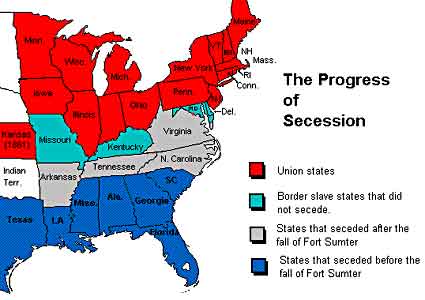
Notice that war got them four states that they wouldn't have had otherwise.
And they expected it would bring them three or four more on top of that.
War also meant that there was no going back or dropping out.
It made the break with the union final and irreversible.
Unfortunately for them, it didn't work out that way in the end, but that's why they wanted the war and why they started the war.
By 1787 five states had either abolished slavery or passed laws providing for the gradual abolition of slavery.
They wouldn't have ratified the Constitution if they thought it would make their laws null and void.
Also the fact that it waited till 1808 to prohibit importation of slaves is an inherent acknowledgement that the practice was so far as the Federal government was concerned, legal.
That was a compromise to keep South Carolina and Georgia in the union.
Also, slavery was "legal, so far as the federal government was concerned," but that didn't override state laws forbidding it.
If the federal government had no laws forbidding absinthe or ecstasy that wouldn't mean that states couldn't ban such substances.
No they didn't. Other than Massachusetts who as usual, engaged in Judicial Activism to make their laws say something completely unintended by the legislators, the other states merely kicked the can down the road with a "gradual abolition of slavery." This was another one of those "I will gladly pay you Tuesday for a Hamburger today." sort of things. No immediate pain from this "feel good" law.
They still had slavery.
That was a compromise to keep South Carolina and Georgia in the union.
Yet implicit in it is the recognition of slavery as a continuing institution in the US. If the other states didn't like this deal, they shouldn't have made it. But they did, and then they did everything they could to renege on the deal to which they had agreed.
Also, slavery was "legal, so far as the federal government was concerned," but that didn't override state laws forbidding it.
A state could pass laws that would prevent slaves from being created by that state's laws, but they could do nothing about slaves created by other state's laws. They also couldn't tell a man to keep his slaves out of their state. Not if they were keeping faith with the intent and explicit protections written into the Constitution.
Again, if they didn't like the deal, they shouldn't have agreed to it.
Disclaimer: Opinions posted on Free Republic are those of the individual posters and do not necessarily represent the opinion of Free Republic or its management. All materials posted herein are protected by copyright law and the exemption for fair use of copyrighted works.