Skylake users given 18 months to upgrade to Windows 10
And next generation processors, including Intel's Kaby Lake, won't be supported in old Windows.
556 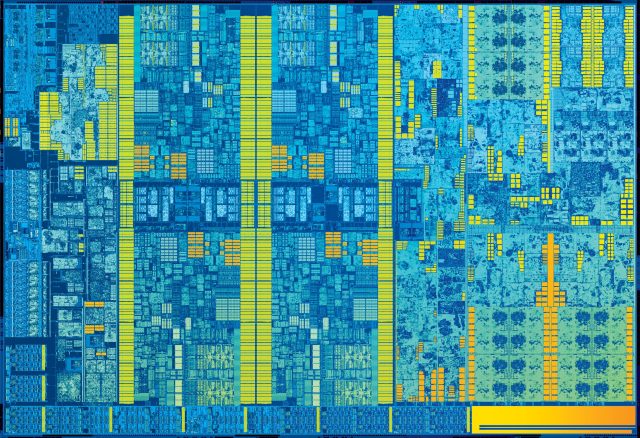 Intel Skylake die shot.Intel
If you own a system with an Intel 6th generation Core processor—more memorably known as Skylake—and run Windows 7 or Windows 8.1, you'll have to think about upgrading to Windows 10 within the next 18 months. Microsoft announced today that after July 17, 2017, only the "most critical" security fixes will be released for those platforms and those fixes will only be made available if they don't "risk the reliability or compatibility" of Windows 7 and 8.1 on other (non-Skylake) systems.
The full range of compatibility and security fixes will be published for non-Skylake machines for Windows 7 until January 14 2020, and for Windows 8.1 until January 10 2023.
Next generation processors, including Intel's "Kaby Lake", Qualcomm's 8996 (branded as Snapdragon 820), and AMD's "Bristol Ridge" APUs (which will use the company's Excavator architecture, not its brand new Zen arch) will only be supported on Windows 10. Going forward, the company says that using the latest generation processors will always require the latest generation operating system.
Microsoft provided PC World a short list of approved devices that use Skylake processors that will continue to be supported during the 18 month window when running Windows 7 or 8.1. Those systems are: Dell Latitude 12, Dell Latitude 13 7000 Ultrabook, Dell XPS 13, HP EliteBook Folio, HP EliteBook 1040 G3, Lenovo ThinkPad T460s, Lenovo ThinkPad X1 Carbon, and Lenovo ThinkPad P70. In conjunction with the system builders, Microsoft will test those systems with Windows 7 and 8.1 to ensure that drivers and operating system fixes work as expected.
The company's official reason for this change is a little opaque:
At the same time, we know many of these customers continue to rely on Windows 7 for its well understood reliability and compatibility. Windows 7 was designed nearly 10 years ago before any x86/x64 SOCs existed. For Windows 7 to run on any modern silicon, device drivers and firmware need to emulate Windows 7's expectations for interrupt processing, bus support, and power states—which is challenging for WiFi [sic], graphics, security, and more. As partners make customizations to legacy device drivers, services, and firmware settings, customers are likely to see regressions with Windows 7 ongoing servicing.
It's not entirely clear what hardware changes are really motivating this. Windows 8.1 and Windows 10 are very similar as far as their hardware requirements around "interrupt processing, bus support, and power states" go. That said, modern hardware has certainly shaken things up quite a bit. Skylake, for example, has a certain degree of autonomous power management, allowing the chip to respond more quickly to changing demands than the operating system can. It's believable that wedding these new hardware features with old software is time-consuming and complex. Similarly, platform features such as USB Type-C, especially with Thunderbolt 3, includes all manner of complexity that Windows 7 was never built for.
It's also not entirely clear why Microsoft is making the decision; this burden seems like something that the hardware companies can make decisions about themselves. Intel, for example, makes such decisions when developing its Wi-Fi drivers. The very latest hardware, the Wireless-AC 8260 controller drops support for the now unsupported Windows 8, and drops 32-bit support for both Windows 8.1 and Windows 10.
Industry analyst Patrick Moorhead of Moor Insights & Strategy suggests that for this reason the move may prove popular with the hardware companies. Cutting off support for old software when releasing new hardware is rarely popular, even though this legacy support has a substantial cost for hardware companies, with Moorhead suggesting that as much as a third of hardware company resources were spent on this. With Microsoft making the decision, it shifts the blame from any individual hardware, allowing the hardware companies to reap the savings, while Microsoft shoulders the blame.
Microsoft's Terry Myerson, Executive Vice President, Windows and Devices Group, was a little less direct about this, but made similar implications. He told us that change was driven by a desire to preserve quality. Ensuring high quality support for Skylake on Windows 7 and Windows 8.1 took a "large investment," and future processor innovations will demand continued investment. Microsoft sees itself as responsible for the ongoing system quality of Windows systems—even though parts of the Windows experience is dependent on third-party contributions—and spending resources to update old operating systems makes that quality hard to achieve. Tying the newest silicon to the newest platform greatly reduces this complexity for the entire PC ecosystem.
This may well prove awkward for enterprise customers. Organizations that have standardized on, for example, Windows 7 have long been able to take advantage of the "downgrade rights" included in certain Windows licenses, so that they can stick with the old operating systems in standardized deployments, even as they buy new hardware. Windows 10 won't remove those downgrade rights, but there will be far fewer guarantees that old Windows will work correctly on new hardware. The named systems above are intended as a kind of stepping stone. They will provide well-tested experience when running the old operating systems. They won't do so indefinitely, but the limits of their full support are clearly defined.