
Posted on 04/21/2015 5:42:36 PM PDT by Citizen Zed
The United States has 115 million households, the makeup of which varies across the board. Some people live alone. In other households, many people reside—the average is 2.6. Some occupants are married. Some are cohabiting. Some have never married. Should the composition of U.S. households and the living arrangements of people in them matter to economists and policymakers? Yes. Think of unemployment and income inequality, for example. No question, these are issues of interest to policymakers. The decision to look for a job, as well as some measures of income inequality, are closely connected with the living arrangements people choose, as I will show in this article with a few statistics.
First, let's take a look at how the composition of U.S. households has changed over the years. According to the Current Population Survey, the fraction of households headed by a married couple has decreased since the 1970s from 70 to 50 percent. Over the same period, the fraction of households made up of men or women living alone has increased, from just below 20 to just below 30 percent. These trends reveal another set of trends: The marriage rate of Americans has decreased, and the divorce rate has increased. Another phenomenon is the increasing number of people cohabiting but not getting married.1
So, how does economic life differ for people in different living arrangements? The possible indicators are many. Consider the decision to be a member of the labor force or not. Being a member of the labor force does not always mean that one is employed. One may be unemployed and looking for a job and still be included in the "labor force participation" data. However, if one does not even look for employment, then one is not part of the labor force.
A person who is sufficiently economically secure may choose not to participate in the labor market. Figure 1, Panel A shows that more than 90 percent of married men between the ages of 18 and 50 who live with their spouses have participated in the labor market since at least the 1970s. Quite different are the numbers for married women living with their spouses. In 1970, fewer than half were in the labor force; that percentage grew by 1990 to 70 percent, where it remains, more or less, today. This trend has been the object of many studies and, in fact, was under way before the 1970s.
The picture of labor force participation changes when one looks at never-married individuals, as in Figure 1, Panel B. There, the difference between men and women appears insignificant compared with Panel A. About 75 percent of never-married men and women participate in the labor force today; this figure has been remarkably steady since the 1970s.
To be sure, Figure 1 does not answer the "which comes first" question, that is, are people deciding to participate in the labor force based on their living arrangement, or are they choosing their living arrangement based on whether they are members of the labor force? These are interesting questions, but not the ones I am trying to answer here. My point is that living arrangements and economic lives are correlated.
Let's turn to another indicator of economic performance: income. More precisely, let us look at the income received from labor and exclude other sources of income, such as financial assets, Social Security payments, etc. It is well-known, and often discussed, that income inequality is large. One form of inequality is the so-called gender gap in labor income, that is, the fact that men tend to be paid more than women. Panel A of Figure 2 shows the ratio between men's and women's labor income. When this number is close to 1, men and women have similar levels of income. When the number is far above 1, men earn more than women. The people considered here are similar in age (between 30 and 40) and education (they have at least a high school diploma). Also, they are all working.
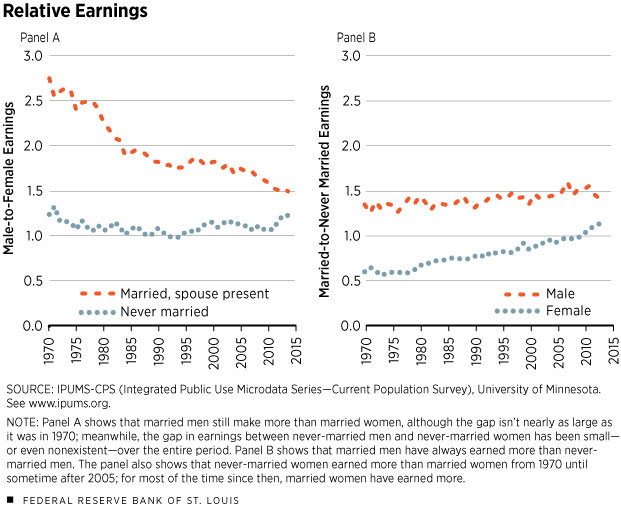
The figure reveals that, when comparing married men and married women, the gap in earnings tends to be large, albeit decreasing over time. In the 1970s, a married man of this type made 2.5 times more money working than a married woman of the same age and with the same education. What is remarkable, however, is that there was almost no difference between never-married men and never-married women. The ratio is much closer to 1, which, again, means that they earn the same amount of money at work. This is more evidence that the arrangement in which people spend their lives has important implications for their economic lives; this is particularly true for women.
Panel B of Figure 2 reveals another aspect of the data that is interesting. It shows the relative earnings between married and never-married people. Again, they are all between 30 and 40, have at least a high school diploma and work. Clearly, for men it is better financially to be married. Married men make about 50 percent more money than never-married men. However, for most of the sample period, it is exactly the opposite for women: Married women tend to make less money (50 percent less in the 1970s) than never-married women (at least until the end of the sample period). Once again, the question of causality is not addressed here: Are the married men making more money than the single men because they are married, or is it the case that more-productive men are better at getting married?
In the end, the lesson from this discussion is that living arrangements are informative about people's economic lives.
hope your wife (if you’re married) doesn’t read that :)

All I know is that the more these self-styled “policymakers” tinker around with things — the worse things get.
We are not talking Rocket Science here. Married men go to work. Married moms stay home and watch the kids if the family can afford it. It has been getting harder and harder to do so over the last several decades.
As to the unmarried. Again, not Rocket Science. Both men and women prefer eating and a roof over their heads to starvation and sleeping under a park bench. Children are much less of an issue. So both men and women work.
Do we actually pay people to study this data in an attempt yo understand it. Do they have to read about The Great Society first? Well, they should since we are watching the fruits of Lyndon Johnson’s dream play out.
The economies of shared living; nothing new.
There is a marriage gap based on education levels now.
Only 5%-10% of women with a 4 year degree have a child out of wedlock.
Only 25% of women with less than a high school degree have a baby in wedlock.
Less than half of children born to a mother with a high school degree are legitimate.
When you look at wage gaps, the married women earn more working full time because they are more educated and more intelligent.
In the Obama recession, the married man is more likely to be laid off than his working wife, hence the declining employment and earnings for them. For the married woman, she has more security he and his income will be around, so the 65% peak of wives working has dropped a little. As a friend said, I became a stay at home mother because it was less frustrating than being unemployed for two years.
The married men’s earnings gap closed because women have flooded into far more professions with higher pay and work more hours. And they are competing with their own wives, so his income drop is in part because he’s competing against all the men AND the women.
Disclaimer: Opinions posted on Free Republic are those of the individual posters and do not necessarily represent the opinion of Free Republic or its management. All materials posted herein are protected by copyright law and the exemption for fair use of copyrighted works.