To: Homer_J_Simpson
Also posted on my profile.
2 posted on
11/30/2009 4:53:10 AM PST by
Homer_J_Simpson
("Every nation has the government that it deserves." - Joseph de Maistre (1753-1821))
To: Homer_J_Simpson
Russia’s attack on Finland on
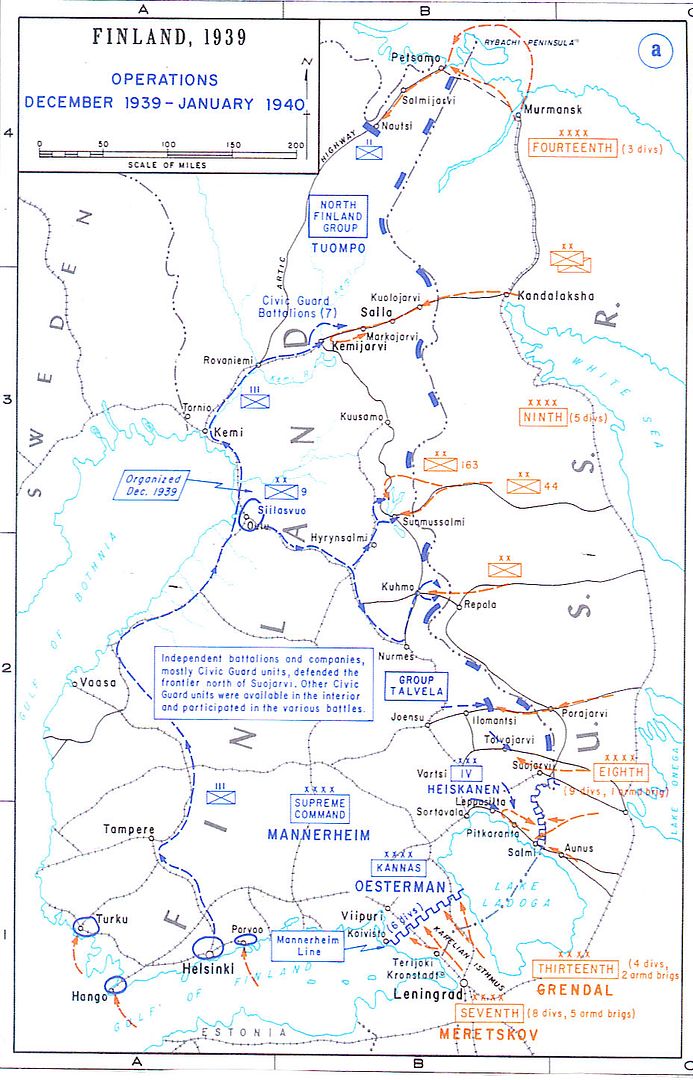
November 30, 1939 radically changed the situation in Scandinavia, immensely increasing its strategic importance to both the Western Allies and Germany. France and Britain began to organize an expeditionary force in Scotland to be sent to the aid of the gallant Finns, who, defying all predictions, held out stubbornly against the onslaughts of the Red Army. But it could reach Finland only through Norway and Sweden, and the Germans at once saw that if Allied troops were granted, or took, transit across the northern part of the two Scandinavian lands enough of them would remain, on the excuse of maintaining communications, to completely cut off Germany’s supply of Swedish iron ore. Moreover, the Western Allies would outflank the Reich on the north. Admiral Raeder was not backward in reminding Hitler of these threats.
William L. Shirer, The Rise and Fall of the Third Reich
3 posted on
11/30/2009 4:53:54 AM PST by
Homer_J_Simpson
("Every nation has the government that it deserves." - Joseph de Maistre (1753-1821))
To: Homer_J_Simpson
Karelian Isthmus-30 November 1939: The 1st line is the Delaying line, the 2nd is the Mannerhiem Line. Note the road network behind the Finnish positions, and the lack of good roads behind the Soviets at the Mannerheim Line.

18 posted on
11/30/2009 10:11:40 AM PST by
tcrlaf
("Hope" is the most Evil of all Evils"-Neitzsche)
To: Homer_J_Simpson; All
In regard to the Winter War, it is important to note Soviet Command sturucture in the days following the Officer purges.
In mid-1937 a so-called “dual-command,” or “collegiate control” arrangement was instituted in which political commissars were assigned to each unit with status equal to that of the tactical commanders.
Field commanders were obligated to submit their plans and decisions to political councils comprised of these commissars, which had veto powers.
The political councils could also recommend demotions, reprimands, etc., which, during this period of Stalin’s purges, were tantamount to death sentences. As can be imagined, such a system severely undermined command confidence, innovation, and effectiveness.
Sounds a lot like the Combat Lawyers we have today, doesn’t it?
27 posted on
11/30/2009 1:19:13 PM PST by
tcrlaf
("Hope" is the most Evil of all Evils"-Neitzsche)
FreeRepublic.com is powered by software copyright 2000-2008 John Robinson