Skip to comments.
Aldo Leopold's new world unlocked by an Arizona wolf
Verde News ^
| 9-9-09
| Steve Ayers
Posted on 09/09/2009 4:47:50 PM PDT by SJackson
As the author of Sand County Almanac, Aldo Leopold became posthumously known as the conscience of the American environmental movement.
It was not what he set out to do.
In fact from early on, Leopold's interaction with wildlife and wild lands can be seen as a bit of an enigma.
As a child he spent his days romping about the backwoods and rolling grasslands of his native Iowa, occasionally taking a skiff across the Mississippi River to explore what the sloughs and swamps of Illinois had to offer.
On these daily bird-watching forays he took his notebooks, his field glasses and his gun.
He kept meticulous records, sketching the birds he saw and mapping the countryside. To protect the birds he found so fascinating he shot cats and squirrels and any other animal he saw as a threat.
His list of threats included hawks, crows and sparrows.
He once proudly told his parents that he had "shot eight sparrows in a few minutes," by laying out a line of grain, then positioning himself at one end and aiming down the row.
While attending prep school in New Jersey he bemoaned the annual slaughter of ducks on the ice-filled lakes of the East, while moaning in letters to his family of his inability to make it home for the fall hunting season.
And even later in life, as he a professional forester he made it his personal mission to restore the indigenous deer population by killing its predators.
But what might be seen as an enigma was in fact a deeply rooted practical streak-a trait that would circuitously lead to some revolutionary observations on the relationship between predator and prey as well as the entire natural world.
Aldo Leopold arrived in Arizona on July 16, 1909, at a time when the American West was rapidly becoming, for lack of a better word, civilized.
In an attempt to protect watersheds and manage timber resources, Congress had created the U.S. Forest Service to manage a system of national forests.
Leopold, one of only a few dozen graduates of the nation's only forestry school at Yale University, saw the new profession as ideally suited to his outdoor lifestyle.
His first assignment was as a forestry assistant on the 1-year-old Apache National Forest in Springerville.
Like all of the rest of the new members of the Forest Service, Leopold arrived with a set of preconceived notions as to how the forest should best be run.
But reality has a way of turning preconceived notions on end.
After a rocky start in which his reclusive personality and highbrow ego clashed with those under him, Leopold settled into becoming an efficient and effective forester.
He also discovered he had little aptitude for trees, but a singular and unique ability to see the forest.
In just three years he rose from forestry assistant to supervisor of New Mexico's Carson National Forest.
Then, barely a year after taking over Carson, Leopold was hit with a life-threatening kidney infection.
Forced to convalesce for almost 18 month. Leopold began reading.
Among the books that passed beneath observant eyes was William Hornaday's "Our Vanishing Wilderness," a treatise advocating total protection of America's game animals.
When Leopold returned to work for the Forest Service, 18 months later, his focus turned to game management. He convinced his superiors that fish, wildlife and recreational uses within the national forests were as important forest products as water and timber.
A gifted writer, Leopold began espousing his idea about land and game management. But many of his ideas were deemed to be too esoteric and often radical by those he worked with.
In spite of what others thought, he managed to create the nation's first wilderness area on the headwaters of the Gila River.
In 1924 he left the Southwest, but took his memories and his observations with him. Discouraged with the direction of the Forest Service, Leopold left the Forest Service in 1929 to become what is arguably the world's first game management consultant.
But his education, as well as his writing, was only getting starting.
In 1936 he took a hunting trip to the Sierra Madres of Mexico, where for the first time in his life he was exposed to virgin wilderness of pine and oak forests, teaming with wildlife -- a land that had never seen a road, never seen a wildlife manager and never seen a fire fighter.
It moved him in ways that forced him to reevaluate everything he had believed.
By then Leopold was a professor at the University of Wisconsin. His personal observations and worldview began changing in scope. His ability to see the forests for what they were soon grew to seeing the natural world for what it was.
He was teaching a new science that crossed multiple disciplines and attempted to solve the imbalances caused by man's existence in a world that was naturally in balance.
Changing views on the predator-prey relationship helped him unlock the door to that new science. And a singular incident that had taken place shortly after he arrived in Arizona was the key.
He remembered looking into the eyes of wolf that lay dying on the banks of the Blue River, shot by him and his companions in the fall of 1909.
He realized at last what the wolf was telling him.
In the wolf's eyes he saw that the deer he was so desperately trying to save feared the wolf. But he also saw that the mountains in which the wolf lay dying feared the deer, for they were rapidly denuding the vegetation that held the mountain together.
Leopold began to develop and espouse a working system in which the predator and the prey, the mountains and the forest were interconnected and dependent on one another for their long-term survival.
He began to write and teach a philosophy of ethics related to man's need to balance that system. The philosophy was a natural expression of Leopold's practical side.
He died fighting a fire on his neighbor's farm in 1948.
Although virtually unknown and unappreciated but by a few students and fellow thinkers in his time, he left behind a collection of essays, which were posthumously published as A Sand County Almanac.
They are perhaps some of the most beautifully written and haunting essays on the natural world ever written. In time they helped open the minds of others to the world around them.
In the 1960s the book, along with Leopold's worldview, was rediscovered by a new generation searching for balance in a world they found desperately teetering on its own demise.
Today that movement still seeks to balance man's propensity to acquire short-term gain at the expense of long-term survival.
And Aldo Leopold's ethics remain a touchstone of that balancing act.
TOPICS: Local News
KEYWORDS:
1
posted on
09/09/2009 4:47:50 PM PDT
by
SJackson
To: Iowa Granny; Ladysmith; Diana in Wisconsin; JLO; sergeantdave; damncat; phantomworker; joesnuffy; ..
If you’d like to be on or off this Upper Midwest/outdoors/rural list please FR mail me. And ping me is you see articles of interest.
A good article, interesting that in a narrative of Leopold's life Wisconsin appears only once.
A peculiar virtue in wildlife ethics is that the hunter ordinarily has no gallery to applaud or disapprove of his conduct. Whatever his acts, they are dictated by his own conscience, rather than by a mob of onlookers. It is difficult to exaggerate the importance of this fact.
Aldo Leopold"One does not hunt in order to kill; on the contrary, one kills in order to have hunted...If one were to present the sportsman with the death of the animal as a gift he would refuse it. What he is after is having to win it, to conquer the surly brute through his own effort and skill with all the extras that this carries with it: the immersion in the countryside, the healthfulness of the exercise, the distraction from his job.
Jose Ortega y Gasset
2
posted on
09/09/2009 4:52:01 PM PDT
by
SJackson
(In wine there is wisdom, In beer there is freedom, In water there is bacteria.)
To: SJackson
Leopold was a plinker who set up poor sparrows to kill. That’s not a Daniel Boone hunting record. Leopold has seen his dead body dragged across liberal Wisconsin as some kind of eco-fascist “hero.” On the contrary, Leopold never understood the prey-hunter relationship. In a word, Leopold was a commoner. He had no more insight of wildlife than a typical farmer or hunter in 1900 Wisconsin.
He’s been raised as a genuis “environmentalist” by the communists looking for a saint. Leopold is not that. I’ve seen better analysis of wildlife relationships by 10-year-old Boy Scouts trained by Robert Baden-Powell.
3
posted on
09/09/2009 5:36:11 PM PDT
by
sergeantdave
(obuma is the anti-Lincoln, trying to re-establish slavery)
To: SJackson
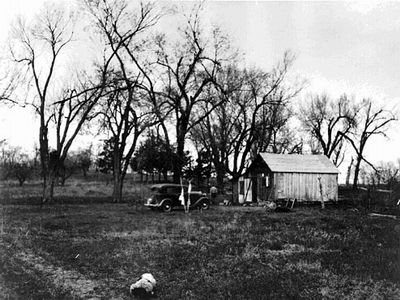
Aldo Leopold made a shack out of an old chicken coop on a played out farm near the Wisconsin River north of Baraboo, pictured here in 1936.
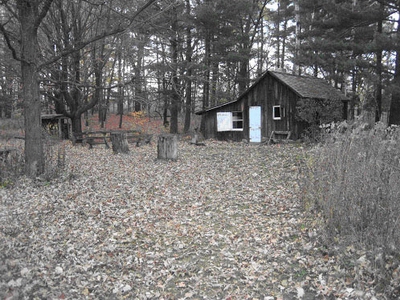
The shack in 2007.

"Acts of creation are ordinarily reserved for gods and poets, but humbler folk may circumvent this restriction if they know how. To plant a pine, for example, one need be neither god nor poet; one need only own a good shovel. By virtue of this curious loophole in the rules, any clodhopper may say: Let there be a tree—and there will be one.
"If his back be strong and his shovel sharp, there may eventually be ten thousand. And in the seventh year he may lean upon his shovel, and look upon his trees, and find them good.
"God passed on his handiwork as early as the seventh day, but I notice He has since been rather noncommittal about its merits. I gather either that He spoke too soon, or that trees stand more looking upon than do fig leaves and firmaments."
To: SJackson
“To protect the birds he found so fascinating he shot cats and squirrels and any other animal he saw as a threat.”
*GASP*
Grandma had me read ‘A Sand County Almanac’ when I was a kid. Blah, blah, blah, blah. What a bunch of navel-gazing!
I repeatedly asked her, as she had me pinned to the couch with her steely gaze, “Can’t I just go play in the WOODS, Grandma?” ;)
5
posted on
09/09/2009 6:40:48 PM PDT
by
Diana in Wisconsin
(Save The Earth. It's The Only Planet With Chocolate.)
To: SJackson
In the 1960s the book, along with Leopold's worldview, was rediscovered by a new generation searching for balance in a world they found desperately teetering on its own demise. Conservationists and ecologists sought balance. Environmentalists sought power.
Unfortunately, (so far, at least) the environmentalists have won.
The conservationists who tried from the fifties onward to preserve the balance in the river I spent my youth on and in, swimming, canoeing, boating, fishing, hunting, crabbing, oystering, and clamming, tried desperately to preserve that functioning ecosytem by focusing on limiting the effects of excessive human actions on it.
Government saw X acre-feet of water (albeit brackish tidewater) calculated the number of pleasure craft it would hold, took action to preserve the scenery, and, in making the water clear of prop-fouling native aquatic vegetation, ensured the river died.
You can still swim there, but at your own risk (get your shots); almost all the seafood is imported.
I no longer live there, but learned long ago that those who depend on the land (or the water) for their livelihood are the ones who are most likely to care for those resources best.
Starry-eyed epiphanies don't cut it with me,
Predators were thinned harshly to prevent our young from being prey, and to leave more animals for our consumption.
Those of us who live past the end of the sidewalk forsake both duties at our peril, and would only be ordered to do so by those who are unaffected and far away.
Today that movement still seeks to balance man's propensity to acquire short-term gain at the expense of long-term survival.
Bullsh*t. Today's human apologists seek to return to a planet that never was, with a modern fauna nearly bereft of humanity, cloaked in some euphoric primitive vision of harmony between humans and their surroundings which did not exist in primitive times.
Primitive peoples were nomadic of necessity: they fouled their campsites, and moved on. They hunted out the local prey and moved on or followed the herd.
Theirs was a hard lot, not euphoric nor balanced, they starved, they froze, they died young after a harsh life, and they either taught predators to fear them or became food.
It has only been since mankind has learned to subdue and dominate, to shape his environment in ways favorable to his dominion over the beasts of the field, that there has been a balance, and then only when wisely managed as a resource, not when blindly worshipped.
While wise management deplores waste and wanton ruin, it is not so squeamish as to decry being at the top of the food chain and staying there.
6
posted on
09/09/2009 10:49:09 PM PDT
by
Smokin' Joe
(How often God must weep at humans' folly. Stand fast. God knows what He is doing.)
Disclaimer:
Opinions posted on Free Republic are those of the individual
posters and do not necessarily represent the opinion of Free Republic or its
management. All materials posted herein are protected by copyright law and the
exemption for fair use of copyrighted works.
FreeRepublic.com is powered by software copyright 2000-2008 John Robinson