Why do our eyes skip and reread words? AI may reveal how we read efficiently | Roselyne Min | Euronews | August 11, 2026 | ©Aalto UniversityVideo editor · Roselyne Min
Posted on 08/12/2026 7:35:13 AM PDT by SunkenCiv
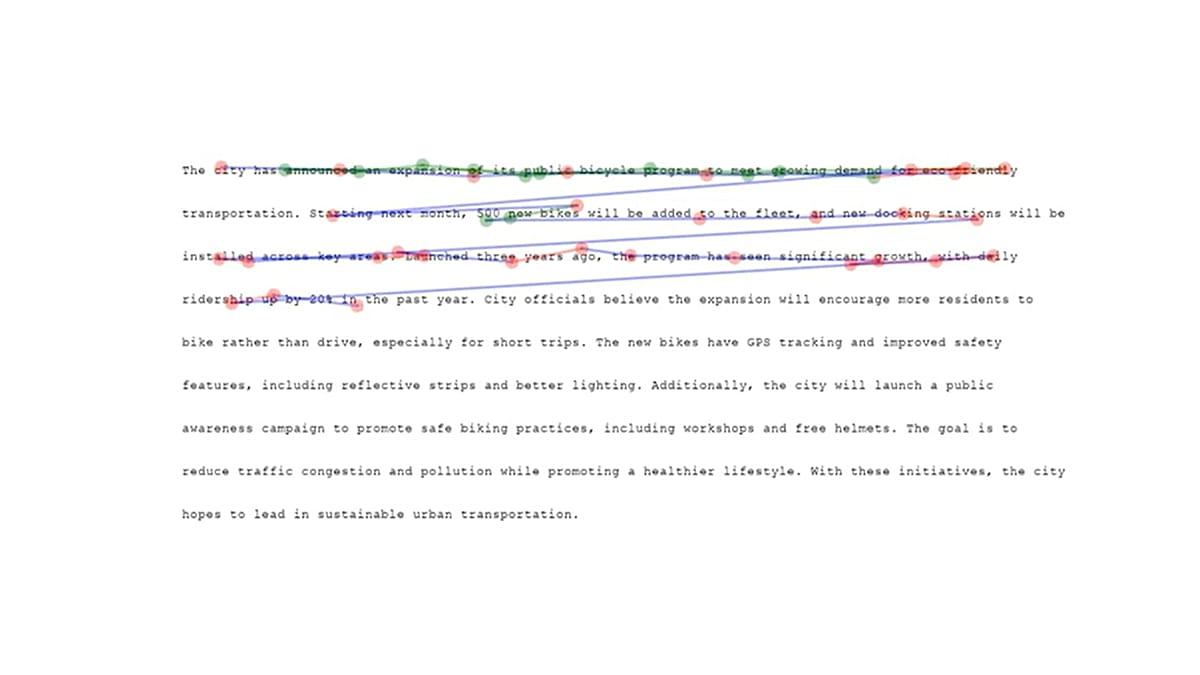
Researchers at Aalto University, together with international partners, have developed the most accurate model yet of how humans read. The new model uses reinforcement learning, a type of AI used in robotics, to explain -- and recreate -- the choices readers make as they move through text...
Earlier models learned from large data sets pairing text snippets with eye-tracking data, then mimicked human behavior, but they lacked true understanding of the content and didn't generalize well across languages or contexts, Oulasvirta explains. In contrast, the new model follows the psychological mechanisms readers use to direct attention, revealing how understanding is built as the eyes move through words, sentences and paragraphs...
They are influenced by factors such as a reader's language, memory capacity, vision and eye speed. For example, a fast reader with a good memory may jump briskly from one paragraph to the next, whereas a reader with a poorer memory is more likely to loop back...
The next step for the team will be to evaluate how the model can be used to help individuals with dyslexia and low language proficiency.
(Excerpt) Read more at techxplore.com ...
Why do we breeze through some sentences in a book or article but have to reread others to comprehend their meaning? A team of linguists and data scientists has found a partial answer in AI -- some of this processing parallels that of neural-network-based large language models (LLMs). However, other aspects of why we read this way cannot be explained by these technologies, revealing where human and AI language processing diverge and maintaining the mystery of some stages of the reading process.
The new study, by researchers from New York University and the University of Massachusetts Amherst, shows that humans and AI process language in similar ways during the earliest moments of reading: Both rely on next-word predictions. However, as reading continues and passages become more complex -- often requiring rereading -- human processing differs from that of AI, which is entirely built on next-word prediction and therefore cannot account for how we navigate these types of passages.Machine learning & AI | New York University | edited by Lisa Lock, reviewed by Robert Egan | August 10, 2026
Why do our eyes skip and reread words? AI may reveal how we read efficiently | Roselyne Min | Euronews | August 11, 2026 | ©Aalto UniversityVideo editor · Roselyne Min
I wonder how this impacts non-readers?
Does AI do “Ebonics”?
Jo Mamma
Of course, there’s that special class of readers known as “FReepers” who can skim over anything in a second, learn nothing, and then comment knowledgeably and confidently about it!
When I was in sixth grade back in 1962, we had a “Speed Reading” machine that moved a shutter / screen down over the reading material. The theory was that it forced you to glance at an entire line at once and absorb it into your brain instead of reading word-by-word (or worse, letter-by-letter). It was supposed to stop you from internally “vocalizing” words, too, which was known to really slow you down. We unconsciously do the muscle movements during vocalization; not as bad as when you are speaking out loud, but there’s the brain kind of triggering the muscles. The whole idea was to get you to read faster and improve comprehension.
Nice in theory, but that 1962 gadget in 6th grade never did anything for me (except annoy me).
😆
“The Miss Ebonics pageant had to be cancelled because no one wanted to be Miss Idaho.” — Rush L.
That shutter thing, btw, sounds familiar. I think we had something similar a few years later, probably a timed reading of a page, then turn over to the blank page, some such thing.
In fourth grade we were introduced to a set of cards and we started out at 1st grade level, answered a quiz, and those who could moved on up. It was designed to gauge our reading level. I got bored, then got suspicious as I saw some classmates (including one who later got busted for B&E before we were out of high school) going through the whole set in an hour or so
Not one of us from that classroom has ever amounted to anything. For that matter, AFAIK never have any of us been tested to determine our reading level since that day. 😁
LOL!!!!!
Evelyn and Doug Wood created a speed reading business in 1959. Their company, Evelyn Wood Reading Dynamics, was initially based in the Washington, DC, area but quickly expanded to 32 cities.Instrumental in the business's success was its wholehearted embrace by the media. Early coverage of the method in Time magazine accepted all of Wood's claims as factual, and other major news outlets were equally uncritical. Early on, an educator at the Harvard Business School raised questions about the validity of Wood's data, but these were largely ignored.
A scathing critique of the method in the Saturday Evening Post got somewhat more attention. But the election of President John F. Kennedy elevated speed-reading to a craze, or, as some saw it, a job requirement. Kennedy, who reportedly read at 1,200 words per minute, had no formal association with Evelyn Wood Reading Dynamics. He said he'd taught himself speed-reading after taking a few classes from a different company that had since ceased operations. Nevertheless, Kennedy's prolific reading and Wood's methods merged in the public mind, lending legitimacy to Wood's claims.
Wood alleged that she was capable of reading 2,700 words a minute, often sharing the traits of reading down the page rather than left to right, reading groups of words or complete thoughts rather than single words, avoiding involuntary rereading of material and applying their efficiency to varied material.. Maintaining that faster readers were also more effective readers, she began developing her programs, ultimately establishing the methodology of using a finger or pointer to trace lines of text while eliminating sub-vocalizing (reading under one's breath or aloud in one's head).
I never used that gadget but that is how I speed read.
What if we don’t want “augmented reality”?
It may have done more for you than you realize. You just wrote 2 coherent paragraphs that describe your experience, which is a lot more than many FReepers can/will do.
When I was in sixth grade back in 1962, we had a “Speed Reading” machine...
By the end of the course some in the class were reading so fast that they spent more time turning the pages of the book than reading the page. Yes, it looks like skimming, and yes it looks fake, but your brain can understand a printed word without having to ‘call it out’ in your mind.
I could read an entire semester’s course reading in the hour before my finals, and because of the speed, it was the second or third time I had read the books.
Don’t use the skill as much anymore, but my wife who is an avid reader still has trouble understanding how I can just seem to look at a block of text and know what it is saying.
Cheech & Chong did a send up of Evelyn Wood’s “sped reading course”, good times, good times. 😁
Heh, heh...thanks!
Yep, I remember that too. Never worked for me at all.
Disclaimer: Opinions posted on Free Republic are those of the individual posters and do not necessarily represent the opinion of Free Republic or its management. All materials posted herein are protected by copyright law and the exemption for fair use of copyrighted works.