Transcript
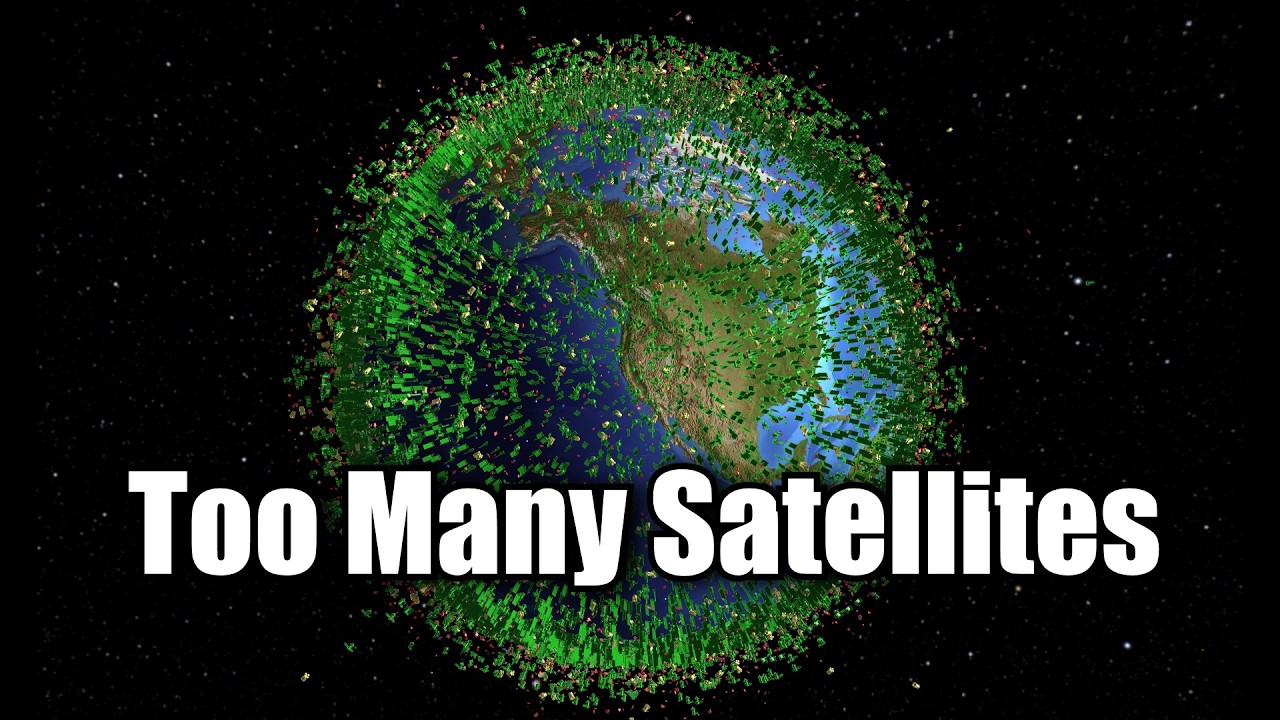
Hello, it’s Scott Manley here. We have just passed a momentous moment in low Earth orbit. Humanity has launched so many satellites, and I really mean SpaceX, but humanity in general has launched so many satellites that we now need six numbers to designate them.
[laughter]
This is something of a Y2K problem for many pieces of software which have been using the familiar TLE or two-line element systems. I’ve written software like this. I have a video a couple of years ago about what you could see if you saw every single satellite. Well, guess what? That program will probably need changes because that’s based on a data format which dates to the 1960s, back in an era where they thought they were being optimistic when they included five digits to count the satellites. Now we’re up to six.
So anyway, yeah, this actually, I mean, this is kind of a fascinating story and it really I want to talk about how this leads into, you know, how the system is managed and everything but yeah just a couple of days ago a Portuguese satellite named Sarago was assigned catalog number 100,000, right? And that basically breaks a lot of existing code and we knew this was coming, right? So back in 2020 they came up with new data formats that would be immune to this and they also came up with a hack to work around this problem for software which couldn’t necessarily be updated quickly enough.
Now, interestingly, the actual number of satellites that can be covered isn’t 100,000 because there’s actually special number ranges. Numbers from like 70,000 through 99,000 or whatever are covered different classes of orbits. For example, anything in the 70,000s is a temporary number, right? So the idea is your spacecraft has just gone into space. There’s a whole bunch of other spacecraft around because you’re launching a Starlink. You know that you have 20 different Starlinks there, but you don’t know which number’s which.
So they get these 70,000 numbers and then when we figure out which one is which, they get their final number. Similarly, there’s the 80,000 range and that covers what are called analyst satellites. These are satellites which we can see, we know they’re there, we have no idea where they came from, right? They might have been launched by a secret launch or more likely they were launched and they weren’t caught quickly enough or the technology improved and they found this object floating in space and we couldn’t connect with any historic launch.
So these things are in the database and there’s also another set from the ‘90s, 90,000s, which are uncorrelated tracks. These are where we’ve seen an object and we’re not seeing it often enough. Perhaps it’s at the edge of detection and so we see it and then we lose it and then we see something else but we can’t guarantee it’s the same object. So these sort of tracks come and go, but the point is that we’ve reached number 6999 and we have to go to the next level. And that honor fell to a Portuguese satellite which was deployed, actually launched in March, March 30th on a transporter mission. And it was attached to a deorbit satellite bus which would be a space tug and it flew around for a while and apparently it was deployed recently and that’s why it got its own number.
So anyway, this whole tracking system is run by Space Track and space goes way back in history to the early to the late 50s, right? You see, when Sputnik launched, the US sort of realized, well, we probably need to be able to track these spacecraft and sure if we are given the elements, for example, by the Soviet Union who were very proud to tell the world they had launched a satellite, you can use computer programs to map these things forward but you kind of have to keep tracking it. And in fact, they got the original elements from the Soviet Union and then they refined it using various sensors.
Interestingly, however, while these satellite numbers are assigned sequentially, the first number in the database is not Sputnik. That first number actually applies to the Sputnik booster which also reached orbit. And because it was a whole lot bigger, it was a whole lot brighter. Most people in the 1960s, if you or 1950s, if you hear them talking about, oh, I saw Sputnik flying overhead as a star, they almost certainly saw the booster and not the Sputnik spacecraft. So yeah, that’s Sputnik is number two. The oldest object still flying in there, of course, is Vanguard and the Vanguard booster which put it into its orbit. It is still going to be up there in 200 years’ time unless somebody goes and gets it or something.
But anyway, yeah, the US very quickly realized that this was a new space that they needed to monitor, right? They had radar to track air, you know, aircraft movement around the country, but they needed a way to track what was going on in space because with the current technology, the Soviet Union might start launching secret stuff and they might not tell the West that they’ve launched something because it was a spy satellite or something.
So the US Air Force created Project Space Track. It was actually originally named, codenamed Harvest Moon, and this was at the Air Force Cambridge Research Center at Hanscom Field and it was led by a couple of, you know, Germans, former Germans, and they built like a global sensor network and they essentially were correlating the data from various places.
So for example, there was a little radar system at MIT which they could point at satellites and bounce data signals off them and get very accurate ranging data. They had cameras, Baker-Nunn telescopes, which would take images on photographic plates that would get very accurate positional information and that would help them again determine the orbit and refine the orbit. And then the US Navy space, they set up like the space survey system. And what this was was a line of like three or four radars that ran across at the 33rd parallel. And anything flying over that, because it was in an inclined orbit, would trigger this and they’d be able to catch it as it passed over the country multiple times, get the periodicity and then dial into what that object was.
So this was like the early monitoring system. All this data would be collected at the Hansen Field facility and the data reduction was initially like by hand manual work and then they eventually wrote software for IBM mainframe and you know that system grew over time. So this was declared operational in 1961 and they stood up the first aerospace surveillance and control squadron at Ant Air Force Base under the Air Defense Command and under NORAD and stuff and so the satellite catalog was really formally born on this date. And it was soon after a Thor Ablestar body like exploded in space.
That was the first time they had to add objects which had pre been launched already because of course one object split into multiple parts. So yeah, they’ve got this data going forward in the 1970s. This is when they sort of really formalized the current TLE standard. So that’s two line element. There’s actually like a three-line version which has a name on the first line but the two lines after are the important ones. They contain all the orbital elements and these were designed to work with the computers of the era.
And anyone that knows about computers from the era, you’ll know that they were very constrained on their data size. I grew up with the ZX Spectrum, right? I had 48K of memory. I didn’t think it was much, but in that era, they were working with punch cards. And the data was designed to fit on a pair of standard 80 column punch cards. And I don’t know if you know what these are like, but basically you have 80 columns and you have like a bunch of holes you can punch out. And depending upon the pattern of the holes, that’s a specific character.
So this is like a text line with fixed width columns. And that of course is why crossing into 100,000 is a problem because this column can’t expand anymore on the front side. Therefore, they’re going to have to come up with something else or they have come up with something else. Now another thing about this is the format was standardized I guess in the 1960s and 1970s.
And the fields that are in there, they start out with like the mean motion, which is the number of times it’s orbiting per day. But on top of that, you obviously have to have the angular elements, the inclination, the longitude of the ascending node, the argument of perigee, and they have a couple of other parameters that show how it is changing over time.
So this is important because they get the positions at a snapshot at a specific time and you want to predict the orbit backwards and forwards in time and one way to do this is using, you know, standard n-body integrators which was way too powerful for the computers of that era. Instead, they had really smart mathematicians or mathematicians as I like to call them and they understood the various, you know, perturbations that would be applied to a standard Keplerian orbit and the idea is that you know if you, for example, you know if you’re depending upon your inclination how fast the oblateness of the earth is going to drive the orbit one way or another. So you can apply that as a perturbation based upon the times, you know, the forces that are going to be applied by the sun and the moon and so those could be put in as changes to this orbit over time.
And another parameter that they want to look at is the aerodynamic drag which causes it to slowly decay. And in the early days, you actually had the derivatives, right? The rate at which the mean motion was changing because of course the periods would be getting shorter and shorter as it decayed. And you would actually have the first derivative and the second derivative and you know that’s what they use but later they just condensed this into something called B star which is essentially the ballistic component right coefficient right the, um, how draggy the satellite is so if it’s like a balloon like echo1 it’s very draggy if it’s something that is just like a solid chunk of metal in space it would be a whole lot less draggy and this would be boiled down to this parameter.
So the other part of this whole standard format thing is that they had to have standardized software for processing it. And so they initially came up with one thing but when it was finally like set in stone so to speak it was something called SGP4 which is the standard generalized perturbations 4 and it includes all those different parameters and it’s designed to run on computers in the 1960s and 1970s. There was also one called SDP4 which is for satellites that are higher up. If you’re higher up, you have less problems with aerodynamic drag, but you have more problems with the perturbations due to the sun and the moon. So they would switch the modeling depending upon the attitude or the period of the orbit.
So anyway, all this was like all written in Fortran by the way, you know, hence fixed width columns is a very common feature in early Fortran. Another thing that I ended up with so yeah, this wasn’t a secret by any means by the way. This was kind of publicly known and researchers knew about it. It wasn’t something there wasn’t like a website obviously because this was the ‘80s but in the ‘80s you did start to see bulletin boards and people like TS Kelso would go and he managed to get the data and scan it in manually and he created a bulletin board where you could actually go and get orbital elements or the parameters for these satellites that astronomy fans or satellite trackers could actually get the data electronically if they just dialed in.
And eventually that evolved into a bulletin board and sorry into a website which is CelestTrack which of course many people use today. They collect a lot of stuff. See while the US officially has SpaceTrack which does a lot of this tracking for us right CelestTrack will include a bunch of things that SpaceTrack doesn’t publish. For example, SpaceTrack will collect the data internally on many classified satellites the US runs, but they won’t publish any of that stuff to the general public. But people in other countries, they can use telescopes, they can use cameras, they can see these objects in space and they can track them and amateurs in the US can of course collect that data back and make it available if necessary.
So understand that the US government is tracking all these satellites and cataloging everything but they are notably leaving out some of their classified stuff. Interestingly by the way the Vera Rubin telescope it’s also doing something like this. All the data that comes down, it actually goes through like a special processor that will carefully remove anything which could show the positions of US classified assets for at least long enough that they can end up elsewhere.
So there’s a whole interesting thing where you can’t you’ll see holes in the data or whatever apparently. But anyway, that whole process is continued today, you know, now like in 2020 they stood up the space fence radar out in Quadrilane which is able to gather a whole lot more. There are now private organizations like Leo Labs who are able to set up their own radars and track a lot more objects. So and of course there are other governments. For example, Russia has the ISON catalog of their own, you know, with their own IDs and I believe there’s also like Cobar IDs and Europe has other stuff.
Now, right now, as I said, we’ve reached this point where the traditional TLE format is broken, right? It cannot handle the new objects and any software that relies on it is likely to fail when they see a new one. But there is a workaround. And the first workaround they came up with was they said, “Okay, well, once we pass 6999, instead of going to 100,000, we’ll put a ‘A’ as the first character, and that will get you another 10,000 IDs.” And they’re going to add another, you know, blocks of 10,000 over time. By the way, when we passed 60,000 was about 18 months ago.
So, it’s taken 18 months to cover, you know, 10,000 objects. That’s only going to get faster over time. So they can add like a couple hundred thousand objects that way. They still have some reserved space in there. And of course, if your software was well written, it may have actually looked at the standard and said, I better sanity check this first field and make sure that it’s all numbers. If your software is doing that, then yeah, you might need to actually manually modify stuff and hack this. I mean, there is software that is still in popular use which has this problem.
The other way, the more correct way to do it is there’s new formats, right? That have all this stuff that’s in CSV or JSON or whatever, something that doesn’t rely on fixed width fields and there’s plenty of ways to process this already out there. Incidentally, this is not actually the first time that we’ve had a Y2K style problem in the satellite catalog because of course the original satellite catalog included two digits for the year. And yeah, when Y2K rolled around, they had to redefine what that it was no longer, 1900 plus that number, but that was a pretty obvious fix. At some point, they’re going to get up to, you know, 207. Then they’re going to have to again redefine what goes on in there. But hopefully people have updated all their software before that time.
So anyway, all this is to highlight the fact that humanity is launching way more satellites than were anticipated. And you know, you can say look back at the 1960s and say, well, you know, they couldn’t have anticipated this many objects, but I will counter that back in the 1960s they were talking about the Apollo program continuing and we would have space stations and moon bases and stuff.
So, they weren’t exactly pessimistic about space flight, but yeah, this represents like a hack, right? We’ve expanded the space of numbers available for these old programs. But ultimately, it is just a temporary hack in a data structure. In real life, of course, there is a limited amount of space around the Earth. And while space is big, satellites move very quickly. So, they cover a lot of space very quickly. And all those Starlink satellites that are orbiting in shells, they are continually updating, modifying their position. They’re actively flying to deconflict and make sure that they don’t hit each other or any other pieces of hardware coming through.
It’s, you know, if you look at some of the things that they have been approved for some of the shells are like 10 km thick with thousands of satellites and if you crunch the numbers on that if they lost control and could no longer steer simultaneously we would expect them to randomly start hitting each other within about 3 days. So there while we have fixed the amount of space available in our data format, we are still having to deal with the very real problem of space in space. I’m Scott Manley. Fly safe.
[music]
I was on a technical team that was provided all of the AIS data and all of the TLE data for a 20 year period. The assignment was to identify every AIS voyage that successfully avoided being under a satellite footprint. The evaded segment had to be identified. It was a massive amount of data, but we pulled it off and won the contract. We had to submit the python code that accomplished the task as part of the "work products". I enjoyed the successful outcome, but it stomped the Christmas holidays pretty hard.