Skip to comments.
A SpaceX Rocket Is About to Slam Into The Moon, Scientist Says
ScienceAlert ^
| 12 May 2026
| Ivan Farkas
Posted on 05/13/2026 12:06:14 PM PDT by SunkenCiv
According to an analysis by independent astronomer Bill Gray, developer of the Project Pluto software used to track near-Earth objects, the spent SpaceX rocket stage will crash into the Moon on 5 August 2026 at about 06:44 UTC (02:44 EDT).
Gray reports the impact should occur around Einstein crater, a heavily impacted area at the threshold between the lunar near side and far side.
"The motion of space junk is mostly quite predictable; it simply moves under the influence of the gravity of the Earth, Moon, Sun, and planets. We know those with immense precision," Gray explains.
At the same time, solar radiation pressure, or the push exerted by sunlight, is constantly acting on the object in ever-changing ways.
(Excerpt) Read more at sciencealert.com ...
TOPICS: Astronomy
KEYWORDS: kickstage; moon; potsdamgravitypotato; spacex; themoon
Navigation: use the links below to view more comments.
first 1-20, 21-34 next last
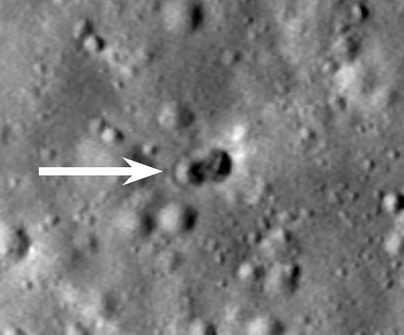
This image shows a pair of craters made in 2022 when the upper stage of China's Chang'e-5 T1 mission hit the moon. One of the craters is about 16 meters across and the other about 18 meters across. The China National Space Administration does not provide figures for the mass of their rockets, but it probably had a mass similar to 2025-010D, and we'll probably get a crater of roughly similar size. It will be coming in at an angle of 34 degrees from the vertical, straight enough down that I don't expect the crater to be very elongated. Courtesy Lunar Reconnaissance orbiter
Upper stage impacting the moon on 2026 August 5 | Project Pluto | most recent update May 12 2026
1
posted on
05/13/2026 12:06:14 PM PDT
by
SunkenCiv
To: AdmSmith; AnonymousConservative; Arthur Wildfire! March; Berosus; Bockscar; BraveMan; cardinal4; ...
During the Apollo program seismometers were left on the Moon, but those went out of service in 1977. An Indian probe on the surface does have a newer one.
2
posted on
05/13/2026 12:08:16 PM PDT
by
SunkenCiv
(TDS -- it's not just for DNC shills anymore -- oh, wait, yeah it is.)
To: SunkenCiv
3
posted on
05/13/2026 12:12:14 PM PDT
by
frank ballenger
(There's a battle outside and it's raging. It'll soon shake your windows and rattle your walls. )
To: SunkenCiv
To: SunkenCiv
5
posted on
05/13/2026 12:12:27 PM PDT
by
Red Badger
(Iryna Zarutska, May 22, 2002 Kyiv, Ukraine – August 22, 2025 Charlotte, North Carolina Say her name)
To: SunkenCiv
To: SunkenCiv
7
posted on
05/13/2026 12:21:59 PM PDT
by
DFG
To: DFG
8
posted on
05/13/2026 12:37:44 PM PDT
by
BenLurkin
(The above is not a statement of fact. It is opinion or satire. Or both.)
To: johnnygeneric
9
posted on
05/13/2026 12:40:28 PM PDT
by
BenLurkin
(The above is not a statement of fact. It is opinion or satire. Or both.)
To: SunkenCiv
“The motion of space junk is mostly quite predictable; it simply moves under the influence of the gravity of the Earth, Moon, Sun, and planets. We know those with immense precision,” Gray explains.
At the same time, solar radiation pressure, or the push exerted by sunlight, is constantly acting on the object in ever-changing ways.
>>>>>>>>>>>>>>>>>>>>>>>>>>>>>>>>>>
makes perfect sense to me! /s...
10
posted on
05/13/2026 12:42:30 PM PDT
by
sit-rep
(START DEMANDING INDICTMENTS NOW!!!!!)
To: SunkenCiv
“constantly acting on the object in ever-changing ways.”
Which is it?
Constant?
Or Variable?
To: ClearCase_guy
I was just thinking about that. Thanks for posting.
12
posted on
05/13/2026 12:48:46 PM PDT
by
ChessExpert
(Infidels of the world unite against the evil that is Islam.)
To: ClearCase_guy
This was exactly my first thought!
13
posted on
05/13/2026 12:50:19 PM PDT
by
Puppage
(You may disagree with what I have to say, but I shall defend to your death my right to says it.)
14
posted on
05/13/2026 12:50:43 PM PDT
by
RandallFlagg
(Democrats should have been barred from elections since The Battle Of Athens.)
To: ProtectOurFreedom
It’s constantly variable.
15
posted on
05/13/2026 1:06:57 PM PDT
by
TonyM
(Score Event)
To: ClearCase_guy
16
posted on
05/13/2026 1:08:07 PM PDT
by
SunkenCiv
(TDS -- it's not just for DNC shills anymore -- oh, wait, yeah it is.)
To: SunkenCiv
Where is Iron Eyes Cody when you need him.
To: ProtectOurFreedom; sit-rep; Lonesome in Massachussets
Most of it is inertial, traveling in a slowly varying trajectory, the variance resulting from small forces at work, including wobbles from the lumpiness of planetary bodies (see the “Potsdam Gravity Potato” keyword), the solar wind, and of course the tidal transfer of momentum.
18
posted on
05/13/2026 1:19:14 PM PDT
by
SunkenCiv
(TDS -- it's not just for DNC shills anymore -- oh, wait, yeah it is.)
To: posterchild
He’d be in close-up, shedding a tear, then enjoying some mostaccioli.
19
posted on
05/13/2026 1:26:17 PM PDT
by
SunkenCiv
(TDS -- it's not just for DNC shills anymore -- oh, wait, yeah it is.)
To: SunkenCiv
This is so funny and I don’t know why!!!!!
20
posted on
05/13/2026 1:32:59 PM PDT
by
Karoo
(..)
Navigation: use the links below to view more comments.
first 1-20, 21-34 next last
Disclaimer:
Opinions posted on Free Republic are those of the individual
posters and do not necessarily represent the opinion of Free Republic or its
management. All materials posted herein are protected by copyright law and the
exemption for fair use of copyrighted works.
FreeRepublic.com is powered by software copyright 2000-2008 John Robinson
%2Fcdn.vox-cdn.com%2Fuploads%2Fchorus_image%2Fimage%2F59605469%2Fmelies.0.jpg&f=1&nofb=1&ipt=0aaea455bf393764553b918e7181d8af92e7ae9d35ee7a41678ceb7c932b8613)


