Simple. All aviationists know how.
Posted on 03/26/2026 6:03:24 PM PDT by TexasKamaAina
A devastating runway collision at LaGuardia Airport has raised serious questions about how multiple layers of aviation safety broke down at once.
In this episode, Captain Steeeve reacts to the latest NTSB update on the Air Canada Express CRJ-900 crash involving a Port Authority vehicle on the runway. With new details emerging from cockpit voice recordings, ATC communications, and ground radar systems, this incident is shaping up to be a classic example of how accidents rarely come down to a single mistake.
From the timing of the runway crossing clearance — issued just seconds before impact — to the limitations of surface radar systems and the challenges of nighttime operations, Captain Steeeve walks through exactly what we know so far and what may have gone wrong.
This is a deep dive into runway safety, communication breakdowns, and the critical systems designed to prevent exactly this kind of accident.
For business inquiries email us at: captainsteeeve@wearebv.com For press or general questions: peter@541co.com
Disclaimer: Captain Steeeve is not a spokesperson for any airline or aviation authority. The opinions expressed in this video are solely his own and are based on his experience as a professional pilot. This analysis is for informational and educational purposes only and should not be interpreted as an official statement from any airline, regulatory agency, or aviation organization.
I would guess that the right seater of the fire truck had a job of being look-out at all times the vehicle was moving.
My guess is the rainy darkness and the fire crew mis calculated the approaching plane.
Read that the fire truck had no transponder….
Fire truck in fatal LaGuardia Airport crash had no tracking transponder: NTSB
https://www.eastbaytimes.com/2026/03/25/port-authority-fire-truck-in-fatal-laguardia-airport-crash-had-no-tracking-transponder-ntsb/
At the angle that plane was bearing down on the fire truck, one would believe the plnne’s landing light was really kicking them in the ass.
Simple. All aviationists know how.
I don’t understand how so many people are blaming the controller. A system that requires people to be 100% perfect while working two jobs at once for 10 hours straight is flawed. Hopefully now that we’ve learned that the fire truck didn’t have a transponder, and that the other United plane was stepping on the transmissions, people will recognize that a momentary and quickly recovered lapse in judgement is not the primary issue.
It is their job to be perfect or people will die. You are excusing the fatal error. If ATC is going to be IN CHARGE then they are held RESPONSIBLE.
I used to work for Boeing in BDS (Boeing Defense and Space), specifically on helicopter flight control software. As part of our testing we would recreate the algorithms that would run on the flight control computer in MS Excel and run tests against it.
There was a point where I was seeing successes flagged in the simulation as failures (and conceivably it could happen the other way around). The reason had to do with floating-point calculation accuracy: the flight hardware uses single-precision 32-bit IEEE floating-point for certain calculations whereas Excel always uses double-precision 64-bit or better.
It was less than a 1% deviation, but I didn’t feel comfortable with it. So I wrote Excel macros to forcibly take a number, build a single-precision value bit by bit, do the calculation manually that way, and then return the result back to Excel. It was “one and done” work: write the macros once and then they can be used in all tests.
I got some heat for it. My team lead felt it was overkill but the way I look at it, if a combat pilot is under strain and taking fire he’s not going to be taking it easy, flying in the middle of the flight envelope. He’ll be pushing the aircraft to its limit, right on the edge between flying and crashing. I don’t want the computer not shaking the stick (which tells the pilot “don’t you dare push this maneuver any farther or you’re certain to lose control and crash”) when it should.
I’m 5 years retired now and I really hope they left my accuracy macros in.
Perhaps the biggest issue is that LGA is just a crappy dump of an airport that is dysfunctional in many ways. Years ago I had an airline pilot tell me that it was the airport he hated most — for a number of reasons … short runways, Flushing Bay right at one end of both runways, too much conflicting air traffic from multiple airports (most people may not know this, but the flight paths for the north-south runways at LGA and JFK Airports overlap with each other even though they are more than 10 miles apart), terrible landside access to the airport, etc.
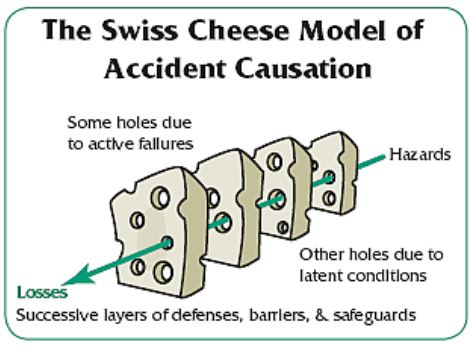
The controller and the truck driver both messed up. The controller appeared to give give permission although the language was not proper. The fire truck driver should not have crossed as the ASDE lights were clearly showing red which means crossing prohibited. At least 2 holes in the Swiss cheese.
Amazing you had to down-convert bit-by-bit double-precision 64-bit to single-precision 32-bit IEEE floating-point to emulate the flight hardware. You were definitely right about that.
Has the organization (Port Authority?) responsible for making sure that La Guardia fire trucks had tracking transponders been identified yet?!?
Did the United Airlines plane with the odor in the back finally get to a gate, or did a truck with stairs arrive to get the passengers off or did the passengers have to use the emergency exits?
What was the cause of the odor?
"If only we had the magic wand. Do not look at the decline of safety in commercial aviation. Do not look at the decline of safety in commercial aviation. Do not look..."
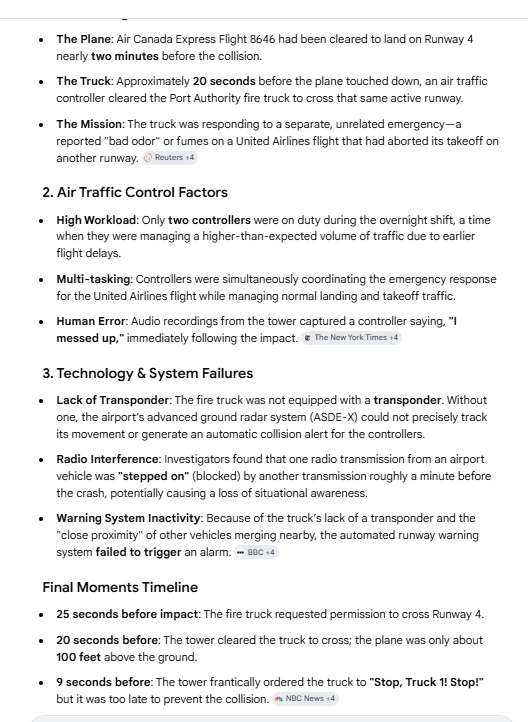
The transponder is a non-issue and the "Technology & System Failures" statement that "the automated runway warning system failed to trigger an alarm" is a misdirection at best.
The controller cleared the fire truck driver onto the active runway. Any alarm would have been irrelevant in the timeframe since the plane was already on the ground.
I completely agree, the transponder would have made no difference at all. It is a total non-issue. The mistake was made by the person that immediately knew it, and immediately admitted it on the radio— the controller.
Disclaimer: Opinions posted on Free Republic are those of the individual posters and do not necessarily represent the opinion of Free Republic or its management. All materials posted herein are protected by copyright law and the exemption for fair use of copyrighted works.