Posted on 05/17/2022 4:43:03 AM PDT by MtnClimber
In the contest to be the most virtuous of all the states on the “carbon-free” electricity metric, the race is on between California and New York. In 2018 California enacted a bill going by the name “SB100,” which set a mandatory target of 60% of electricity from “renewables” by 2030 (and 100% by 2045). Not to be outdone, New York responded by enacting its “Climate Leadership and Community Protection Act” in 2019, setting its own statutory targets of 70% of electricity from renewables by 2030 (and 100% by 2040).
So is any of this real? Or is it just so much posturing to show conformity with current fashions, all of which will be forgotten by the time the now-seemingly-distant deadlines approach? As to New York, I have had multiple posts (for example here and here) explaining how the supposedly mandatory goals are completely unrealistic as to both feasibility and cost, and how the people charged with achieving the goals have no idea what they are doing.
Is California any less clueless?
The short answer is “no.” However, a gaggle of “think tanks” is just out with a big Report trying to convince us otherwise. Indeed, the Report advocates that California can achieve not just its current statutory goal of 60% carbon-free electricity by 2030, but rather an even more ambitious 85% — as indicated by the headline of the press release announcing the Report, which is “Achieving 85 Percent Clean Electricity By 2030 In California.” The Report itself has the title “Reliably Reaching California’s Clean Energy Targets.” The think tanks putting their names on the Report are Energy Innovation, Telos Energy, and GridLab. The authors of the Report are identified as Derek Stenclik and Michael Welch of Telos and Priya Sreedharan of GridLab.
Also identified is a big “Technical Review Committee” of some 13 members. Do you think these people may be the experts who are going to be sure that this project gives honest technical and engineering answers as to how to achieve the ambitious goals? Don’t kid yourself. Five of the 13 are California energy bureaucrats (three from the California Energy Commission and two from the California Community Choice Association); and the rest are environmental and “green energy” advocates of various sorts, including from the Environmental Defense Fund, Vote Solar, Jas Energies, Sharply Focused and so forth. Even the few listed as “independent consultants” have backgrounds in advocacy for wind and solar energy.
And then there is this bizarre combination of “Disclaimer” and funding disclosure:
The views contained in this report do not represent the views of any of the technical review committee organizations and cannot be attributed to any single technical review committee members. This work was supported by funds from Climate Imperative.
In other words, “you can’t blame me when none of this works.” And, have you heard of the funding organization, Climate Imperative? Neither had I. But a few moments with a search engine will give you the answer. Two of the six members of the Board of Directors are Laurene Powell Jobs and John Doerr. Yes, that is the Laurene Jobs who inherited the Apple money, and the John Doerr of Kleiner Perkins who just dropped a billion on Stanford University to create a new school of “Sustainability.”
The Report is some 89 pages long, much of it couched in seemingly highly technical jargon. The goal is to persuade you that the target of 85% carbon-free electricity by 2030 can be easily achieved with full reliability. We have “models” that include all the relevant variables. We have run “stress tests” on every sort of possible extreme scenario. The following is from the blurb promoting the Report found on the Energy Innovation site:
Modeling from GridLab and Telos Energy finds California can achieve 85 percent clean energy by 2030 without compromising reliability, even under stressful conditions. . . . The technical study developed three 85 percent clean electricity by 2030 portfolios, reflecting different resource buildouts and accelerated electrification. These portfolios were tested against stressors including retiring in-state natural gas units, replacing West-wide coal with renewables and energy storage, and mimicking the August 2020 heat waves that caused rolling power outages. The study evaluated all stressors together, including stricter-than-normal import restrictions, finding the future clean grid is capable of serving load under these extreme conditions.
So the message to Californians is, invest some hundreds of billions of dollars of taxpayer and ratepayer money over the next eight years in complete blind faith that our models have considered everything that can go wrong. And by the way, don’t expect any kind of cost projection from us — that is beyond the scope of this project.
As readers here know, I have a simple answer to these kinds of fantasies, which is, show me the working demonstration project, even for a small town of 5000 or 10,000 people, from which we can evaluate the feasibility and cost of doing this for a large state of 40 million. Needless to say, no such thing exists.
To consider whether there is any seriousness at all behind this effort, let’s look at how the scenarios in the Report deal with two questions: (1) overbuilding of capacity, and (2) energy storage.
To its modest credit, the Report recognizes that reaching the 85% carbon-free electricity target will mean retaining a residuum of about 15% generation from natural gas. But how much wind and solar capacity will be needed to supply the remainder?
And the Report also gives at least some recognition that large amounts of storage will be required. But how much storage and at what cost?
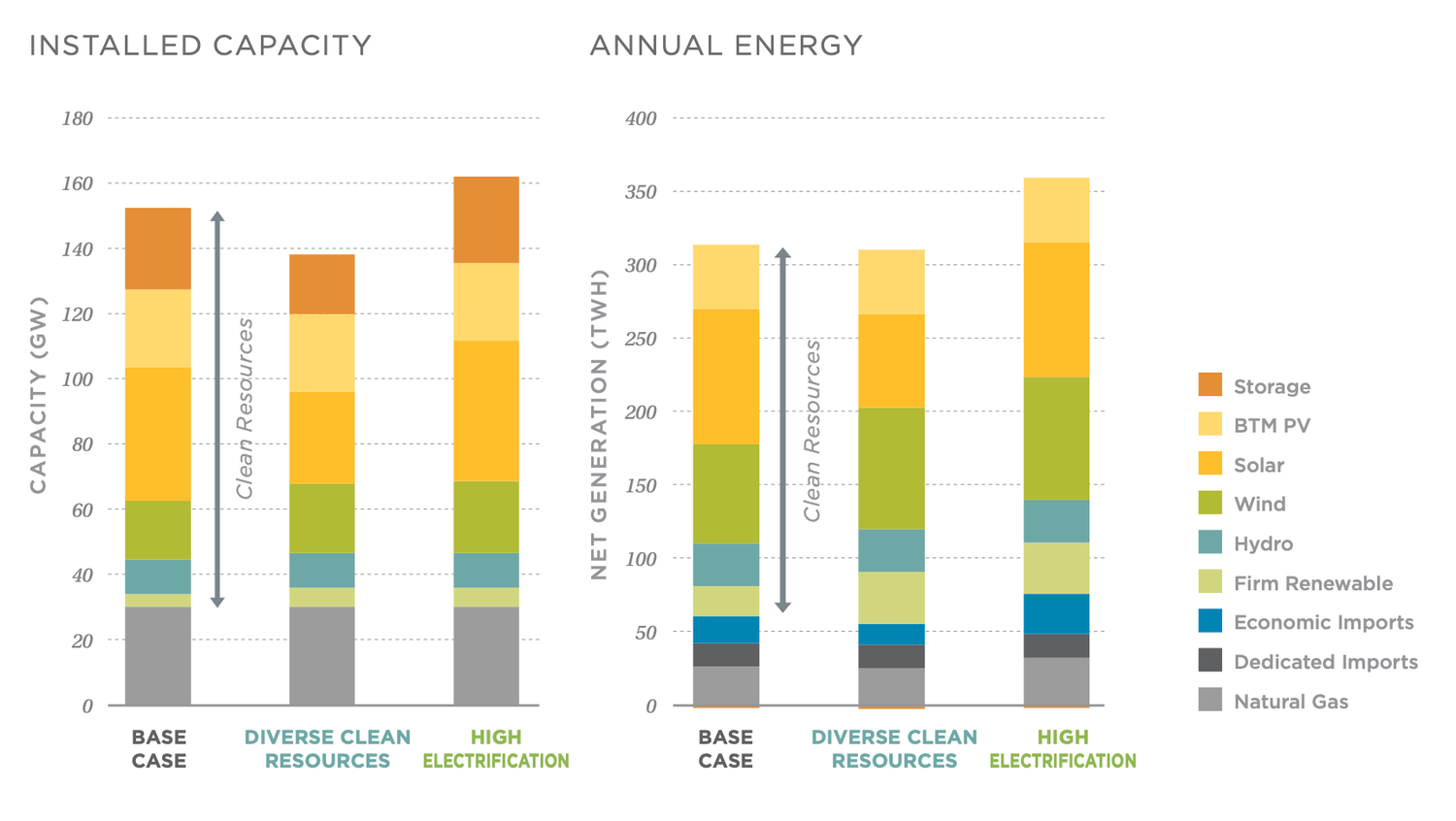
The heart of the information addressing these questions appears in this chart from page 24:
For perspective, California’s peak electricity usage of all time hit 50.27 GW on July 24, 2006. In most recent years, the peak has been in the range of 46 - 47 GW. Current generation capacity from all sources is about 82 GW, already representing substantial overbuilding to deal with intermittency of large amounts of wind and solar. These scenarios from the Report for 2030 propose building capacity up to the range of 140 - 160 GW, or approximately three times peak usage. Natural gas capacity of about 30 GW would be almost enough to supply all of average usage, and about two-thirds of peak usage, but apparently the proposal is to keep it fully maintained and ready, but turned off about 85% of the time.
As to how much storage will be needed for these scenarios, the chart shows a range from about 20 GW in the “diverse clean resources” scenario, to about 25 GW in the “high electrification” scenario. OK, but how many gigawatt hours will you need, and how much will that cost? Even though that is far and away the most important question that must be addressed in any effort to build a primarily wind/solar/storage electricity system, you will not find that question addressed in this Report. Like the Scoping Plan of New York’s Climate Action Council, this Report is just that incompetent. (Or maybe the authors are aware of the problem and avoid addressing it because they know that addressing it would demonstrate the impossibility of the project and displease the paymasters. It’s hard to know which.). The only discussion in the Report of energy storage in gigawatt hours appears all the way on page 79, where from the context it is clear that the storage being discussed is only intended for intra-day balancing, and cannot even begin to address the seasonality of wind and solar generation.
So, what will be the cost of all of this? Building capacity to a level that is triple peak usage; keeping an entire back-up natural gas system fully-maintained but idle at least 85% of the time; and adding sufficient storage to deal with the seasonality of wind and solar? Three times the cost of the current system would seem conservative. Five times is more likely. And of course, this Report does not address the cost issue.
Over at Watts Up With That on May 12, Eric Worrall comments, “California seems utterly determined to be the next pauper state. . . . [A]nyone with an ounce of engineering talent can see where California’s ruinous policies could lead, the human tragedy in the making, how close California and other green states are to losing all the security and comfort their parents and grandparents worked their butts off to provide.”

I’m betting the answer is NO.
They probably will, since everyone is leaving 😁
Eight years?
I doubt it, unless they kill off 85% of their residents.
Sure they can. After 95% of the people leave due to no electricity and no water. The rest can survive by importing power from another state that has a coal fired plant to provide them what they need.
The problem this is the rats will move to other states and infect them too.
Re: Can California Really Achieve 85% Carbon-Free Electricity By 2030?
Of course, they can. Afterall California Royals, like Washington DC Royals are endowed by God and if they decree it, it must happen.
Sheesh, I thought we all knew that.
Sure. They’ll just say they did and the media will agree. Until people start having their heads placed on pikes, the nonsense will never end.
Yes it's called Agenda 2030 and the goal is for 95% of the population to live a primitive lifestyle while the other 5% fly over them in their private jets.
Yes, most definitely YES. The land of flakes, nuts and fruits can and will achieve 85% carbon free electricity by 2030 and beat their rival lunatic state New York by a country mile.
How? Simply by mandating it, regulating by law less carbon fuel use as well as putting up more stupid wind mills and solar panels. Now they will achieve the goal, but they will not have enough electricity for the state’s needs, such as for their homes or their EV’s. The population will just have to suffer Venezuelan style.
In the land of glorious communism, they will all be happy, like it or not. Those that are unhappy will receive less food rationing, or sent to jail, or get a visit from the nearest BLM/Antifa welcome wagon.
Stalin and Mao will be smiling in their graves!
Sure if they just buy more russian gas (like Germany did).
An excellent point made (IMO): show us us how this works in a smaller scale like 3k to 5k people. (real people, not another computer model).
Basically what they'd have would be the same thing we experienced at a remote safari camp in Kenya a few years ago.Hot water between 6AM and 6:30AM....lights available for only an hour each evening...
It might seem odd to you, but it makes perfect sense for us in this city. Everything you considered a product, has now become a service. We have access to transportation, accommodation, food and all the things we need in our daily lives. One by one all these things became free, so it ended up not making sense for us to own much.
First communication became digitized and free to everyone. Then, when clean energy became free, things started to move quickly. Transportation dropped dramatically in price. It made no sense for us to own cars anymore, because we could call a driverless vehicle or a flying car for longer journeys within minutes. We started transporting ourselves in a much more organized and coordinated way when public transport became easier, quicker and more convenient than the car. Now I can hardly believe that we accepted congestion and traffic jams, not to mention the air pollution from combustion engines. What were we thinking?
Sometimes I use my bike when I go to see some of my friends. I enjoy the exercise and the ride. It kind of gets the soul to come along on the journey. Funny how some things seem never seem to lose their excitement: walking, biking, cooking, drawing and growing plants. It makes perfect sense and reminds us of how our culture emerged out of a close relationship with nature.
In our city we don’t pay any rent, because someone else is using our free space whenever we do not need it. My living room is used for business meetings when I am not there.
Once in awhile, I will choose to cook for myself. It is easy – the necessary kitchen equipment is delivered at my door within minutes. Since transport became free, we stopped having all those things stuffed into our home. Why keep a pasta-maker and a crepe cooker crammed into our cupboards? We can just order them when we need them.
This also made the breakthrough of the circular economy easier. When products are turned into services, no one has an interest in things with a short life span. Everything is designed for durability, repairability and recyclability. The materials are flowing more quickly in our economy and can be transformed to new products pretty easily. Environmental problems seem far away, since we only use clean energy and clean production methods. The air is clean, the water is clean and nobody would dare to touch the protected areas of nature because they constitute such value to our well being. In the cities we have plenty of green space and plants and trees all over. I still do not understand why in the past we filled all free spots in the city with concrete.
Shopping? I can’t really remember what that is. For most of us, it has been turned into choosing things to use. Sometimes I find this fun, and sometimes I just want the algorithm to do it for me. It knows my taste better than I do by now. When AI and robots took over so much of our work, we suddenly had time to eat well, sleep well and spend time with other people. The concept of rush hour makes no sense anymore, since the work that we do can be done at any time. I don’t really know if I would call it work anymore. It is more like thinking-time, creation-time and development-time.
For a while, everything was turned into entertainment and people did not want to bother themselves with difficult issues. It was only at the last minute that we found out how to use all these new technologies for better purposes than just killing time.
My biggest concern is all the people who do not live in our city. Those we lost on the way. Those who decided that it became too much, all this technology. Those who felt obsolete and useless when robots and AI took over big parts of our jobs. Those who got upset with the political system and turned against it. They live different kind of lives outside of the city. Some have formed little self-supplying communities. Others just stayed in the empty and abandoned houses in small 19th century villages.
Once in awhile I get annoyed about the fact that I have no real privacy. No where I can go and not be registered. I know that, somewhere, everything I do, think and dream of is recorded. I just hope that nobody will use it against me.
All in all, it is a good life. Much better than the path we were on, where it became so clear that we could not continue with the same model of growth. We had all these terrible things happening: lifestyle diseases, climate change, the refugee crisis, environmental degradation, completely congested cities, water pollution, air pollution, social unrest and unemployment. We lost way too many people before we realised that we could do things differently.
Before my most recent retirement, I worked at an association for the state’s electrical power cooperatives. The first iteration of this nonsense was known as 20 by 25, a drive to achieve 20 renewables by 2025. Such earnest pleadings, too, intended to bring along the state’s generation and distribution companies.
Except. For the utter nonsense.
In the fine print. No electricity generated from hydroelectric power could be counted against the renewables milestone. No matter that power generated at dams is the original and only truly dependable renewable.
You see, many of the cooperatives in my state had already met or exceeded the milestone with existing reliance on hydro. But that would not be fair to the other states. So, our renewable did not count.
That’s intellectual integrity for you.
Don’t get me started on the myths and reality of wind power.
Look, if these bozos really wanted enough power to charge all the cars they will eventually foist on the country, they’d advocate for the greenest, cleanest power of all. Nuclear. (Which, I argue, is not truly a renewable, since it does consume a resource just as coal-fired plants do. Just more slowly and with no pollution.)
Bad enough that the politicians and greens are so dishonest. The real tragedy is that Americans are so gullible as to believe that wind power and solar energy come without cost. It’s called willful ignorance. Or maybe intellectual childishness. Or both.
But that's works for me and not at the utility level for multiple reasons.
1. Bureaucracy: I get to focus on efficiency and not a bunch of rules meant to enrich the cronies.
2. Predictable demand: My wife and I aren't bringing in scores of illegal aliens to live in our house, tons of people moving out of state, tons more moving in, or moving within the state, switching jobs, etc. Can you imagine trying to engineer for such a moving target?
3. It's my money -- it means more to me: I have an incentive to make sure I picked the right components and such to mesh costs and throughput.
4. I'm not trying to win elections: I have no desire to muck up the system that works by trying to include the latest catch-phrase into the system.
5. It's a home, not a skyscraper: I basically have a lot of roof space for the panels to power a simple two-story home for two people to live in. That's way different from trying to power many tall buildings each with many floors and many people -- and each building needing a mega amount of power for only part of the day (i.e. an office building being full of workers during work hours while apartment buildings are empty, then after hours apartment buildings fill up as office buildings empty).
6. I have an attic, which is a heat source. My hybrid water heater has a built in heat pump to pull heat from the air it takes in and push that heat to the water tank -- exporting cold air. I duct the air intake from my attic -- which is hot much of the year here in Alabama -- so my water heater doesn't have to work hard to siphon heat from the air. Again, apartment buildings don't have that option.
very good post
I promise you I would rather use fossil fuels because they're much more energy rich, cheaper, and dependable. But I can't do those on my own. To use those means depending on broke, failing government making them more expensive as they try to control us through our energy needs.
The solar system and replacing my nat. gas appliances with electric ones has enabled me to shift a huge part of my variable future costs (only Brandon knows how much power rates, natural gas rates, and gas prices will be in the future) into fixed costs (my monthly heloc payment to pay the loan I took out to do the solar and such). As my wife and I transition into retirement, energy inflation is one less thing I worry about eating up our retirement savings. I wish I could do the same with food inflation without having to work like a farmer.
How long does the inverter(the gizmo that converts DC to AC) for a home solar PV system last?
My son in law says his is warranted for ten years.
Disclaimer: Opinions posted on Free Republic are those of the individual posters and do not necessarily represent the opinion of Free Republic or its management. All materials posted herein are protected by copyright law and the exemption for fair use of copyrighted works.