Posted on 01/20/2016 5:03:47 AM PST by Kaslin
Last July, Anthony Hervey, an outspoken black advocate for the Confederate flag, was killed in a car crash. Arlene Barnum, a surviving passenger in the vehicle, told authorities and the media that they had been forced off the road by a carload of "angry young black men" after Hervey, while wearing his Confederate kepi, stopped at a convenience store en route to his home in Oxford, Mississippi. His death was in no small part caused by the gross level of ignorance, organized deceit and anger about the War of 1861. Much of the ignorance stems from the fact that most Americans believe the war was initiated to free slaves, when in truth, freeing slaves was little more than an afterthought. I want to lay out a few quotations and ask what you make of them.
During the "Civil War," ex-slave Frederick Douglass observed, "There are at the present moment many colored men in the Confederate army doing duty not only as cooks, servants and laborers, but as real soldiers, having muskets on their shoulders, and bullets in their pockets, ready to shoot down loyal troops, and do all that soldiers may to destroy the Federal Government and build up that of the traitors and rebels" (Douglass' Monthly, September 1861).
"For more than two years, negroes had been extensively employed in belligerent operations by the Confederacy. They had been embodied and drilled as Rebel soldiers, and had paraded with White troops at a time when this would not have been tolerated in the armies of the Union." (Horace Greeley, in his book, "The American Conflict").
"Over 3,000 negroes must be included in this number (of Confederate troops). These were clad in all kinds of uniforms, not only in cast-off or captured United States uniforms, but in coats with Southern buttons, State buttons, etc. These were shabby, but not shabbier or seedier than those worn by white men in rebel ranks. Most of the negroes had arms, rifles, muskets, sabres, bowie-knives, dirks, etc. They were supplied, in many instances, with knapsacks, haversacks, canteens, etc., and were manifestly an integral portion of the Southern Confederacy Army. They were seen riding on horses and mules, driving wagons, riding on caissons, in ambulances, with the staff of Generals, and promiscuously mixed up with all the rebel horde" (report by Dr. Lewis H. Steiner, chief inspector of the U.S. Sanitary Commission).
In April 1861, a Petersburg, Virginia, newspaper proposed "three cheers for the patriotic free Negroes of Lynchburg" after 70 blacks offered "to act in whatever capacity" had been "assigned to them" in defense of Virginia.
Those are but a few examples of the important role that blacks served as soldiers, freemen and slaves on the side of the Confederacy. The flap over the Confederate flag is not quite so simple as the nation's race "experts" make it. They want us to believe the flag is a symbol of racism. Yes, racists have used the Confederate flag as their symbol, but racists have also marched behind the U.S. flag and have used the Bible. Would anyone suggest banning the U.S. flag from state buildings and references to the Bible?
Black civil rights activists, their white liberal supporters and historically ignorant Americans who attack the Confederate flag have committed a deep, despicable dishonor to our patriotic Southern black ancestors who marched, fought and died not to protect slavery but to protect their homeland from Northern aggression. They don't deserve the dishonor. Dr. Leonard Haynes, a black professor at Southern University, stated, "When you eliminate the black Confederate soldier, you've eliminated the history of the South."
Your obsession with and Liberal Projection of your deviant sexual practices are duly noted.
I’m not the one posting winks back and forth with BrokebackJoe.
(Pssst! This isn’t a dating site.............or is it............nevermind........)
How about you address that point? Also your arguments about revenue are so much crap. All of New England shipping and economic interests were at threat because of lower duty Southern ports.
Not only did the FedGov lose a tremendous amount of money from an Independent South, The New England Shipping interests and warehouses would have take a massive hit on their vigorish, and New England factories would have lost major chunks of their business.
.
.
I always used to wonder why people thought the Union blockade was essential to winning the war. When I was younger, I never understood the point of it. Presumably all the men who would fight were already in the South, and Presumably they had enough guns to do it, so what did the blockade do except just annoy people?
Now I understand exactly what the blockade did. It kept those Southern ports from financially massacring New England ports. The Blockade was ESSENTIAL to winning the war, because once Europe started seeing real economic gains from trading at those southern ports, there would be no putting that economic genie back into the bottle.
The only way possible for the Union to win was to make sure European business interests never saw those profits from trading at Southern ports. Thus the Blockade was absolutely necessary.
.
.
I found out a long time ago that the Union didn't launch a war over slavery. I have since come to realize that the Union launched a war because of money. It was the potential loss of Massive amounts of money that made the leadership decide an independent South was a threat to their livelihood.
And so they propagandized the slave issue to obfuscate their real reasons for sending a massive invasion force. No one would have fought so that rich people could continue to make large amounts of money, so they needed an emotional hook.
The war was about money.
Okay, now you can go back to your "We had more black soldiers than you did" distraction.
Thanks so much for that link.
I've saved it for future reference.
PeaRidge: "You are exerting a lot of energy trying to make a difference into a distinction that neither is relevant nor real."
You are exerting a lot of energy trying to make a difference into a distinction that neither is relevant nor real.
Your problem is your misuse of the data and exaggerated, inaccurate conclusions.
But I have already answered that question numerous times -- in depth and in summary -- on many threads, including most recently directly to you on post #196 above.
In brief, the answer is:
The first battle resulting in one Confederate soldier killed, Private Henry L. Wyatt of the 1st North Carolina Volunteers, was Big Bethel on June 10,1861.
By that time dozens of Union troops had been killed, over 100 wounded and hundreds more captured and held POW in Texas.
And that's why there was a Civil War.
All the rest is just talk.
DiogenesLamp: "Why the Union was fine with Slavery, so long as it was under their control.
How about you address that point?"
Of course, slavery was the South's "peculiar institution" and was never "under Union control".
But more generically, your question is yet another I've answered numerous times.
That's what elected "Black Republican" Lincoln president in 1860 leading to Slave-Power declarations of secession, Confederacy and war on the United States.
That would be the US Constitution itself. Dred Scott is absolutely correct in holding that you can't ban slaves in "free states."
"Free States" are required by constitutional law to return to their masters any slaves held by the laws of their State of origin. So long as there were any slave states, the "Free States" were required to respect their laws regarding labor due.
So how can you make a "Free State" with that being a constitutional requirement? How do you do it without breaking the highest law of the land?
It inevitably ends up being a situation where Northern states would be required to enforce slavery within their own borders. Even George Washington drove a truck through that loophole.
"Not only did the FedGov lose a tremendous amount of money from an Independent South, The New England Shipping interests and warehouses would have take a massive hit on their vigorish, and New England factories would have lost major chunks of their business."
Then, obviously, you've not paid any attention to my actual arguments, but fantasize something different.
To repeat: my argument is not that Southern cotton was unimportant, far from it.
Rather, my argument is that cotton was not the USA's only export, and therefore was not solely responsible for import tariffs which produced Federal revenues.
Once again, the facts are simple & clear: in 1860 US cotton exports totaled $191 million, and US imports $362 million, producing Federal revenues of $52 million (15% tariff).
So it's entirely fair to say cotton paid for 53% of imports, and therefore 53% of Federal revenues.
That's a huge number -- nobody North, South, East or West would be happy about losing 53% of US export earnings.
Especially hard hit would be shippers, merchants and manufacturers in big cities like New York, Philadelphia and Boston.
This is not a matter of dispute.
But some, including DiogenesLamp have claimed the number was much higher than 53% -- if I remember correctly, some have claimed upwards of 85%, and that is just ridiculous.
And as proof that the American economy and Federal Government could quickly adjust to life without cotton, it certainly did just that during the Civil War.
DiogenesLamp: "The only way possible for the Union to win was to make sure European business interests never saw those profits from trading at Southern ports.
Thus the Blockade was absolutely necessary."
Remember, General Scott's Anaconda Plan was based on a preexisting plan created years earlier, to be used in the event of domestic insurrections.
It was not a new idea, and would have been well known to a former Secretary of War like, for example, Jefferson Davis.
DiogenesLamp: "I found out a long time ago that the Union didn't launch a war over slavery.
I have since come to realize that the Union launched a war because of money.
It was the potential loss of Massive amounts of money that made the leadership decide an independent South was a threat to their livelihood."
Total rubbish, the Union didn't "launch a war" for any reason, period.
The Confederacy provoked, launched, declared & waged war against the United States for months before the Union did anything significant in response.
Of course, once the Union did respond, it fought for total victory and unconditional surrender, including the abolition of slavery.
Those are very simple facts anybody should be able to remember.
So why can't you?
No, you can be certain that if our Founders had intended to make slavery legal in every state, regardless of that state's own laws, they would have said so.
They did not.
Just the opposite, Founders recognized Congress's authority to allow slavery in some places while abolishing it in others.
Indeed, George Washington himself was obliged to obey the anti-slavery laws of Pennsylvania whenever he was in the US capital of Philadelphia.
So, as has unfortunately happened too often in US history, the Supreme Court's Dred Scott decision -- saying slaves could be kept in every state, and Africans could never be citizens -- that wrote new law, never intended by our Founders.
It's one significant cause of the 1850s Republican anti-slavery revolution.
DiogenesLamp: "It inevitably ends up being a situation where Northern states would be required to enforce slavery within their own borders.
Even George Washington drove a truck through that loophole."
But in fact, Washington obeyed the anti-slavery laws of Pennsylvania when he lived there.
Okay, I read up until I saw the words "Southern Cotton" and I realized my point had gone completely over your head.
The economics of this were way beyond cotton. They were about shipping, manufacturing, and banking. An independent South represented a MASSIVE threat to the economic well being of New York, Boston, Chicago and Philadelphia.
The very foundation of what created New England wealth would have collapsed. No, this was about perhaps as much as 80% of the entire Eastern Seaboard economy, it wasn't about just cotton or tariffs. It was about the big enchilada. Southern Dominance of European trade.
Requiring all states to return freed slaves is them pretty much saying so.
Again, George Washington himself flaunted Pennsylvania's anti-slavery laws.
But seriously, tell me how this works. How do you get around "YOU WILL BE REQUIRED TO RETURN SLAVES TO THEIR MASTERS."
How does a "free state" get around that requirement?
Sorry, FRiend, but actual numbers & events don't support your wildest fantasies.
First of all, you need to remember that the majority of US cotton in 1860 was grown in the Deep South Gulf Coast states, not along the Eastern Seaboard.
As such, more cotton shipped internationally from New Orleans than anywhere else -- half the entire US cotton exports shipped from New Orleans.
Of cotton exports from New Orleans, 50% went to Britain, 20% to France, 15% to other European customers (that's 85% total) with just 15% going to Northern US customers.
So, your notion that Northerners were in sole control of Southern production is just mistaken.
Southerners shipped their produce wherever and whenever they chose.
And those who did use Northern ports could well insist they receive the same returns as those who shipped directly from New Orleans.
Note below that most cotton was produced near & shipped from, New Orleans and 85% of that to international markets:
But nobody before the 1857 Dred Scott decision even imagined that Southern slave-holders could move permanently to Northern free-states and still hold their slaves in bondage.
The basic principle here is very simple: Northern states must respect Southern slave laws by returning runaway slaves.
Southerners must respect Northern anti-slavery laws by not bringing & settling their slaves in free-states.
That's the law which you claim Washington "flaunted".
In fact, Washington conscientiously followed the letter of Pennsylvania's anti-slavery laws by cycling his slaves in and out within the allowed time period.
So, our Founders' original intentions are clear here, and it is the Supreme Court's 7-2 Dred-Scott decision which was way, way out of bounds.
I'm not sure how to get the point across to you. Eliminate Cotton and Slavery all together, and what remains is the fact that an Independent South was a grave threat to North Eastern financial interests.
Taking trade away from New York, Boston, Philadelphia, and to a lesser extent Chicago, would have dealt a massive financial blow to the New England region.
Trade was New York's life blood.
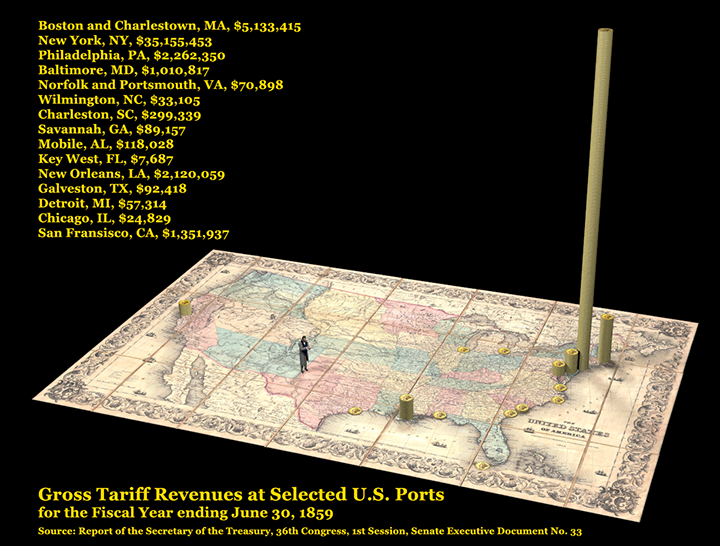
What do you suppose would happen to the economy of New York if 80% of that New York pile was moved over to Charleston S.C. ?
There is no constitutional requirement to respect anti-slavery laws. There IS a constitutional requirement for Free states to recognize slave laws.
This is the sort of deal, that if you don't like it, you don't agree to it.
Requiring slave owners to abide by anti-slavery laws is an obvious infringement upon the rights which ARE written in the Constitution. You cannot forbid a man from traveling, and you cannot forbid him from bringing his slaves into a "free state."
According to the law of the time, they belonged to him, not the state or the people in the state.
A correct reading of the law during that time period offers NO SUPPORT for free states to ban slavery. None.
They can decree that people subsequently born in their states cannot be slaves, but they can do nothing to stop people from bringing in slaves born in other states.
It would have required a constitutional amendment to accomplish that.
In fact, Washington conscientiously followed the letter of Pennsylvania's anti-slavery laws by cycling his slaves in and out within the allowed time period.
You do realize that what you have said is an utter contradiction of your point? He "Flaunted" their laws by "cycling his slaves in and out within the allowed time period."
This is what we call a "loop hole" big enough to drive a truck through. The bottom line is this. Washington maintained slaves in Pennsylvania after Pennsylvania had banned slavery.
Boy irony is lost on you.
Are you slow?
Your point has everything to do with cotton, because without cotton, the South had no trade -- none, nada.
By 1860, without cotton the South was a backwater agrarian economy, self-sufficient enough to not need trade, as indeed it became during the Civil War.
In 1860, if you take away cotton, the South had nothing economically, was nothing and certainly no economic threat to the North.
Of course, if you wish to fantasize a tariff war between Confederacy & Union, with each side lowering their tariffs to beat out the other, fine.
But Northern trade was so much greater that Southern -- especially if you discount cotton -- that the Union could well generate higher revenues on lower tariff rates than the Confederacy.
As for the potential that Charleston might exceed New York in size, well, you need only consider the two cities today.
Today, Charleston's metropolitan area is ranked 76th in the nation, at 712,000 people, while the New York metropolitan area is first, at 23 million.
Conclusion: given free and fair competition, New York still does well economically.
Bottom line: your argument assumes that cotton was the only thing the United States had to sell abroad in 1860.
The reality is that while at 53% cotton was certainly important economically, it was far from the only product exported.
And indeed, during the Civil War, when cotton was virtually eliminated from the Union economy, Northern states and the Federal government quickly adjusted to find other means of livelihood.
DiogenesLamp: "Taking trade away from New York, Boston, Philadelphia, and to a lesser extent Chicago, would have dealt a massive financial blow to the New England region."
But that's exactly what did happen during the Civil War, as a result of which Northern states made necessary adjustments, emphasizing manufacturing, and came out of the war more prosperous and dominant than ever.
With Southern ports charging far less in tariffs for imports, All the traffic from Europe would have gone South to avoid the Northern city tariffs.
The US Would have been supplied with European goods going through the Southern ports instead of New York, Boston and Philadelphia.
Cotton would be the trigger that started the trade, but eventually the trade would have built to the point that it eclipsed the cotton trade.
Bottom line, an Independent South was a financial disaster for the Monied people in New England. Utter disaster. So of course they directed their obligated President to do something about it. They left the politics and image shaping to him, and he was a master at it.
No, in fact, the Constitution authorizes Congress to control, or abolish, the international slave trade, and Founders themselves also outlawed slavery in what were then called "western territories".
So any suggestion that Congress had no authority over slavery is just bogus.
As for Northern anti-slavery laws, there was no suggestion in our Founders' time -- none, nada -- that states had no right to abolish slavery.
So the Supreme Court's 1857 Dred Scott decision to the contrary was new law, and therefore unconstitutional.
That makes your argument here totally bogus to the max.
DiogenesLamp: "A correct reading of the law during that time period offers NO SUPPORT for free states to ban slavery. None."
Except that nobody in 1787 or anytime later, asserted what you now ludicrously proclaim.
Your logic is based solely on the Supreme Court's 1857 Dred Scott decision, not on Founders' original intentions.
DiogenesLamp: "The bottom line is this. Washington maintained slaves in Pennsylvania after Pennsylvania had banned slavery."
But only within the limits allowed by Pennsylvania law.
Disclaimer: Opinions posted on Free Republic are those of the individual posters and do not necessarily represent the opinion of Free Republic or its management. All materials posted herein are protected by copyright law and the exemption for fair use of copyrighted works.