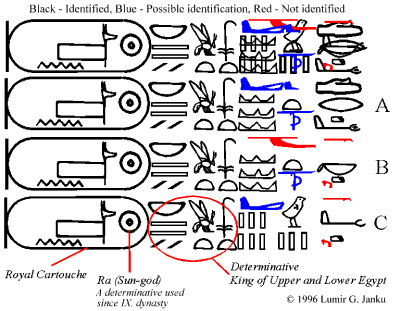
The first image is 'cleaned up' and the actual thing looks like this: 
":..., I am afraid that you have been subjected to the famous "Abydos helicopter" mania, here. There is a simple explanation to what you are seeing, at least, as we see it in Egyptology. There is no mystery here; it's just a _palimpsest_ (though without the use of that term, and which is defined as "... A manuscript, typically of papyrus or parchment, that has been written on more than once, with the earlier writing incompletely erased and often legible" AHED). It was decided in antiquity to replace the five-fold royal titulary of Seti I with that of his son and successor, Ramesses II. In the photos, we clearly see "Who repulses the Nine Bows," which figures in some of the Two-Ladies names of Seti I, replaced by "Who protects Egypt and overthrows the foreign countries," a Two-Ladies name of Ramesses II. With some of the plaster that once covered Seti I's titulary now fallen away, certain of the superimposed signs do indeed look like a submarine, etc., but it's just a coincidence.
What is happening in the photographs is quite clear; just consult Juergen von Beckerath, Handbuch der aegyptischen Koenigsnamen, Muenchner aegyptologische Studien 20, pages 235 and 237.
This issue comes up from time to time on such academic e-mail lists as the Ancient Near East (ANE) List and so on, so we're all pretty familiar with it. Regards. Katherine Griffis-Greenberg" Member, American Research Center in Egypt International Association of Egyptologists University of Alabama at Birmingham Special Studies