
YouTube transcript reformatted at textformatter.ai *may* follow.
I don’t study Rome but it is clear to me that a kid who is a heavy reader could get hooked on learning about Rome and spend the rest of his life deeply immersed in reading about Rome as the dominate subject of his personal reading and book collecting, it would easily fill a lifetime hobby of nighttime reading, or a PHD career and never get boring or short of more exciting information, or entertainment for pleasure reading.
They have used a term for centuries......
The Roman Arch.
It is so stable that many are still standing in not only buildings, but aqueducts.
Their roads are another engineering marvel.
Of course African slaves were the source of this knowledge as well as the labor that built it while being raped by greasy Italians.
Here's a video of rain in progress:
https://www.youtube.com/watch?v=73vEsV9nvmw
FF to about 4 minutes for the rain.
The shape does create a 'mist' effect that tends to cause raindrops to break up as they fall but the building was engineered knowing the rain still would get through. The floor is slightly crowned from the center to the perimeter, causing water to run away from the middle of the building. And there are 20-odd discretely camouflaged drains around the perimeter so there's very little puddling.
There is a monument to the Yankee soldiers from Illinois in the Vicksburg National Military Park that is a scaled-down replica of the Pantheon. It has an oculus in its dome, and the locals there also perpetuate the myth that it doesn't rain through the hole, but it does there, too.
https://en.wikipedia.org/wiki/Illinois_Memorial
Summer is the driest part of the Roman year so there's limited opportunity for the bulk of tourists to see for themselves.
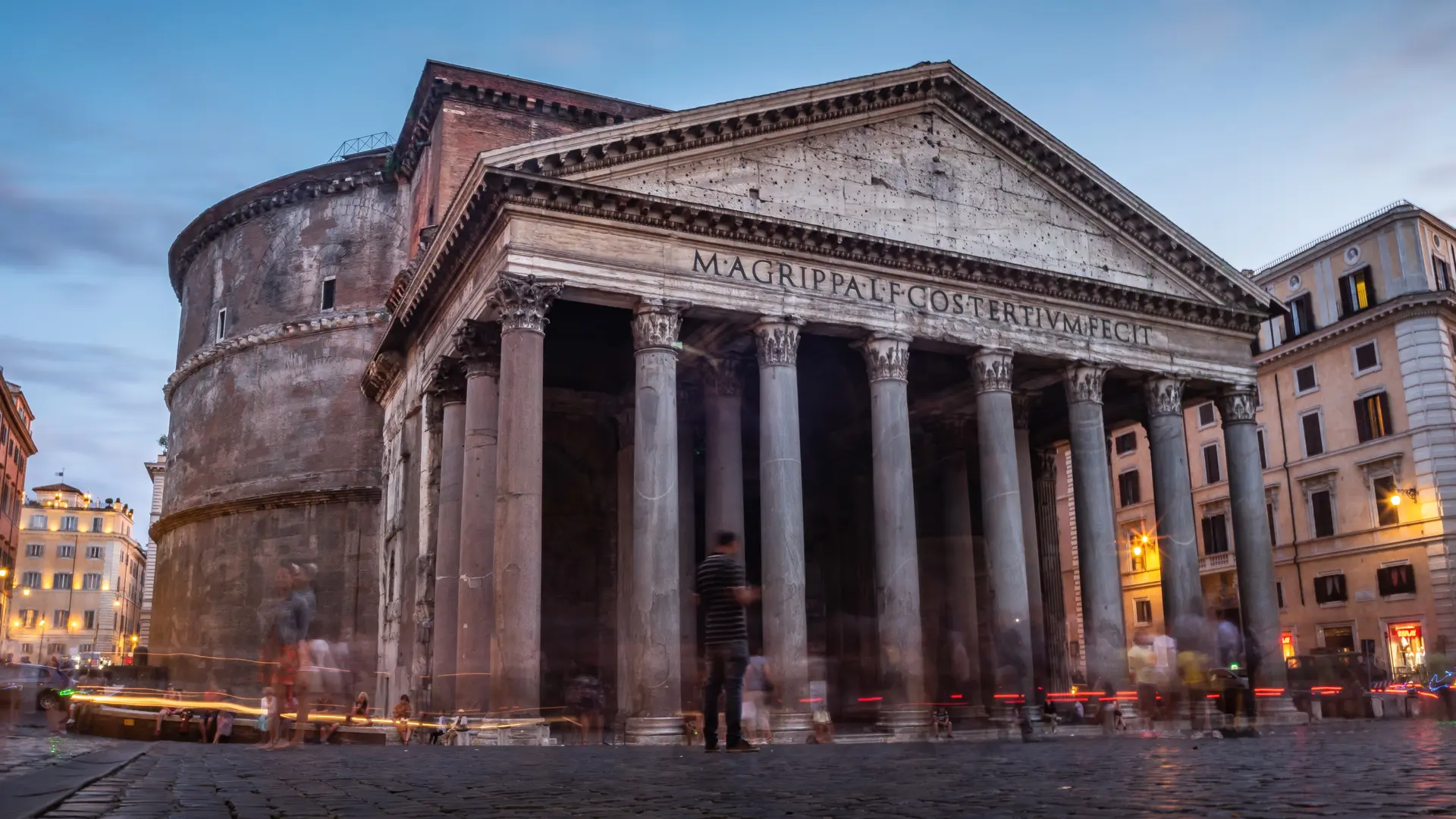
To me, a greater mystery than the self-healing concrete is why the pediment over the portico is 10 feet lower than intended.

On the wall above and behind the pediment you can see where it originally was intended to come to. It mirrors the pitch of the roof on the pediment but there's no roof there, so something's obviously not right.
All anyone knows for certain is the columns there now are about 10 feet too short. They're made from Egyptian marble that would have come by boat across the Mediterranean so theories range from a simple engineering foul-up to the ship carrying the original columns being lost at sea. In any case it would have taken months to get proper replacements so they might have grabbed whatever columns were handy and made do with 10 feet too short.
RE: the inscription on the portico, it reads: M⸱AGRIPPA⸱L⸱F⸱COS⸱TERTIVM⸱FECIT
As it means in highly abbreviated Latin: Marcus Agrippa Lucii filius consul tertium fecit
What it means in English: Marcus Agrippa, son of Lucius, [during his] third term [as] consul did [made] this