Posted on 07/11/2026 2:46:44 PM PDT by MtnClimber
Anti-fascism in Germany has changed from a militant fringe concern into the moral common sense of its educated middle classes. One consequence of this is that the label ‘fascist’ now makes violence less objectionable.
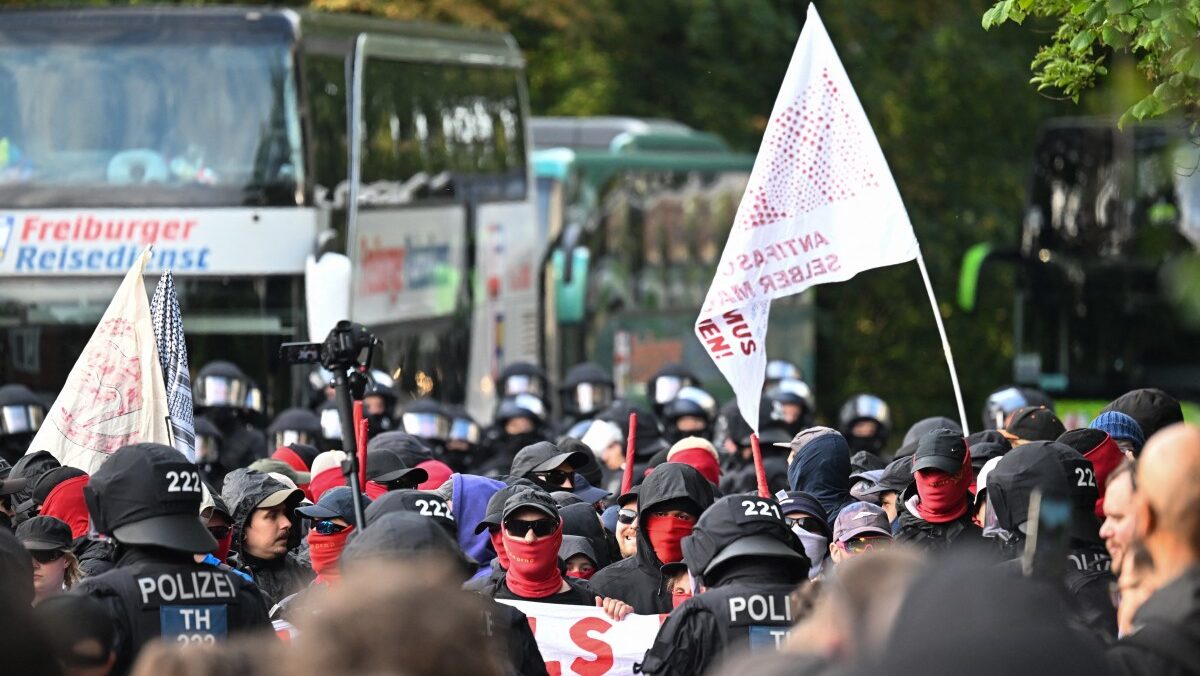
Far-left demonstrators face police in Erfurt, eastern Germany on early July 4, 2026, during a protest march against the party congress of Alternative for Germany (AfD). RALF HIRSCHBERGER / AFP.
At the protests against the Alternativ für Deutschland’s (AfD) party conference in Erfurt last weekend, a reporter for Apollo News was chased through the crowd and kicked in the head. He suffered a bloody wound. The next day, representatives of the anti-AfD alliance ‘Widersetzen’ were asked repeatedly if they condemned the attack. Initially they refused. Eventually, one activist replied: “Fascists with a press pass are still fascists.”
This was not any old Antifa gathering. Tens of thousands of people had come to oppose the AfD, with varying degrees of direct and indirect state funding. The German Trade Union Confederation (the DGB) mobilised, alongside a broad network of unions and civil society groups. An official Bundestag response to the event listed more organisations involved in the mobilisation, documenting substantial federal grants to several of them, albeit for other work. For example, MOBIT (Mobile Beratung in Thüringen e.V.)—a prominent German civil society NGO fighting right-wing extremism, racism, and antisemitism—received about €1.1 million across the listed period; NaturFreunde Thüringen more than €2 million across several programmes. The government denies funding Widersetzen’s Erfurt campaign. Nevertheless, the point is not that Berlin paid for a journalist to be kicked in the head; it is that the respectable anti-AfD movement rests on an ecosystem of unions, NGOs, and campaign groups, parts of which are publicly funded.
Political thugs are nothing new. What is new in this case is the social context and justifications of their thuggery. Anti-fascism in Germany has changed from a militant fringe concern into the moral common sense of its educated middle classes. One consequence of this is that the label ‘fascist’ now makes violence less objectionable.
nderstandably, anti-fascism has a unique meaning and cultural value in Germany’s postwar history. The anti-fascism of the 1968 generation at least had a real historical object. Young Germans confronted parental silence and institutions in which men with genuine Nazi biographies still held positions of authority. ‘Never again’ arose in a society where the Nazi past was still present in families, professions, and public life. The continuities were real, including the return of former Nazi functionaries to politics, administration, business, the military, police, and judiciary.
But while the historical situation slowly changed, the moral imperative remained. ‘Never again’ became more than a warning. It became a way, if not the way, of being German. In Germany’s peculiar version of identity politics, the most powerful identity has been anti-fascist. The educated classes have increasingly defined themselves through distance from the national past. To be a good German is to be the German who has learnt the correct lesson.
Europeanism, multiculturalism, suspicion of national identity, and progressive ideas about migration and minority rights came to be treated not simply as political positions but as signs of democratic virtue, precisely because they were the most potent and deliberate counterpoint to fascist values. Even President Frank-Walter Steinmeier has warned that Germany cannot explain itself only ex negativo, only through ‘never again.’
Jürgen Habermas’s concept of constitutional patriotism belongs to this history. It offered a serious answer to a post-war problem: how could Germans develop political attachment without returning to a compromised nationalism? Loyalty could be directed towards democratic constitutional principles rather than ethnic inheritance. But over time, the distinction between loyalty to a constitution and loyalty to a worldview, in this case a world view of Germany’s post-national establishment, became blurred.
What is often less drawn out in this history is the class element. Much of the nominal Left in Germany is no longer an opposition to a dominant political class. Rather, it provides its staff members. The old Left argued about wages, ownership, work, and class power. The new educated Left is strongest in universities, media, cultural institutions, NGOs, the trade-union bureaucracy, and the public sector. It has exchanged material conflict for moral management.
Anti-fascism is one of the ways this managerial class recognises and justifies itself. Research into the large anti-right protests of 2024 found that the participants were disproportionately highly educated, left of centre, and likely to identify with the middle or upper-middle class. The electoral split is equally revealing. In the 2025 federal election, the AfD took 29% among voters with lower educational qualifications and 13% among the highly educated; for the Greens, the figures were 4 and 18%.
This divide is not about qualifications but rival forms of belonging. The educated, institutional class has learnt to identify with Germany through repudiating old-style Germanness. Its patriotism is constitutional, post-national, and European. It has little patience for the unembarrassed patriotism of those who identify more directly with Germany as a nation, with borders, inherited culture, and the right to decide who enters. Such attachments are treated as morally suspect.
This is one reason why arguments over immigration and borders are so explosive. They are not treated as disputes over numbers, wages, housing, sovereignty, or social trust. Instead, they become tests of moral character. To insist that Germany is a nation-state with a right to preserve political and cultural boundaries is heard by a class formed around the idea of ‘never again’ as the first echo of something darker.
The German obsession with ‘Haltung‘ captures this perfectly. The word means stance or posture, but in political life it now means showing that one stands on the correct side. Institutions are urged to ‘show Haltung.’ The term allows moral positioning to replace political argument. One no longer has to ask whose interests are served, what a policy costs, or whether voters consent. One demonstrates virtue.
The EU is the natural home of this outlook, with its post-national political order in which conflicts over class, borders, and sovereignty are translated into the language of values, rights, inclusion, and resilience. For example, the European Commission’s CERV programme explicitly funds civil-society organisations to promote ‘EU values’ and speaks of an ‘empowered civil society’ built around common values, history, and memory. National identity is discreetly avoided.
This is an ideal political world for a class that no longer sees itself as a class but imagines itself above narrow national interests and material conflicts. Borders have become morally embarrassing, national loyalty provincial, and demands for democratic control dangerous. From this standpoint, the people most attached to the nation-state can easily be cast as the people from whom democracy must be protected.
The AfD’s great offence is that it refuses this position, this Haltung. It challenges the consensus on migration, nationhood, Europe, and identity. Conveniently for the established parties, disagreement with this consensus can easily be recast as hostility to the constitutional order. While the overblown rhetoric around the AfD is of a fascist takeover, the legal picture is much less clear. This February, the Cologne Administrative Court stopped the domestic intelligence service from treating the AfD as a right-wing extremist organisation because the evidence had not established that any tendencies, such as they are, defined the party as a whole.
Erfurt showed where the more or less deliberate confusion can lead. Widersetzen had openly set out to prevent a lawful party conference. Afterwards, it declared: “We are implementing the AfD ban on the street today.” While the constitutional order had not banned the party, the activists had decided to act as though it had.
German history supplies Widersetzen with their veneer of moral self-justification. From this perspective, fascism must be stopped before it takes power. The great sin is to wait, look away, and become the bystander. Once an opponent has been classified as fascist, legal procedure begins to look like foot-dragging complacency. This explains the particular response to the attack on the Apollo News reporter. The activist from Widersetzen did not deny that a man had been kicked in the head, choosing instead to change the status of the victim to one with less moral respectability and caché. A ‘fascist’ was not entitled to concern.
Germany’s educated classes are wilfully blind to this danger of this position. Anti-fascism is too ingrained in their own self-image, and how they know themselves to be democratic. Blocking meetings, excluding elected representatives, or banning a major opposition party can all be experienced as acts of democratic virtue once the opponent has been placed outside democracy.
That is the bitter end of Germany’s anti-fascist identity. A class that abandoned the left-wing politics of material interests now claims moral authority over those who still identify with nation, borders, and inherited belonging. It calls their authority democracy. When the people outside this class are labelled fascists, they become fair game.
Erfurt should be a warning. A journalist was kicked in the head. The people asked to condemn it chose to cast aspersions over what kind of person he was. Germany has spent 80 years teaching itself that dehumanising political categories are dangerous. It should be alarming that ‘fascist’ is now becoming one of these dehumanising categories itself.
The left seems to be growing in their confidence that they can crush conservatives.
Texas Eagle
The anti-fascists are not. They are.
You are not wrong.
Exactly
Antifa = Communist = Nazi
It’s a continuum. Same in the USA.
Red Army Faction II
« The left seems to be growing in their confidence that they can crush conservatives. »
As they did in Germany in the 1920s. Constitutional republicanism was no match for the KPD and antifa.
We are not really working on the problem yet. As one of Obama’s heroes said, « people will follow the strong horse ». Right now the DSA and antifa are winning in the streets where this will be decided.
Remember that the official name of the Berlin Wall that imprisoned the East Germans was the “Anti-Fascist Protection Rampart”. Those attempting to defy the “anti-fascists” will be gunned down in their tracks and fed to the dogs.
“When Fascism returns to Germany it will be in the form of anti-Fascism.
Texas Eagle”
____________________________________________________________
It’s already there in the form of AfD. The USA should also have a Constitutional office to protect the republic from fascists and communists.
The left does not obey the law. It seems that conservatives will lose if they don’t realize that they are fighting against being lined up against the wall and fight for their life, laws be damned. Or have a strong horse that prosecutes all of the leftists. Those seem to be the only two choices to stop communism. And I don’t see any prosecutions.
The number of antifas that show up in the streets is an insignificant number compared to those who hate them… For now most sane people dont waste their time marching down streets to fight idiots with rainbow flags.
“The number of antifas that show up in the streets is an insignificant number compared to those who hate them”
But that is irrelevant. This is about power, not popularity.
No surprise here. Give up God and you’re given over to your own futile mind.
Romans 1:21-22
They project power amplified by the media but they are empty
Disclaimer: Opinions posted on Free Republic are those of the individual posters and do not necessarily represent the opinion of Free Republic or its management. All materials posted herein are protected by copyright law and the exemption for fair use of copyrighted works.