Know your Nautical Terminology
We continue our new series of items highlighting with humanity's early exploration of Earth's oceans, lakes, and rivers and leading to the use of watercraft for transportation and commerce. This month I introduce the devices that allowed the finding of latitude.
The initial attempt at measuring latitude was the Astrolabe. It is thought to have originated with Hipparchus (c. 150 BCE) or Apollonius (c. 240 BCE). The version developed by Arabs around the 7th–10th centuries was more reliable. The mariner’s astrolabe (a simplified version) emerged for sea use around the late 13th–15th centuries. It measured the altitude of the Sun or stars using a suspended ring or disk with sights and a scale; a plumb bob helped establish the vertical. It was useful but challenging on a rolling ship. The REAL reason pirate captains are depicted as wearing an eyepatch was from staring into the sun taking noon sights over the years.
The 14th through the 16th centuries saw the development of the Quadrants, Cross-Staff, and Backstaff.
* Quadrant (mariner’s quadrant): A quarter-circle instrument (wood or brass) in use by around 1450, with roots in earlier astronomical versions from the 9th century. It measured angles via sights and a plumb line. Popular with Portuguese explorers in the 1400s but unstable at sea.
* Cross-staff (Jacob’s staff): Described in 1342 by Levi ben Gerson. It used a staff and sliding crossbar to align a celestial body with the horizon. Accurate but required viewing two points simultaneously and looking directly at the Sun.
* Backstaff (Davis quadrant): Invented c. 1595 by John Davis. Allowed the user to face away from the Sun, using its shadow aligned with the horizon. A significant improvement for solar observations.
These tools primarily enabled latitude determination (e.g., via the Sun at noon or Polaris at night) but were limited by ship motion, direct Sun glare, and the need for separate sightings.
The 17th through the 18th centuries saw the introduction of reflecting instruments leading to the Sextant.
* Isaac Newton developed ideas for a double-reflecting instrument around 1699 (unpublished). Robert Hooke proposed related designs in 1674.
* The Octant (reflecting quadrant) was independently invented around 1730 - 1731 by John Hadley (English) and Thomas Godfrey (American). It used two mirrors to superimpose the image of a celestial body onto the horizon, allowing simultaneous viewing. This was far more practical on a moving ship. The name comes from its 45° arc (1/8 of a circle). It largely replaced earlier tools by the late 18th century.
* The Sextant: evolved directly from the octant. John Bird produced the first practical sextant in 1757 - 1759 (with a 60° arc, 1/6 of a circle, allowing measurements up to 120°). It was developed to support the lunar distance method for longitude (measuring angles between the Moon and other bodies). Captain John Campbell is sometimes credited with suggesting the expansion to 60°. The sextant offered greater range and precision.
The double-reflection principle (mirrors) was the key innovation, solving the problem of simultaneous horizon and celestial sightings amid ship motion.
This solved the problem of the determining latitude and the altitude of celestial bodies. It only remained for determining longitude to enable full celestial navigation.
Next month I will discuss the finding of longitude. Then we can discuss the dark art of Celestial Navigation.
The Hadley Quadrant _-_(MeisterDrucke-197058).jpg)
An Octant from the Royal Museums Greenwich 
The modern Sextant showing its parts 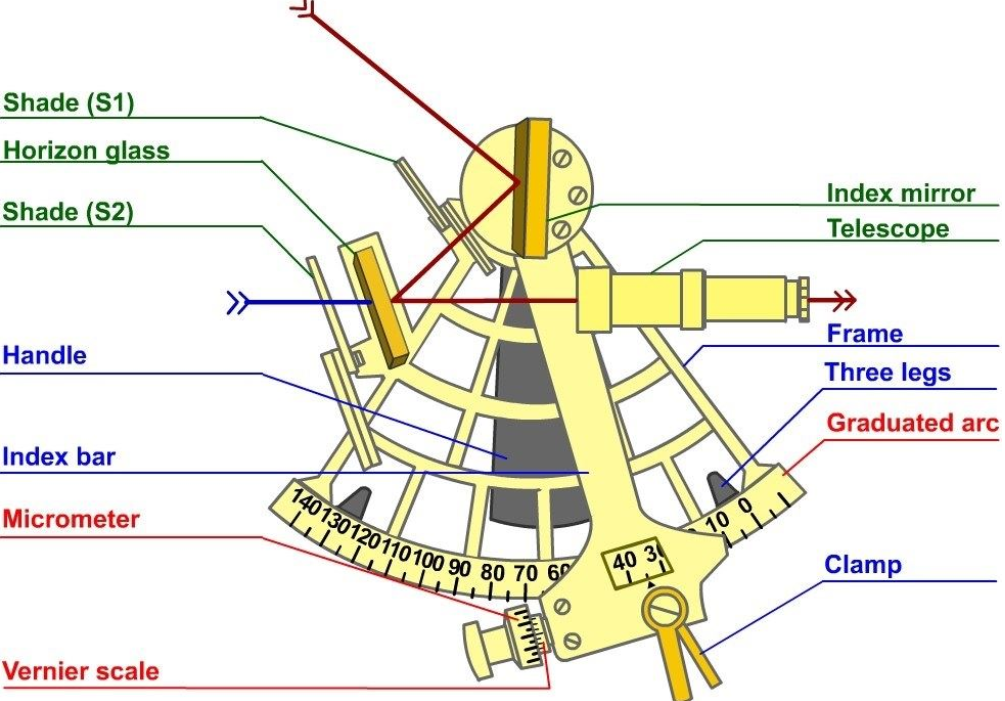
SpyNavy
Garde la Foi, mes amis! Nous nous sommes les sauveurs de la République! Maintenant et Toujours!
(Keep the Faith, my friends! We are the saviors of the Republic! Now and Forever!)
LonePalm, le Républicain du verre cassé (The Broken Glass Republican)