Free Republic
Browse · Search
General/Chat
Topics · Post Article

To: Axenolith; little jeremiah
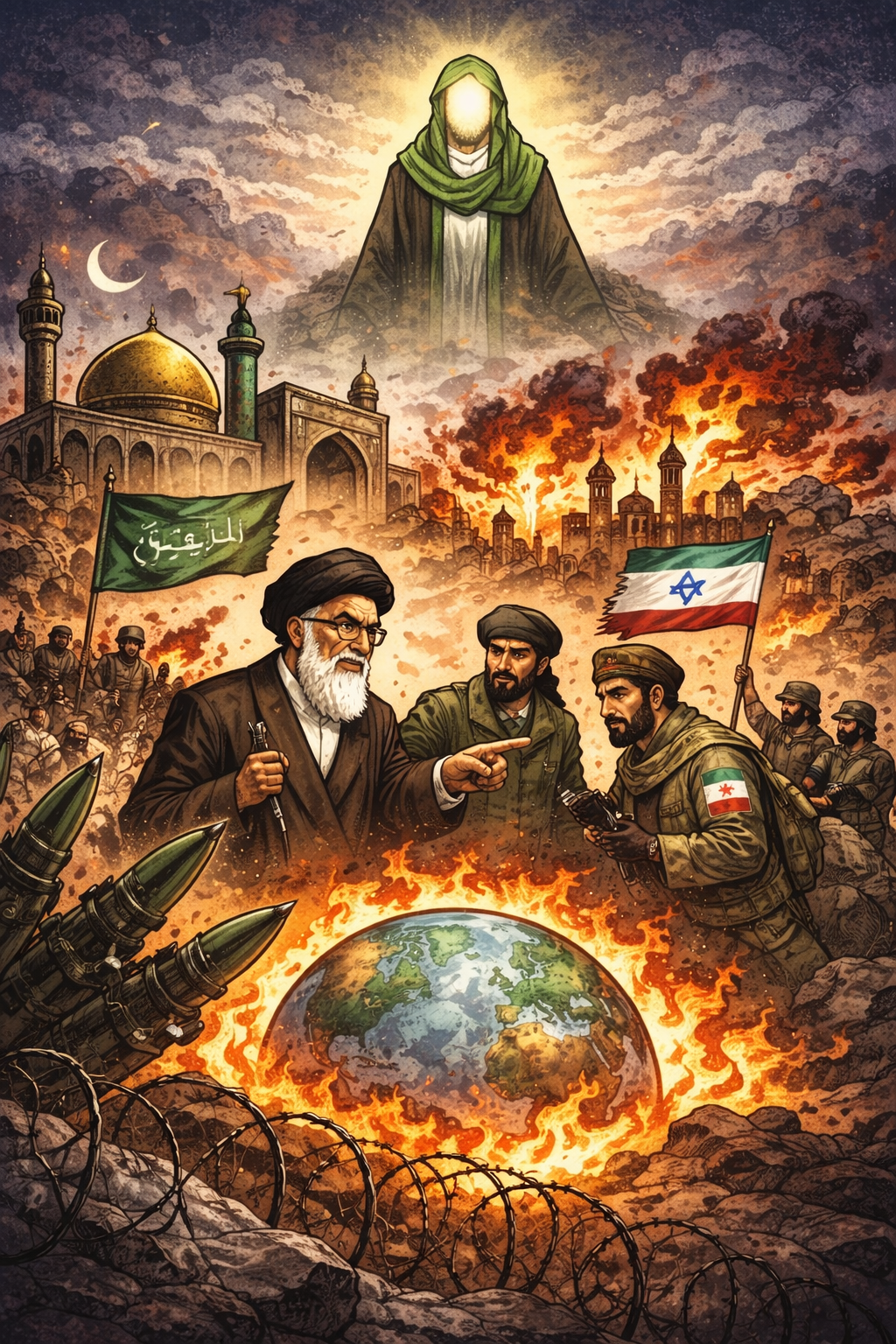
***Don’t forget that their flavor of islam is apocalyptic, their final prophet is supposed to arrive in the flames of destruction***

Excellent! Right now the Mullahs could well be saying that 'this is the time' ... now the Mahdi is expected to rise from his well, appear and set the world straight. Quite possible such a person will appear now.

I have posted recently that the nature of this 'spiritual' warfare is that the enemy wants to try to take control of the 'apocalypse' and have it turn out their way - rather than the way expected by Jews and Christians as per the Bible.

This scenario - an excuse for the Mahdi to appear - may be exactly what has been building. Prez Trump has said that he expected Iran to emerge as the aggressor and attack first. His actions now would not change Iran's {Shia} expectations.

If the Mahdi does 'appear' it is just a ploy to try to convince Islam that they should unite and defeat the infidels. - - - An interesting time! ❗

552 posted on 03/03/2026 12:00:23 PM PST by Bob Ireland (The Democrap Party is the enemy of freedom.They use all the seductions and deceits of the Bolshevics)
[ Post Reply | Private Reply | To 410 | View Replies ]


To: Bob Ireland
I used to have a good article saved about the Shia "Twelver" ideology, but can't find it. So I searched and found some info. It is of course totally diabolical. In short, they think that once the world is conquered, then th Mahdi appears.

Twelver Shiism, the Hidden Imam, and the Revolutionary Use of Eschatology in Iran

Islam divided into Sunni and Shia branches over succession after the death of Muhammad. Sunnis grounded leadership in communal selection. Shia grounded it in divinely appointed lineage through Ali and a line of Imams. Over time, this developed into a theological system centered on sacred authority transmitted through bloodline.

Twelvers, the largest Shia group, believe twelve Imams were appointed through Muhammad’s lineage. The twelfth, Muhammad al-Mahdi, entered occultation in the ninth century and remains alive but hidden. He will return to establish global justice and rule decisively over the world.

Occultation and Sovereignty The doctrine of occultation creates a structural tension. If the only fully legitimate ruler is absent, what authority can any government claim? For centuries, clerics limited themselves to jurisprudence and religious guidance while political rulers operated without claiming divine infallibility. That restraint ended in the twentieth century.

The Constitutionalization of Guardianship Ruhollah Khomeini argued that the Imam’s absence did not suspend divine governance. He asserted that qualified jurists must rule as deputies of the Hidden Imam until his return. This doctrine, Velayat-e Faqih, transformed clerical authority into political sovereignty.

After 1979, this interpretation became constitutional law. The Supreme Leader governs not merely as a political head of state but as steward of the Islamic Revolution and representative of the Hidden Imam. The regime’s legitimacy is explicitly theological.

Apocalyptic Expectation as Political Resource Twelver hadith literature describes the period before the Mahdi’s return as marked by severe injustice, violent upheaval, and widespread bloodshed. Many narrations speak of large-scale conflict in the Middle East and dramatic confrontation preceding the establishment of global justice. The Mahdi’s arrival is portrayed as forceful intervention that overturns existing political orders.

Those themes provide a powerful reservoir of imagery. When a regime defines itself as guardian during the occultation, apocalyptic expectation becomes politically useful. Instability can be framed as prelude. Conflict can be cast as purification. Endurance under pressure becomes participation in sacred history rather than evidence of failure.

Leveraging Sacred Narrative The Islamic Republic repeatedly frames its struggle in theological terms. Resistance to Western pressure is cast as moral duty. Hostility toward Israel is framed as alignment with ultimate justice. Sacrifice, whether economic or military, is presented as fidelity to the revolution and preparation for a divinely ordered future.

This does not require leaders to openly declare they seek chaos. It requires only that confrontation and hardship can be absorbed into a sacred narrative that promises ultimate vindication. That framing strengthens ideological cohesion and reduces internal pressure to normalize relations or abandon revolutionary posture.

Conclusion Twelver Shiism teaches that history culminates in the return of the Hidden Imam to establish global justice through decisive intervention. The Islamic Republic has embedded that expectation into its governing structure and uses its imagery to reinforce revolutionary legitimacy. By leveraging apocalyptic themes, Iran’s leadership turns geopolitical struggle into theological mission. Conflict is not merely strategic competition; it is framed as alignment with sacred destiny. Any serious analysis of the regime must account for how eschatological expectation is used to sustain confrontation, justify sacrifice, and preserve ideological control.

575 posted on 03/03/2026 1:30:11 PM PST by little jeremiah (SCARE: Social Chaos And Response Emergency)
[ Post Reply | Private Reply | To 552 | View Replies ]

To: Bob Ireland
Bob;

I was going to say that someone should send a missile down the Jamkran well where the 12th Imam is thought by some Shia to be alive and hidden waiting for the proper time to return, but I wandered around the Wikipedia articles on Qom and the 12 Imam and thought better of it. (Leave it to Christ to resolve.)

Brave search gives this regarding the 12th Imam

"Muhammad al-Mahdi, the 12th Imam, is a central figure in Twelver Shia Islam, believed to be the final Imam in a line of twelve successors to the Prophet Muhammad. He is also known as al-Mahdi ("the rightly guided"), Sahib al-Zaman ("Lord of the Age"), and al-Muntazar ("the Awaited One").

Birth and Lineage: Born in 869 CE (255 AH) in Samarra, Abbasid Empire, he is the son of the 11th Imam, Hasan al-Askari, and his mother, Nargis Khatoon.

Occultation: After leading his father’s funeral prayers at age five in 874 CE (260 AH), he disappeared from public view, marking the beginning of the Minor Occultation (874–941). This transitioned into the Major Occultation, which continues to the present day. Twelvers believe he is alive and hidden by divine will, not dead.

Current Status: Shia Muslims believe he is hidden in a secret location, often associated with the Jamkaran well in Iran, a site of pilgrimage where believers drop written requests for help. He is believed to be aware of all events and will reappear when the world is filled with oppression and tyranny.

Return and Role: According to Islamic tradition, he will reappear to establish global justice and equity, filling the earth with fairness after it has been filled with injustice. This event is tied to signs such as a green banner emerging from Khorasan and widespread global trials.

Sunni View: Unlike Twelver Shia Islam, Sunni Islam does not recognize the 12 Imams or the concept of a hidden Mahdi. They believe the leadership of the Muslim community (caliphate) ended with the last rightful caliph, and they do not anticipate a 12th Imam."

More info on the City of Qum.

Qom Iran

657 posted on 03/03/2026 6:21:33 PM PST by Pete from Shawnee Mission ( )
[ Post Reply | Private Reply | To 552 | View Replies ]

Free Republic
Browse · Search
General/Chat
Topics · Post Article


FreeRepublic, LLC, PO BOX 9771, FRESNO, CA 93794
FreeRepublic.com is powered by software copyright 2000-2008 John Robinson