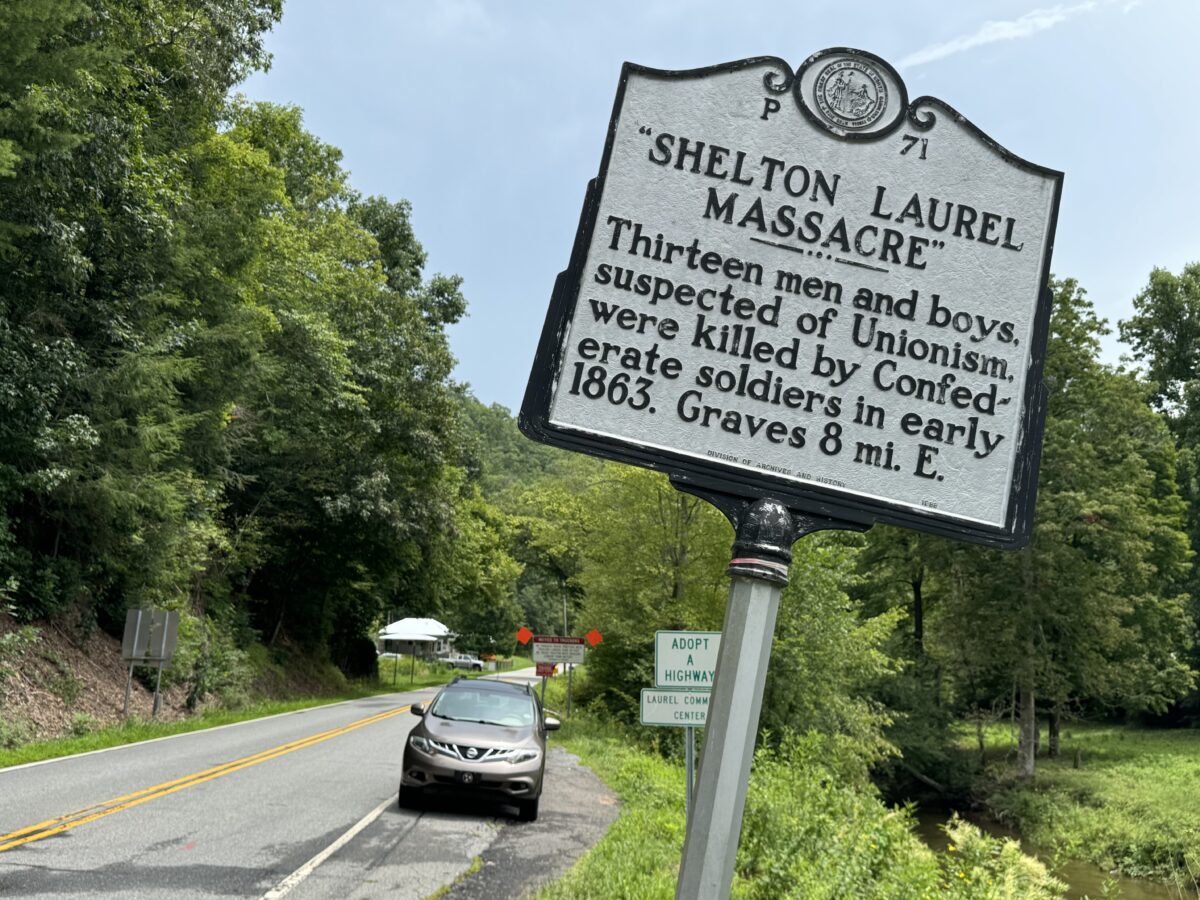
Your own East Tennessee is a perfect example. By the way, my parents met in college in East Tennessee in the 1930s. They married shortly after WWII, living in Philadelphia and New Jersey at the time. December 1861: Bridge Burners hanged in East Tennessee: East Tennessee in 1860 had few to zero slaves, only ~5% of East TN families owned slaves, compared to ~30% in West Tennessee. Two thirds of East Tennesseans voted against secession, even after Fort Sumter flipped the state from Union to Confederate. East Tennesseans tried to secede from Tennessee and set up their own Union state, similar to West Virginia. Some East Tennesseans conducted sabotage raids on Confederate military infrastructure. More East Tennesseans served in the Union Army (31,000) than in the Confederate army (~20,000). The CSA made a Department of East Tennessee, commanded by Major Gen. Kirby Smith & Brig. Gen. Henry Heth, to suppress rebellion in East Tennessee. CSA Gen. Smith declared East Tennessee, "an enemy's country". CSA Generals Smith & Heth imposed on East Tennessee: Martial law Suspension of habeas corpus Arrests and deportations of suspected Unionists Confiscations of suspected Unionist properties Acting like a military dictator, Smith jailed and deported suspected Unionists and vigorously enforced the CSA's April 1862 conscription act. January 1863: Shelton Laurel Massacre, Western NC: Confederate authorities in western North Carolina and East Tennessee increasingly treated Unionist civilians as enemies rather than protected noncombatants. This treatment included: Torture to extract information Summary executions Collective punishment of families These heavy‑handed measures succeeded in further provoking Unionists and spreading discontent, turning previously neutral East Tennesseans into enemies of the CSA. In January 1863, CSA Gen. Heth ordered the 64th North Carolina Infantry to "take no prisoners" in dealing with suspected Unionists in western NC. The result was the Shelton Laurel Massacre of civilians. Bottom line: Confederates who lived in regions with few to no slaves overwhelmingly supported the Union, opposed secession, the CSA and Confederate military service. These people were not treated well by Confederate authorities.East Tennessee is not the whole South. Its not even the whole South outside of the more heavily cotton producing areas. You seem to want to focus exclusively on East Tennessee.
You want to talk about oppression of civilian populations that were not supportive of the war? OK. We can do that. It was worse in the Union under Lincoln and afterwards under the Radical Republicans in Congress than it was in the Confederate states.
"Those who advocated the right of secession alleged in their own justification that we had no regard for law and that the rights of property, life, and liberty would not be safe under the Constitution as administered by us. If we now verify their assertion we prove that they were in truth fighting for their liberty, and instead of branding their leaders as traitors against a righteous and legal government, we elevate them in history to the rank of self-sacrificing patriots, consecrate them to the admiration of the works, and place them by the side of Washington, Hampden and Sidney." President Andrew Johnson on Radical Reconstruction
"Candor compels me to declare that at this time there is no Union as our fathers understood the term, and as they meant it to be understood by us. The Union which they established can exist only where all the States are represented in both Houses of Congress; where one state is as free as another to regulate its internal concerns according to its own will, and where the laws of the central Government, strictly confined to matters of national jurisdiction, apply with equal force to the people of every section." President Andrew Johnson 3rd annual message to the Union
"The man who stands by and says nothing when the peril of his Government is discussed cannot be misunderstood. If not hindered, he is sure to help the enemy; much more if he talks ambiguously — talks for his country with "buts" and "ifs" and "ands." (Collected Works of Lincoln, vol. 6, pp. 264—265.) You have to actively cheer for the tyrant....or you're a traitor.
One of those imprisoned for fourteen months for simply questioning the unconstitutional suspension of habeas corpus was Francis Key Howard, the grandson of Francis Scott Key and editor of the Baltimore Exchange newspaper. In response to an editorial in his newspaper that was critical of the fact that the Lincoln administration had imprisoned without due process the mayor of Baltimore, Congressman Henry May, and some twenty members of the Maryland legislature, he was imprisoned near the very spot where his grandfather composed the Star Spangled Banner. After his release, he noted the deep irony of his grandfather's beloved flag flying over "the victims of as vulgar and brutal a despotism as modern times have witnessed" (John Marshall, American Bastile, pp. 645—646).
After his release, Francis Key Howard wrote a book about his experiences entitled Fourteen Months in American Bastilles in which he described daily life as "a constant agony, the jailers as modified monsters and the government as an unfeeling persecutor which took delight in abusing its political prisoners" (Sprague, p. 284). In his defense and whitewashing of Lincoln's civil liberties abuses even Lincoln apologist Mark Neely, Jr., author of The Fate of Liberty, noted that in Fort Lafayette (aka “the American Bastille”) and in other dungeons where political prisoners where held, "Handcuffs and hanging by the wrists were rare [but not nonexistent], but in the summer of 1863 the army had developed a water torture that came to be used routinely" (p. 110) Repeatedly, whenever Congress asked for information on the arrests, he replied that it was not in the public interest to furnish the information (p. 302).
In May 1861 the New York Journal of Commerce published a list of 100 Northern newspapers that opposed the Lincoln administration. Lincoln ordered the Postmaster General and the army to shut them all down. May 18, 1864, Lincoln order that directly issued to General John Dix: "You will take possession by military force, of the printing establishments of the New York World and Journal of Commerce . . . and prohibit any further publication thereof . . . you are therefore commanded forthwith to arrest and imprison . . . the editors, proprietors and publishers of the aforesaid newspapers." For good measure, all telegraph communication in the North was censored as well.
"Davis . . . possessed the authority to suspend the writ of habeas corpus for a total of only sixteen months. During most of that time he exercised this power more sparingly than did his counterpart in Washington. The rhetoric of southern libertarians about executive tyranny thus seems overblown." (McPherson, The Battle Cry of Freedom, p. 435) Did you get that? That's chief PC Revisionist James McPherson admitting it!
"With the suspension of habeas corpus [the right not to be arrested without reasonable charges being presented], Lincoln authorized General Scott to make arrests without specific charges to protect secessionist Marylanders from interfering with communications between Washington and the rest of the Union. In the next few months, Baltimore's Mayor William Brown, the police chief, and nine members of the Maryland legislature were arrested to prevent them from voting to secede from the Union. . . . "Twice more during the war Lincoln suspended habeas corpus, including the suspension 'throughout the United States' on September 24, 1862. Although the records are somewhat unclear, more than thirteen thousand Americans, most of them opposition Democrats, were arrested during the war years, giving rise to the charge that Lincoln was a tyrant and a dictator." (Davis, Don't Know Much About the Civil War, pp. 182-183)
Lincoln won New York state by 7000 votes "with the help of federal bayonets," wrote Pulitzer Prize—winning Lincoln biographer David Donald in Lincoln Reconsidered.
The border states were systematically disarmed, and two "confiscation acts" were written into law in which any U.S. citizen could have all of his private property confiscated by the government for such "crimes" as "falsely exalting the motives of the traitors"; "overstating the success of our adversaries"; and "inflaming party spirit among ourselves." Informers who turned in their neighbors could keep 50 percent of their neighbors' property; the other half when to the U.S. treasury. In Constitutional Problems Under Lincoln James G. Randall painstakingly details all of these attacks on constitutional liberty, and more
According to a 2011 New York Times article, Seward supposedly told Lord Lyons, the British envoy, "My Lord, I can touch a bell on my right hand, and order the arrest of a citizen in Ohio. I can touch the bell again, and order the arrest of a citizen in New York. Can the Queen of England, in her dominions, do as much?".
"Fate has indeed taken a malignant pleasure in flouting the admirers of the United States. It is not merely that their hopes of its universal empire have been disappointed; the mortification has been much deeper than this. Every theory to which they paid special homage has been successively repudiated by their favorite statesmen. They were Apostles of Free Trade: America has established a tariff, compared to which our heaviest protection-tariff has been flimsy. She has become a land of passports, of conscriptions, of press censorship and post-office espionage; of bastilles and lettres de cachet [this was a letter that bore an official seal which authorized the imprisonment, without trial of any person named in the letter] There was little difference between the government of Mr. Lincoln and the government of Napoleon III. There was the form of a legislative assembly, where scarcely any dared to oppose for fear of the charge of treason." the Quarterly Review in Britain
How many were unlawfully arrested during the war? This is another area where historians disagree. The numbers vary greatly. One scholar, Alexander Johnston, writing in the 1880s, estimated it as high as 38,000. Other historians believe this to be exaggerated. Some estimates are around 14,000, which seems a bit low. It was more than likely in the 20,000-30,000 range. A major account of Lincoln’s prisoners was published in 1881, written by John A. Marshall, entitled American Bastille. In his work, he recounts dozens of stories of victims of these arbitrary arrests, including some of the most prominent targets of the Lincoln administration. It includes many from across the North, not just those residing in Border States.
“[The Lincoln administration] has destroyed a vast mass of property and happiness, and scattered to the winds the best hopes of the American people,” wrote the London Times. “The Republican majority in Congress … deserve a foremost place among those representatives of the people who from time to time have made themselves notorious in the history of the world by surrendering the liberties of their country into the hands of a dictator or tyrant…. The office of President, plain and republican as it came from the hands of the founders … is hardly recognizable beneath the mass of powers with which it is overlaid. The first citizen of the republic, the servant of the people, the head of an executive, exercising certain few and clearly defined powers, has become, by the treason of a legislature … the most absolute autocrat on earth.”
Of the situation in the North, Dean Sprague, author of Freedom Under Lincoln, wrote, “The laws were silent, indictments were not found, testimony was not taken, judges did not sit, juries were not impaneled, convictions were not obtained and sentences were not pronounced. The Anglo-Saxon concept of due process, perhaps the greatest political triumph of the ages and the best guardian of freedom, was abandoned.”
Lambdin P. Milligan, an Indiana lawyer, believed the South had every right to secede from the Union. The government accused him of joining an anti-government secret society, the “Knights of the Golden Circle,” which Washington claimed wanted to overthrow the government, and charged him with several offenses – “conspiracy against the government of the United States; affording aid and comfort to rebels against the authority of the United States; inciting insurrection; disloyal practices; and violation of the laws of war.” More specifically, Milligan had communicated with the enemy, conspired to seize munitions of war stored in the arsenals and liberate Confederate prisoners held in military prisons in Indiana, and resisted the draft. The military commander arrested Milligan in the fall of 1864 and brought him before a military commission, where he was convicted and sentenced to hang. The military had a presence in Indiana, as the war was still ongoing but the civil courts were still in operation.
One of the attorneys arguing on behalf of Milligan was James A. Garfield, future President of the United States. During his oral presentation before the Court, Garfield compared Lincoln’s policy with that in the Confederate States, where nearly all of the war had been fought. Despite the South’s “rebellion,” said Garfield, there was still in the minds of those men, during all the struggle, so deep an impression on this great subject, that, even during their rebellion, the courts of the Southern States adjudicated causes, like the one now before you, in favor of the civil law, and against courts-martial established under military authority for the trial of citizens. In Texas, Mississippi, Virginia, and other insurgent States, by the order of the rebel President, the writ of habeas corpus was suspended, martial law was declared, and provost marshals were appointed to administer military authority. But when civilians, arrested by military authority, petitioned for release by writ of habeas corpus, in every case, save one, the writ was granted, and it was decided that there could be no suspension of the writ or declaration of martial law by the executive, or by any other than the supreme legislative authority.