Skip to comments.
Solano Chronicles: Mare Island’s role in the history of Pearl Harbor attack
Vallejo Times Herald ^
| 12/04/2025
| Brendan Riley
Posted on 12/07/2025 5:49:21 AM PST by DFG
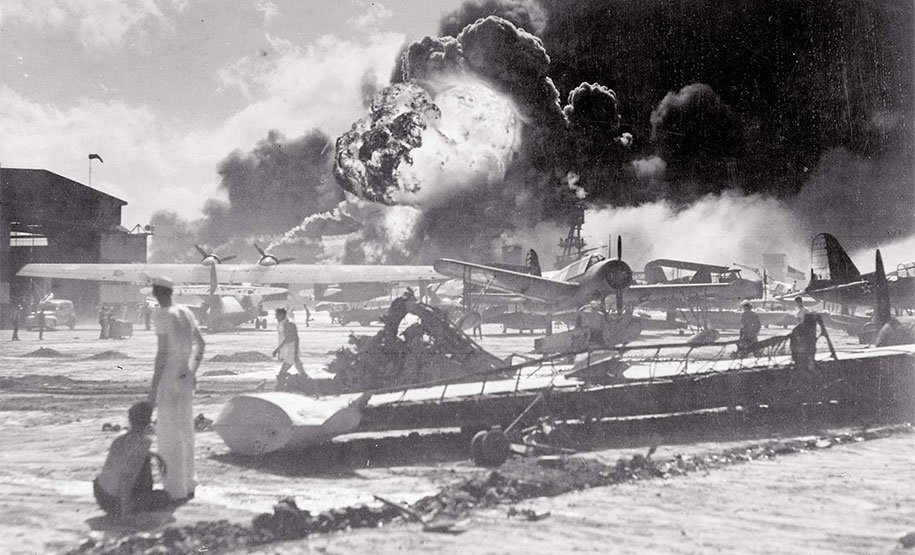
On Sunday morning, Dec. 7, 1941, powerful antennas on the Mare Island shipyard picked up an urgent radio-telegram meant for U.S. Navy ships operating 3,600 miles away near Hawaii – “AIR RAID ON PEARL HARBOR – THIS IS NO DRILL.” That was the first stateside word about the devastating surprise attack by Japanese warplanes.
The strafing and bombing started just before 8 a.m. Hawaii time, or 10:30 a.m. PST on Mare Island under the time zone system used in 1941. The radio message went out immediately from Pearl Harbor, and was relayed to top Navy brass in San Francisco by senior telegrapher Van Dayton, on duty in Mare Island’s communications office.
Less than an hour later, at 11:20 a.m. PST or 2:20 p.m. EST, President Franklin Roosevelt’s press secretary, Stephen Early, on a telephone hookup to Associated Press, United Press and International News Service offices in the nation’s capital, made the information public.
A flood of national news about Pearl Harbor followed, starting with bulletins from the three news services. That included an all-caps flash filed at 2:22 p.m. EST by AP editor William Peacock, who repeated Early’s disparaging term in common use to describe the Japanese – “WHITE HOUSE SAYS JAPS ATTACK PEARL HARBOR.”
The radio-telegram was sent on orders from Lt. Cmdr. Logan Ramsey, operations officer for the Pacific Fleet Air Wing at Pearl Harbor, after he witnessed one of the first Japanese planes flying in low to drop a bomb. At first, he thought it was a U.S. plane being flown by a reckless pilot, but then he heard the explosion of a delayed-action bomb.
Ramsey’s first radio message was followed by a second one, in the same all-caps format, that stated, “WE ARE AT WAR WITH JAPAN – THIS IS NO DRILL.” Then a third message arrived, ordering Mare Island to immediately initiate a war plan that had been prepared in advance and locked in a safe in a shipyard office.
Mare Island historian Dennis Kelly says that caused problems – the staffer who had the safe’s combination was vacationing at Lake Tahoe. A few hours later, a California Highway Patrol trooper showed up at the door of the man’s Tahoe cabin with orders to return at once to Mare Island and open the safe.
The attack by Japanese planes and submarines at the ill-prepared Pearl Harbor base resulted in more than 3,500 U.S. casualties, including 2,403 killed. Twelve ships sank or were beached, and nine other vessels were damaged. More than 180 U.S. aircraft were destroyed, and more than 150 others were damaged.
The following day, in an address to a joint session of Congress, President Roosevelt called Dec. 7, 1941, “a date which will live in infamy.” Congress then declared war on Japan, abandoning the nation’s isolationist policy and ushering the U.S. into World War II. Within days, Japan’s allies, Germany and Italy, declared war on the United States, and the country began a rapid transition to a wartime economy.
The attack on Pearl Harbor galvanized the nation, resulting in an overnight refocusing of all U.S. military, economic, industrial, and scientific activity. Work on Mare Island ratcheted up to a level never seen before or since. The day after the attack, crews started pouring cement for bomb shelters on Mare Island.
Soon, the Mare Island-Vallejo area was “bristling with anti-aircraft batteries” and “a herd of barrage balloons was tethered above the island, their purpose being to discourage attack by low-flying planes,” author Arnold Lott wrote in “A Long Line of Ships,” his book detailing Mare Island’s history.
Civilian shipyard employment soared to about 44,000 during the war, with workers coming from almost every state. Sailors, Marines, and Army soldiers arrived by the thousands, and Vallejo’s pre-war population of about 30,000 tripled.
A third of the wartime population lived in hastily constructed housing projects scattered around the city – projects that were filled as soon as they were built. Some workers slept in cars, on porches, in hallways, bathrooms, abandoned shacks, barns, garages, or even on the docks. About 300 buses went out in a radius of 75 miles six times a day to pick up workers who lived outside Vallejo.
Mare Island was a key part of a San Francisco Bay area shipbuilding complex that was the largest in the world. During the war, Mare Island workers built 17 submarines, 31 destroyer escorts, 33 assorted small craft, and 301 landing craft, and repaired more than 1,200 damaged vessels – including several ships damaged in the Pearl Harbor attack.
One of the vessels repaired at Mare Island was the USS Indianapolis, which left in mid-July 1945 on the most secret mission of the war – delivering components of “Little Boy,” the world’s first operational atomic bomb. The components were unloaded at the island of Tinian on July 26, 1945. Four days later, the Indianapolis headed to Leyte Gulf in the Philippines, was torpedoed and sank. Of the 1,196 men aboard the big cruiser, about 900 made it into the water. After almost five days of shark attacks, starvation, thirst and exposure, 317 men were rescued.
On Aug. 6, 1945, an American B-29 bomber dropped “Little Boy” over Hiroshima. The explosion immediately killed about 80,000 people. Three days later, a second B-29 dropped another A-bomb on Nagasaki, killing an estimated 40,000 people. Japan’s Emperor Hirohito announced his country’s unconditional surrender in an Aug. 15 radio address, and formal surrender documents were signed Sept. 2 aboard the USS Missouri in Tokyo Bay.
— Vallejo and other Solano County communities are treasure troves of early-day California history. My “Solano Chronicles” column highlights various aspects of that history. If you have local stories or photos to share, contact me on Facebook or at genoans@gmail.com.
TOPICS: History
KEYWORDS: 19411207; godsgravesglyphs; japan; pacific; pearlharbor; ussindianapolis; worldwareleven; ww2
Navigation: use the links below to view more comments.
first previous 1-20, 21-32 last
To: fso301
Also politics. Everyone knew war was coming, what was unknown was where and when. Kimmel and Short had warnings and should have had their submarines out on picket and aircraft in the air at dawn on patrol but they didn't.Even as total as the surprise was at Pearl, the Japanese still took significant losses and would probably have been badly mauled if the US forces had been on alert.
(The responsibility for the naval defense would have fallen to Admiral Kimmel.) (Yes, there should have been a picket line of ships and/or submarines in the waters around Oahu.)
The Japanese losses were a fraction (5%, actually) of the American losses.
It wasn't the losses that ended their attacks, nor was it the American response. They had more time than they themselves knew, so complete was their surprise and so off-guard were the Americans. The unknown was arguably the driving force in the decision to head home after two sorties.
In the end, the Japanese victory at Pearl Harbor may have helped seal their fate at Midway, as Japan left two carriers behind in their belief that four would suffice; had the American response to the attack been more vigorous, it is likely that the Japanese would have taken us far more seriously six months later and put all six carriers to sea for a second voyage across the Pacific.
21
posted on
12/07/2025 12:15:34 PM PST
by
Captain Walker
("Justice exalteth a nation: but sin maketh nations miserable." – Proverbs 14:34)
To: Captain Walker
(The responsibility for the naval defense would have fallen to Admiral Kimmel.) (Yes, there should have been a picket line of ships and/or submarines in the waters around Oahu.)Look at all the long range float planes sitting on the ground rather than fanned out hundreds of miles from Pearl on patrol.
The Japanese losses were a fraction (5%, actually) of the American losses.
Japanese aircraft losses were 29 or about 8.5 percent of the strike force.
At that rate, all attacking Japanese aircraft would be lost in 11 such attacks.
22
posted on
12/07/2025 12:42:55 PM PST
by
fso301
To: exnavy
For the squids on this thread, who could forget The Horse and Cow, the dive bar just off base.
23
posted on
12/07/2025 12:51:44 PM PST
by
power2
(JMJ)
To: power2
I do not remember that one.
24
posted on
12/07/2025 1:56:03 PM PST
by
exnavy
(See article IV section 4 of our constitution.)
To: Captain Walker
Didn’t someone in Washington deduce from intercepted Japanese diplomatic messages that an attack on Pearl Harbor was imminent and send a telegram, but because of it being a weekend there were delays and the message was delivered to the commander at Pearl Harbor after the attack had already started?
To: silent majority rising
My father was a Marine stationed at Mare Island on Dec. 7, 1941. He and a friend had gone to the mountains to cut down a Christmas tree in a vehicle that did not have a radio. My father’s parents lived in Sacramento so maybe the tree was for them. At some point on the return trip, maybe at his parents’ house, he learned about the attack and that they had to get back to Mare Island immediately.
To: StayAt HomeMother; Ernest_at_the_Beach; 1ofmanyfree; 21twelve; 24Karet; 2ndDivisionVet; 31R1O; ...
[snip] One of the vessels repaired at Mare Island was the USS Indianapolis, which left in mid-July 1945 on the most secret mission of the war – delivering components of "Little Boy," the world’s first operational atomic bomb. The components were unloaded at the island of Tinian on July 26, 1945. Four days later, the Indianapolis headed to Leyte Gulf in the Philippines, was torpedoed and sank. Of the 1,196 men aboard the big cruiser, about 900 made it into the water. After almost five days of shark attacks, starvation, thirst and exposure, 317 men were rescued.
On Aug. 6, 1945, an American B-29 bomber dropped "Little Boy" over Hiroshima. The explosion immediately killed about 80,000 people. Three days later, a second B-29 dropped another A-bomb on Nagasaki, killing an estimated 40,000 people. Japan's Emperor Hirohito announced his country's unconditional surrender in an Aug. 15 radio address, and formal surrender documents were signed Sept. 2 aboard the USS Missouri in Tokyo Bay. [/snip]

27
posted on
12/07/2025 5:49:54 PM PST
by
SunkenCiv
(Kudos to the Admin Moderator, reason: "Randspam" [ 4354167 ])
To: Verginius Rufus
Didn’t someone in Washington deduce from intercepted Japanese diplomatic messages that an attack on Pearl Harbor was imminent and send a telegram, but because of it being a weekend there were delays and the message was delivered to the commander at Pearl Harbor after the attack had already started? (While this doesn't directly answer your question, I have to point out as an aside that on 11/27/41, Kimmel had received a message from the Navy Department that began with the lines, "This despatch (sic) is to be considered a war warning. Negotiations with Japan looking toward stabilization of conditions in the Pacific have ceased and an aggressive move by Japan is expected within the next few days.")
The telegram you describe appears to pertain to the message sent by General Marshall to Pearl Harbor on 12/07/41 at 1300 EST/0800 HST that described a 14-part decrypted communiqué sent to Japanese diplomats in DC that they were to destroy sensitive codes and paper. This message from Japan was decrypted overnight from 12/06/41 until 12/07/41; instructions were given from the codebreakers to have it delivered at the time described (1300/0800). It has to be noted that the message sent to Hawaii was not an explicit warning of a specific attack, and it arrived minutes after the Japanese attack had commenced. It has to be noted as well that this communiqué was not delayed because of the weekend; it was sent via commercial cable, due to concerns about secrecy and delays.
(You would probably be aware that the military in Oahu was practically screaming for more raw intelligence, but the information that was being decrypted and processed back on the east coast was nothing more than noise; the military could forward it to Oahu, but without intelligence behind it, it would take the perfect reading of the evidence to piece together that an attack was coming at 0800 HST on 12/07/41. I have never come across any information that would indicate such a direct message warning of a Sunday AM attack had been sent [whether on time or tardy].)
28
posted on
12/07/2025 6:32:33 PM PST
by
Captain Walker
("Justice exalteth a nation: but sin maketh nations miserable." – Proverbs 14:34)
To: Captain Walker
US intelligence could not even hazard a guess as to where they might be, and the estimates were off by several orders of magnitude.Eggsactly!
Most war gamers predicted the attack would be in the Dutch East Indies, Philippines, or Australia, NOT Pearl Harbor. When it was discussed, most planners scoffed at the idea....to far....to complicated....
29
posted on
12/08/2025 5:51:21 AM PST
by
DCBryan1
(Inter arma enim silent leges! - Cicero )
To: Verginius Rufus
I think my Dad learned of it at Church or shortly after. He was 17 and had to have permission to join, which my Grandparents gladly signed for. But they were just Country folk, and that is what they all did.
30
posted on
12/08/2025 5:52:39 AM PST
by
silent majority rising
( United Israel - Judea, Samaria, and Gaza - US get out of the UN-we are not United with them.)
To: Verginius Rufus
I think my Dad learned of it at Church or shortly after. He was 17 and had to have permission to join, which my Grandparents gladly signed for. But they were just Country folk, and that is what they all did. He actually became a SeaBee because they were giving cash bonuses to join.
31
posted on
12/08/2025 5:54:03 AM PST
by
silent majority rising
( United Israel - Judea, Samaria, and Gaza - US get out of the UN-we are not United with them.)
To: fso301
Oh I see. So we should have waited until December 6 to put them out of harm’s way and alerting the Japs which is certainly something FDR did not want. How moronic.
Disinformation has been a part of warfare long before Pearl Harbor.
Navigation: use the links below to view more comments.
first previous 1-20, 21-32 last
Disclaimer:
Opinions posted on Free Republic are those of the individual
posters and do not necessarily represent the opinion of Free Republic or its
management. All materials posted herein are protected by copyright law and the
exemption for fair use of copyrighted works.
FreeRepublic.com is powered by software copyright 2000-2008 John Robinson