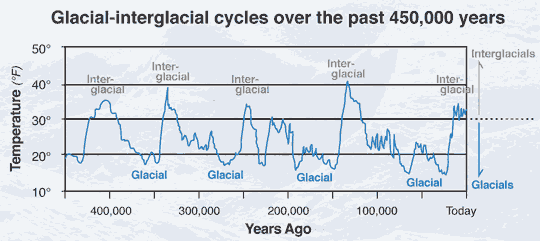
Think of it as watching a heartbeat on a monitor, with a large beat followed by a small beat, followed by a large beat then a small beat, etc. The larger "beats" occurred about 120K years ago and one before that about 340K years ago. In between those large "beats" are smaller "beats" (the current one, and the ones at about 200K years ago and 250K years ago).
So what's it like if you zoom into the current "beat"? Our current Holocene interglacial period may have topped out (as indicated by the red and blue graph too) about 6K years ago and it's in a slow decline, even though this interglacial has smaller rises and falls within it (the 1K long warming and cooling cycles in the first graph). In other words, it's a good bet that the Modern Warm Period won't top out as high as the Medieval Warm period before it, which didn't top out as high as the Roman Warm Period before that. (Which I think is what you're saying too.)
Or another way to put it, when the Dims fuss about higher sea levels, wake me up with the Pevensey Castle in the UK has the tide come up to the castle like it did during the Medieval Warm Period. (Again, I trust written history's support of warming and cooling periods more than I trust tree ring "studies" and other proxy temperature "studies".) Until the sea level is back up to the castle's wall, our current sea levels aren't as high as what used to be normal.