Posted on 11/25/2025 6:16:44 AM PST by MtnClimber
A pair of hasty, snarky opinions by Judge Cameron Currie once again illustrate an out-of-control judiciary increasingly seizing executive authority to sabotage the will of the people.
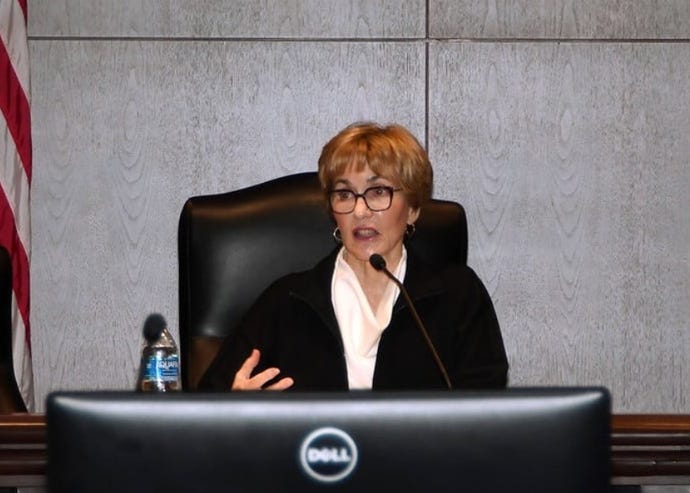
Judge Cameron McGowan Currie in what is probably an old photo
Describing acting U.S. Attorney Lindsey Halligan as “a former White House aide with no prior prosecutorial experience,” Judge Cameron McGowan Currie today dropped the criminal cases against New York Attorney General Leticia James and former FBI Director James Comey pending in the Eastern District of Virginia. “I agree with Ms. James that the Attorney General’s attempt to install Ms. Halligan as Interim U.S. Attorney for the Eastern District of Virginia was invalid,” Currie wrote. “And because Ms. Halligan had no lawful authority to present the indictment, I will grant Ms. James’s motion and dismiss the indictment without prejudice.” Currie wrote the same passage in her order dismissing the charges against Comey.
Currie, 77, was appointed to the federal bench by Bill Clinton in 1994. Last month, the chief judge of the Fourth Circuit tasked Currie, who is based in South Carolina, with handling Comey’s disqualification motion. Chief Judge Albert Diaz said in an October 21 order that the transfer was necessary for the “limited purposes in the interest of maintaining public confidence in the impartial administration of justice.” A similar motion by Leticia James also landed on Currie’s docket.
Both orders are here and here. In stark contrast to Judge Aileen Cannon’s five-month deliberations as to the lawfulness of Special Counsel Jack Smith’s appointment—Donald Trump’s lawyer filed a motion to dismiss the documents case based on Smith’s unconstitutional appointment in February 2024 and Cannon agreed with Trump in the matter and dismissed the documents indictment in July 2024—Currie took less than a month to kick Halligan off both cases. (She held a hearing on November 13 when, among other things, Currie accused Halligan of intentionally withholding part of a grand jury transcript from the day of the indictment.)
Currie claims Halligan’s appointment violates federal law and the Appointments Clause of the Constitution while making the stunning argument that judges, not the president or attorney general, bear the primary responsibility of appointing interim U.S. Attorneys. Consider the ramifications of this: “Subsection (d) then provides a single option for how subsequent interim appointments may be made: ‘If an appointment expires under subsection (c)(2), the district court for such district’ — and only the district court — ‘may appoint a United States attorney to serve until the vacancy is filled.’ The text and structure of subsection (d) in particular make clear the appointment power (1) shifts to the district court after the 120-day period and (2) does not revert to the Attorney General if a court-appointed U.S. Attorney leaves office before a Senate-confirmed U.S. Attorney is installed.” Crazy talk.
Both James and Comey, Currie announced, can “[return] to the status [they] occupied before being indicted.”
The Department of Justice plans to appeal. Further, both indictments were dropped “without prejudice,” which means the government could seek new indictments although the Comey case might be trickier given the expired statute of limitations.
White House spokeswoman Karoline Leavitt reacted to the judge’s decisions this afternoon on Fox News: [video at link]
Comey already is taking a victory lap, claiming the decision vindicates him from any criminality. (It of course does no such thing.) He thanked his defense attorneys and DOJ prosecutors who had refused to bring any charges against him, resulting in a purge of the office. Comey forgot to mention that the father of Erik Siebert, the ex-interim U.S. Attorney removed for refusing to indict the former FBI director for making false statements and obstructing Congress, is godfather to one of Comey’s children.
Hopefully his preening won’t last long. Even if he skates on these charges, Comey appears to be a target of the DOJ’s “grand conspiracy” investigation into the perpetrators of Russiagate and decade-long lawfare against the president.
It’s about doing things the right way from the start.
Here’s the text of that statute:
“(a) Except as provided in subsection (b), the Attorney General may appoint a United States attorney for the district in which the office of United States attorney is vacant.
(b) The Attorney General shall not appoint as United States attorney a person to whose appointment by the President to that office the Senate refused to give advice and consent.
(c) A person appointed as United States attorney under this section may serve until the earlier of—
(1) the qualification of a United States attorney for such district appointed by the President under section 541 of this title; or
(2) the expiration of 120 days after appointment by the Attorney General under this section.
(d) If an appointment expires under subsection (c)(2), the district court for such district may appoint a United States attorney to serve until the vacancy is filled. The order of appointment by the court shall be filed with the clerk of the court.
What was misrepresented/misinterpreted?
If this had gone forward and Comey were convicted, he’d have a slam-dunk appeal. Better to catch it now, don’t you think?
Section a clearly states that the AG (Executive Branch) has appointment power. That is the bases upon which all the rest of the statute hangs.
Section b clarifies the one caveat imposed on the Executive with regard to appointments.
Section c places limits on how long a temporary appointment can last. It DOES NOT say that there can't be a subsequent temporary appointment or even that the same person can't be reappointed.
Section d allows the Article III branch to appoint someone to that position (subsequent to the 120 day expiration) if the Article II branch does not. It DOES NOT say that the Article II branch forfeits their appointment authority if the 120 day period runs. It really CAN'T say that because Section 2 of Article II of the Constitution vests appointment authority in the Executive branch. There is no appointment power granted to the Article III branch by the Constitution.
By claiming that the Judicial branch, and ONLY the judicial branch, has authority to appoint someone once the 120 day rule has run would run completely contrary to one of the most fundamental principles of our Constitutional construction.
Disclaimer: Opinions posted on Free Republic are those of the individual posters and do not necessarily represent the opinion of Free Republic or its management. All materials posted herein are protected by copyright law and the exemption for fair use of copyrighted works.