“Jack” is a bit trickier. It’s likely a generic stand-in, common in English for tools or everyday objects (e.g., “jackknife,” “lumberjack”). It might also nod to jakke, an old term for a simple dish or a person (like “every man’s jack”), making “flapjack” a humble, everyman’s flatbread.
"Flapjack" first popped up in print around 1553, in a dictionary by Richard Huloet, as “flapjacke,” meaning a flat cake or tart. By 1600, it’s in Shakespeare’s Pericles, Prince of Tyre (Act II, Scene 1): “Come, thou shalt go home, and we’ll have flesh for holidays, fish for fasting-days, and moreo’er puddings and flapjacks.” Here, it’s a treat—likely a baked flatbread or early pancake, not quite the modern fluffy stack. Back then, it wasn’t strictly our pancake. It could mean anything flat and fried or baked—apple tarts, oatcakes, or dough slapped on a griddle.
By the 18th century, “flapjack” narrowed to something closer to today’s meaning: a batter-based cake cooked on a flat surface and flipped. English cookbooks—like Hannah Glasse’s The Art of Cookery (1747)—start linking it to griddlecakes, though recipes vary (some with fruit, some plain).
The “flap” action—flipping it mid-cook—becomes key. It’s distinct from “pancake” (from “pan” + “cake,” broader and older), emphasizing the flipper’s skill.
In the U.S., “flapjack” is a casual synonym for “pancake”—big, round, fluffy, stacked with syrup. But in the UK, it diverges: by the 1900s, “flapjack” often means a chewy oat bar, baked and cut into squares, leaving “pancake” for the griddle version. The old “flat cake” sense morphs with local tastes.
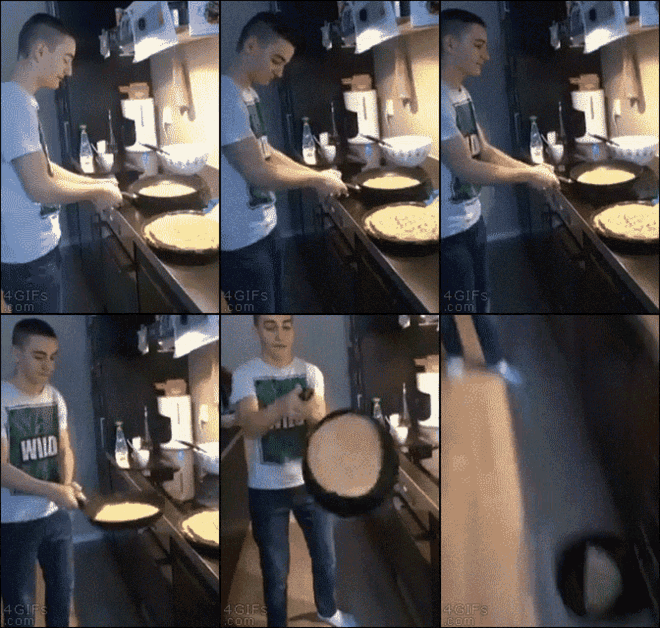
I've never been able to master the flipping of a flapjack in the pan. I always use a boring and uninteresting spatula. I learned my lesson the last time I tried flipping my flapjack.