Posted on 01/03/2025 5:37:28 AM PST by Red Badger
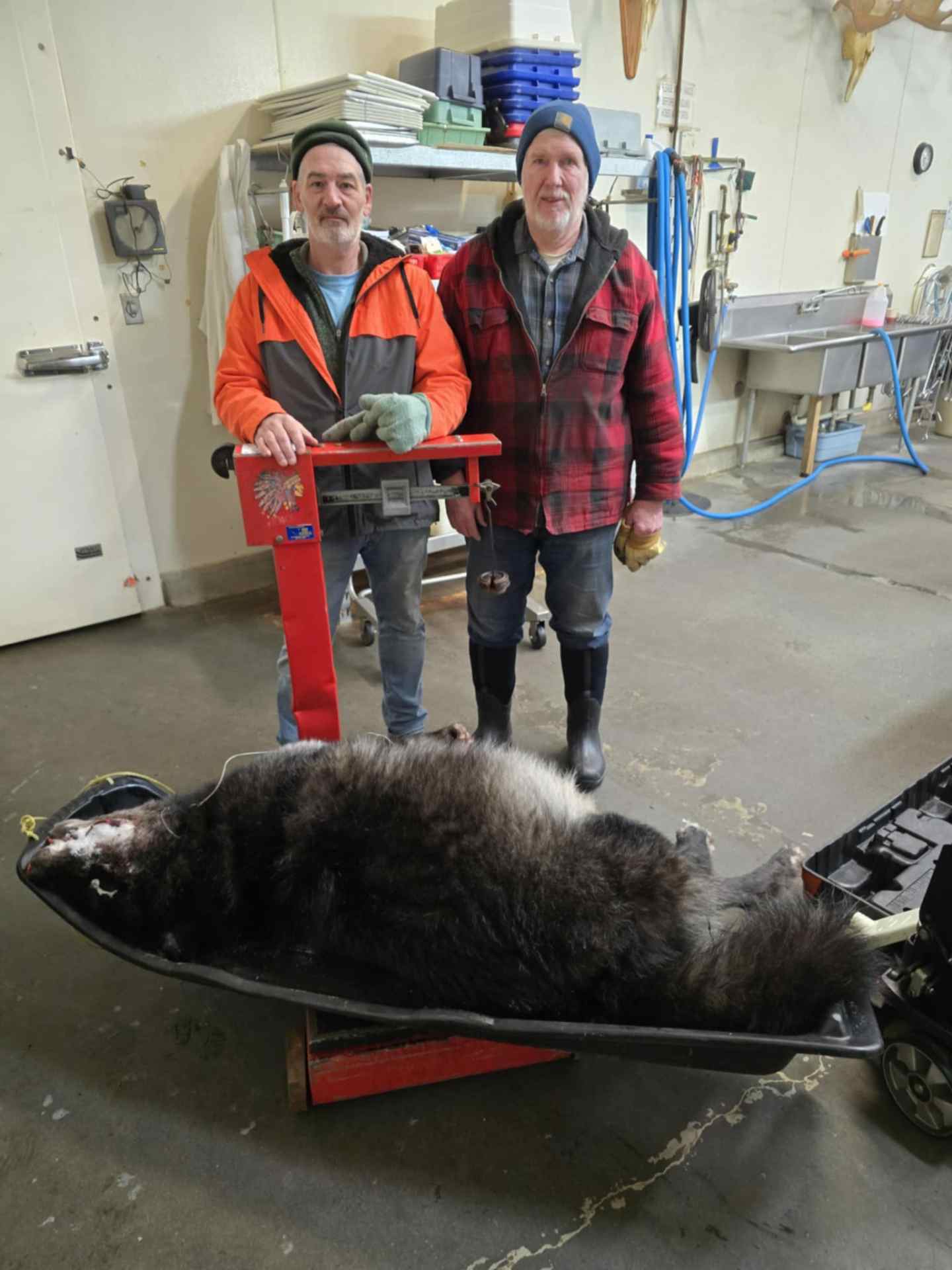
Shortly before Christmas, two trappers snared a giant wolf and rushed to have it weighed on a certified scales
Evans and Standley with their giant Alaskan wolf on the scale. Courtesy of Morgan Evans
On Dec. 22 I received a message from a local Fairbanks trapper whom I’ve known for years. It included a photo of an enormous black wolf he and his trapping partner had just caught, as well as the scale it was hanging from. It displayed 152 pounds. “We’re taking it to get it weighed on a certified scale right now,” he wrote. I knew, as well as he did, that this could be one of the largest wolves ever recorded.
Morgan Evans and Bob Standley have been running a recreational trapline in the area for many years, according to Evans — a fact that I can verify because I used to run a marten line next to their territory. They’ve trapped many wolves over the years, which are abundant in the area, but they knew they had something special this time. Evans told me that the heaviest wolf they had ever caught before this was 118 pounds — a normal top-end weight for a really big male wolf.
After deducting the weight of the plastic sled it was set on, the wolf weighed an incredible 149.6 pounds on a certified scale. It was weighed by Al Barrette, who is also a trapper, fur tanner, and current Alaska Board of Game member. Al has handled hundreds, if not thousands, of wolves in his career and told Evans that the heaviest he’d seen was in the 130- to 140-pound range.

Evans with their giant wolf. Courtesy of Morgan Evans How Big Do Wolves Get? How big can a wolf get? That’s a question that will summon all sorts of answers, but few are based in reality. On social media and internet forums, you’ll hear tales of wolves weighing over 200 pounds, but none of those have been verified and are almost certainly myth. If you depend on Google, you’ll read that the average Mackenzie Valley male wolf (another name for the same subspecies that inhabits northwestern Canada and Alaska) averages 175 pounds. That is false.
If you talk to experienced wolf trappers, the heaviest wolves usually weigh in the 120 to 130 pound range but aren’t common. Through my own trapping and the years I spent skinning wolves, wolverines, lynx, and other Alaskan furbearers for a local fur buyer, I’ve handled approximately 375 wolves myself. The largest I ever saw was a blue color-phase wolf that a friend found dead and frozen. He was investigating a flock of ravens he saw perched in some brush that had been attracted to the carcass. We couldn’t determine its cause of death, but assumed it had been shot and lost, asserting that a visible wound we found on it was a bullet hole that had been opened up by the ravens. It weighed 123 pounds on my scale. I have seen only four or five wolves that broke the 120-pound mark.
The Alaska Department of Fish and Game has a good informational article documenting some of the largest wolves known to have been weighed as well as average wolf weights. The largest wolf referenced in the story was reportedly caught in July 1939 by famous Alaskan market hunter and predator control agent Frank Glaser. It weighed 175 pounds, though it’s unclear if he weighed it in the field.
According to the aptly named book, Alaska’s Wolf Man, Glaser trapped and shot more than 500 wolves during his career. Though the book didn’t mention this 175-pounder, it makes note of other exceptionally large wolves Glaser saw or collected. He says to have seen a 212-pound wolf put on a scale by “the Purdy brothers,” in Chicken, Alaska, but there’s no other information available. According to Glaser’s journal, he shot a 156.5-pound wolf from his cabin on the Savage River on Jan. 23, 1934 and, we assume, weighed it on the same beam scale with which he mentions weighing his captive male wolf at 145 pounds.
In more modern times, USGS biologist Layne Adams once handled a 135-pound male wolf in Denali National Park, according to the ADFG article, and described its size “as if it were some kind of mutant.” For context, the average male wolves in Denali National Park weigh 105 pounds.
A Record Wolf? Any time someone boasts of an abnormally heavy wolf, there is skepticism. Most of it is fair, considering that people often guess or exaggerate animal weights and there is no official record of big wolf weights in Alaska. The ADF&G doesn’t keep such records. Neither do record-keeping organizations like Boone and Crockett, Pope and Young, or SCI. Because there are no official records of big wolf weights — or standards for taking measurement — the “biggest” wolf ever will always be disputed. A wolf’s weight can vary dramatically depending on when they last ate. It probably varies throughout the seasons too, but depends on prey availability more than anything. Known to gorge themselves until they can barely move, a large wolf might eat 20 pounds or more in a sitting. Some of the largest wolves known to have been weighed have had a stomach full of recently eaten meat. Of course a full stomach shouldn’t disqualify a heavy wolf’s weight, but it does account for the astonishing weight of some wolves.
As photos and the weight of the wolf were posted on local trapping Facebook pages, one of the first things commenters speculated about Evans and Standley’s wolf was whether it had a belly full of meat. A huge, 125-pound wolf could feasibly weigh 149 pounds if it had just feasted. To investigate, the trappers emptied the wolf’s stomach, the contents of which weighed 6 pounds.
Although there is no official list to recognize it, Evans and Standley’s wolf is one of the heaviest — if not the single heaviest — wild wolf to ever be weighed on a certified scale.
To Haitians?..................
1st thing that came to my mind was that book.
LOL!
Take off eh!
My dog in the 1970's weighed over 200 pounds.
I hadn’t read it since the 7th grade. I loved it then. This Thanksgiving, on a long auto trip with my grandson, we listened to a recording of it. We both loved it. It’s a good book. I loved it as much now as I did back in junior high school.
The TV program about Wind Walker Ranch (Utah)claimed they found the remains of one. They saved the skull and someone ID’d it as a Dire. Never heard what DNA test showed. Maybe tune in next year or something.
saved
I think they killed it more significantly than they caught it.
How big can a wolf get? That is a Dire question
= = =
I’ll research that.
From a fellow ‘Bob’
He’ll get a nice chunk of change for that pelt. If he doesn’t stuff it.
Only if it wasn’t hungry at the time, and would kindly pose long enough for a photo.
There’s a “wolf farm” for lack of a better term, in Colorado that charges $300 to get up close and personal with their wolves, including a picture of you sitting right next to the big alpha male, no fence, no nothing, just you and the wolf.
A friend of mine did it, and I wanted to also. That boss wolf they have is a fine beast, more grey than black like the wolf in this post, and friendly as you can expect.
I’d have done it for $50, but $300 is outside my parameters.
They followed human tracks until they reached a small cottage with “R. Riding Hood” on the door. And turned back. You don’t mess with a Riding Hood.
That’s not Buck. Buck was smart enough to take down a bull moose all by himself without working up a sweat. Buck ain’t gettin caught by no trap.
“Perrault knew dogs, and when he looked at Buck he knew that he was one in a thousand”. “One in ten t’ousand”, he commented mentally.” - Call of the Wild, Part I - Jack London
That and White Fang are two of the best books ever written. They illustrate the struggle of all of us poor critters here on earth.
yeah, they never confirm things liek that- at best they will say “The data is unsure” or “unkonw species”
or soemthing
friend of ours had a wolf/dog- i never liked the thing- she eventually got rid of it because it got too big and powerful to handle-
LOL
Disclaimer: Opinions posted on Free Republic are those of the individual posters and do not necessarily represent the opinion of Free Republic or its management. All materials posted herein are protected by copyright law and the exemption for fair use of copyrighted works.