
For those who may not be familiar with it, The Prisoner is a British television series that originally aired in the late 1960s, created by and starring Patrick McGoohan. The show is renowned for its surreal and enigmatic storytelling, exploring themes of individuality, freedom, and authoritarian control combining elements of espionage, psychological drama, and science fiction, with a striking visual style and allegorical depth.
McGoohan plays an unnamed protagonist referred to as "Number Six," a former secret agent who is abducted and held in a mysterious, seemingly idyllic community called "The Village." The Village is controlled by an entity or authority that designates its residents by numbers rather than names, stripping them of their identities. Throughout the series, Number Six resists the efforts of various Village authorities, particularly "Number Two," to break his will and discover why he resigned from his government position.
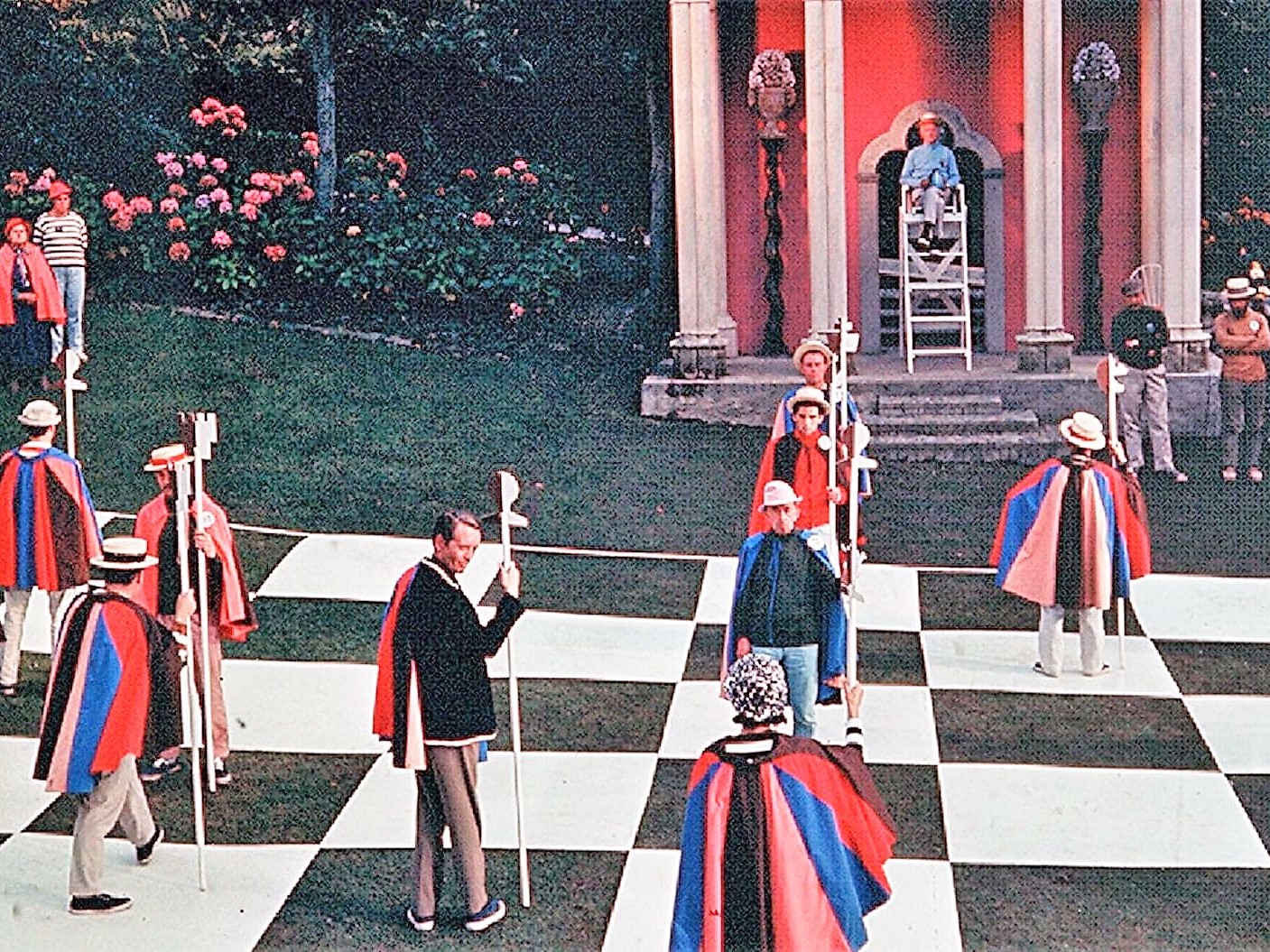
In "Checkmate", Number Six becomes part of a life-sized chess game, where human players are moved at the command of a "Chessmaster" who oversees the game from a high vantage point. This chess motif is central to the episode, serving as a metaphor for the power dynamics in The Village and the dehumanization of its inhabitants.
During the game, Number Six befriends another player, referred to as "The Rook," who shares his dissatisfaction with The Village. Number Six comes to believe that some prisoners are more "resigned" to their fate, while others—like himself and The Rook—are "rebels" seeking freedom. This leads him to devise an escape plan, recruiting those he identifies as allies.
However, as the escape attempt unfolds, it becomes clear that The Rook has mistaken Number Six's leadership and independence as evidence that he is part of the Village's control apparatus. The Rook betrays him, and the plan collapses, leaving Number Six trapped once again.
Themes and Analysis
Trust and Control: The episode explores the difficulty of distinguishing between allies and enemies in an oppressive system. Number Six’s assumption that he can identify fellow rebels backfires, illustrating how The Village manipulates perceptions to sow mistrust. [Certainly Trump's first term and the ongoing threat moving forward.]
Dehumanization: The chess game symbolizes the way people are treated as pawns by those in power. The human players are stripped of agency, embodying the broader dynamic of life in The Village.[The objective: "You will own nothing and be happy."]
Individuality vs. Conformity: Number Six’s efforts to rally a group of rebels reflects his resistance to conformity. However, his failure underscores the challenges of fostering solidarity in a setting where suspicion is a survival mechanism. [Clown World, Black Pillers, the truly Brainwashed, "The end will not be for everyone."]
Psychological Manipulation: The Village exploits The Rook's misunderstanding of Number Six's motives, showcasing the psychological games that are a hallmark of The Prisoner. This manipulation emphasizes the theme of how authoritarian systems control not just actions but thoughts and beliefs.[Project Mockingbird]
Okay, What Does It Mean?
Is Biden signalling that he is controlled. Is he even the one responsible for these "comms" if that's what they are? If it's not Biden, then it's his controllers.
If it's Biden then the comms could be an apology to the Democrat faithful that says "I was a prisoner. I had no choice." Equally, it could be Biden telling the White Hats "Hey, I'm still on board, fellas. I'm still following the script like you told me to."
If the drapes are the work of his controllers, is their message "All is going according to plan"?
Does this episode draw a parallel with Trump being betrayed in his first term--and is now the wiser for it? Is there an acknowledgment that there were, are, and will be Black Pillers and Doomers who view him as "false opposition" who will eventually let everyone down?
There are no doubt more parallels to be drawn. Then again, it could be nothing.
While I'm not sure of any specific meaning I think the title of the episode is enough to indicate there's something here.
Also, Number Six's position on the board is the White Queen's Pawn, the same position Alice played in Lewis Carroll's Through The Looking-Glass.
If you haven't watched the program I highly recommend it.