Iran Update Special Report, June 2, 2026
The Iranian regime is likely trying to transform negotiations about ending the war with Iran into negotiations about ending the war in Lebanon, which Iran and Hezbollah seek to end in Israel's capitulation. The Iranian regime is likely also using the time it is buying through this negotiation tactic to try to legitimize its illegal traffic separation scheme in the Strait of Hormuz and solidify its de facto control over the strait. Islamic Revolutionary Guards Corps (IRGC)-affiliated media outlets reported on June 2 that Iran has not sent a response to US President Donald Trump's amendments to the draft US-Iran memorandum of understanding (MoU) and that Iran and the United States have not exchanged messages for several days.[1] IRGC-affiliated Fars News Agency, citing an informed source, reported on June 2 that Iran's last message to the United States was a “clear message” about Lebanon.[2] Iranian officials have previously conditioned further negotiations with the United States on a ceasefire in Lebanon, but Iranian officials have coalesced around and emphasized this demand to a greater degree following Trump's request for amendments to the draft MoU, particularly amendments related to Iran's highly enriched uranium (HEU) and the Strait of Hormuz.[3] Iran is likely using the Lebanon issue to deflect attention from these core disputes and to protract discussions about a ceasefire in Lebanon, which buys Iran time to preserve its sources of leverage, such as its nuclear program and control over the Strait of Hormuz.
The United States mediated a partial agreement between Israel and Hezbollah to halt Israeli strikes against Beirut and Hezbollah strikes against northern Israel.[4] The ceasefire appears to be largely holding but is very fragile.[5] A partial ceasefire likely does not meet Iran and Hezbollah's maximalist demand for a complete ceasefire in Lebanon, which Iran and Hezbollah view as a prerequisite for the withdrawal of Israeli forces from Lebanon. President Trump held a phone call with Israeli Prime Minister Benjamin Netanyahu on June 1 and stated that Israel agreed not to attack Beirut.[6] The Lebanese Embassy in Washington said that the Lebanese government received confirmation from Hezbollah that the group accepted the US-mediated proposal, in which the Israel Defense Forces (IDF) would stop strikes against Beirut in exchange for Hezbollah halting attacks on Israeli territory. The embassy stated that the ceasefire “would be extended to all Lebanese territory” over an unspecified timeframe.[7] The IDF has not struck Beirut since the US and Lebanese governments announced the partial ceasefire proposal. Hezbollah has also not claimed any attacks against northern Israel since the announcement. Israeli military correspondents reported on June 1 that Hezbollah fired two rockets and one drone at targets in northern Israel, none of which caused any casualties, however.[8] The IDF and Hezbollah continued to launch attacks against each other in southern Lebanon on June 1 and 2, which could threaten to collapse the fragile US proposal.[9] Israeli Prime Minister Benjamin Netanyahu and Israeli Defense Minister Israel Katz warned that the IDF would resume its planned strikes against Hezbollah infrastructure in Beirut if Hezbollah attacks northern Israeli communities.[10]
The partial ceasefire likely does not meet Iran and Hezbollah's maximalist demand for a complete ceasefire encompassing all Lebanese territory, however. Hezbollah and Iranian officials stated on June 1 and 2 that they will not accept a partial ceasefire that only bars strikes against Beirut and demanded a complete end to Israeli operations in Lebanon.[11] Iranian Parliament Speaker Mohammad Bagher Ghalibaf told Lebanese Parliament Speaker and Hezbollah ally Nabih Berri that Iran seeks a complete ceasefire in Lebanon and will not resume negotiations with the United States until the IDF ends its operations in Lebanon, for example.[12] Hezbollah media spokesperson Youssef al Zein separately emphasized that Israel must agree to a comprehensive cessation of hostilities across Lebanese territory.[13] Hezbollah Deputy Political Council head Mahmoud Qamati similarly told Western media that Hezbollah will not accept a partial ceasefire and warned that the group would respond to any Israeli strikes on Beirut.[14] Iran and Hezbollah would likely demand that Israeli forces withdraw from Lebanese territory following a complete ceasefire in Lebanon. Hezbollah officials have repeatedly called for a complete ceasefire in Lebanon and the complete withdrawal of Israeli forces from Lebanese territory.[15] A complete ceasefire in Lebanon and Israeli withdrawal from Lebanon would achieve Iran's objective of preserving Hezbollah, which has historically played a central role in Iran's Axis of Resistance and been a key pillar of Iran's deterrence strategy.[16]
Iran and the Axis of Resistance are conducting an information operation that is likely intended to pressure the United States to convince Israel to halt its operations against Hezbollah in Lebanon. Iranian officials have threatened attacks against both Israel and shipping in the Bab el Mandeb Strait in response to Israeli operations in Lebanon, likely because they calculate that the threat of an expanded conflict will drive the United States to pressure Israel to stop its operations against Hezbollah. Khatam ol Anbia Central Headquarters Commander Major General Ali Abdollahi Ali Abadi threatened on June 1 to attack civilians in northern Israel if the IDF conducts airstrikes targeting Beirut.[17] Iran rarely issues public warnings before conducting attacks, which suggests that Abadi’s threat sought to achieve an informational effect. IRGC Quds Force Commander Brigadier General Esmail Ghaani separately threatened on June 1 that Iran will “activate” the Bab el Mandeb Strait, just like the Strait of Hormuz, in response to Israel's operations against Hezbollah in Lebanon.[18] A senior Houthi official also warned on June 2 that the group's “hands are on the trigger.”[19] Iran and the Houthis have consistently threatened to resume attacks against shipping in the Bab el Mandeb Strait throughout the war, but have not acted on those threats, which suggests that their current threats are intended to achieve the effect of pressuring the United States to convince Israel to halt its operations against Hezbollah.[20]
The Iranian regime also seeks to exploit the Lebanon issue to try to sow divisions between the United States and Israel. Iranian Parliamentary National Security and Foreign Policy Committee member Fadahossein Maleki claimed on June 2 that Israeli Prime Minister Benjamin Netanyahu increased operations against Hezbollah in southern Lebanon to disrupt US-Iran negotiations after Netanyahu allegedly realized that Trump's approach did not align with Israeli demands.[21] This and similar statements from Iranian officials suggest that the Iranian regime is trying to portray Israel as the main obstacle to a US-Iran deal and an end to the war with Iran.
Iran is also using the time it is gaining by deflecting attention from the US-Iran negotiations to advance other objectives, such as securing Iranian control over the Strait of Hormuz. The IRGC Navy announced on June 2 that it permitted 24 vessels to pass through the strait in the past 24 hours.[22] It warned that it will implement “smart control” over the strait and claimed that “evil foreigners” have no place in the Persian Gulf or the strait.[23] The US-sanctioned Persian Gulf Strait Authority (PGSA) separately claimed on June 1 that over 300 non-Iranian vessels have submitted information to receive permission from Iran to transit through the strait since late April, which supports Iran's efforts to normalize its control over the strait by forcing vessels to comply with its transit protocols.[24] The IRGC Navy and PGSA’s statements highlight how Iran is trying to normalize its coercive transit regime, which includes Iran's illegal and unrecognized traffic separation scheme, permit system, and toll scheme.
Even if Israel and Hezbollah reach a ceasefire in Lebanon, Iran could condition further US-Iran negotiations on additional US concessions. Former IRGC Commander Major General Mohammad Ali Jafari previously stated on May 11 that Iran would not enter negotiations with the United States until the United States accepted Iran's terms, including an end to the war on “all fronts,” sanctions relief, the release of frozen Iranian assets, compensation for war-related damages, and recognition of Iran's sovereignty over the Strait of Hormuz.[25] Iran is currently imposing its demand for a ceasefire on “all fronts” on the United States, but could demand additional US concessions–such as economic relief–even if the United States agrees to accept Iran's demand for a complete ceasefire in Lebanon. An Iranian negotiating team member close to Parliament Speaker Mohammad Bagher Ghalibaf stated on June 2 that Iran would withdraw from any US-Iran agreement or refuse to enter the next phase of negotiations if Iran could not access its frozen assets, sell oil during the 60-day negotiations period, lift the blockade, or agree to Iranian demands related to the Strait of Hormuz.[26] Giving in to Iranian preconditions would reduce US leverage in future negotiations and make it harder to extract concessions from Iran on its nuclear program and the Strait of Hormuz.
The Iraqi Shia Coordination Framework announced its support on June 1 for restricting arms to the state and separating the Iranian-backed Popular Mobilization Forces (PMF) from all “political, partisan, and social frameworks.”[27] The framework's announcement is probably a response to intensified US pressure on the Iraqi federal government to disarm the militias, rather than an indicator that the framework intends to disarm the militias. The PMF is an Iraqi state security service comprised of multiple Iranian-backed Iraqi militias that answer to Iran instead of the Iraqi prime minister.[28] The framework did not specify what it meant by “restricting weapons to the state” or “political, partisan, and social frameworks.” The framework could be referring to an effort to separate militias’ political wings from militia-controlled PMF brigades and restricting weapons to the PMF. The framework's statement affirmed the PMF as an official state institution.[29] The framework's announcement follows the framework's formation in May 2026 of a committee, including incumbent Prime Minister Ali al Zaydi, former Prime Minister Mohammad Shia al Sudani, and Badr Organization head Hadi al Ameri, to develop a mechanism to disarm the militias and integrate their members into state institutions.[30] These disarmament efforts come amid increased US pressure on the Iraqi federal government to decrease Iranian influence in Iraq, including through militia disarmament, due to US militia attacks against US and foreign targets in Iraq and the region during the war.[31] Multiple sources close to framework leaders told Iraqi media on June 2 that framework leaders are concerned that the United States will not accept the “mere formality of disarmament,” but will instead pressure Baghdad to dissolve the PMF.[32]
The framework's statement conditioned militia disarmament on the end of the international coalition's mission in Iraq.[33] US-led international coalition forces completed their mission in federal Iraq in January 2026, but continue to operate in Iraqi Kurdistan.[34] The United States and Iraq agreed in September 2024 that all US-led international coalition forces would withdraw from Iraq by the end of 2026. Iranian-backed Iraqi militias disproportionately attacked US positions in Iraqi Kurdistan during the war.[35] Iranian-backed Iraqi militias used violent and non-violent means for years to pressure the United States to remove US forces from federal Iraq.[36]
The framework is a loose coalition of Iraqi Shia political parties, some of which Iran backs, and it is unclear which specific elements of the framework supported this announcement. The framework includes the political wings of multiple Iranian-backed Iraqi militias that have recently rejected disarmament, including Kataib Hezbollah.[37] Kataib Sayyid al Shuhada and Harakat Hezbollah al Nujaba also reportedly reject disarmament.[38] These militias have, both historically and during the war, been the most kinetically active and are more subordinate to Iran than other Iraqi militias.[39]
Iranian-backed Iraqi militia Asaib Ahl al Haq announced on June 2 that it has formed an internal committee to begin “disengaging” from the PMF. This announcement comes amid Asaib Ahl al Haq leader Qais al Khazali’s public support for disarmament and shift toward political activity in recent years.[40] Asaib Ahl al Haq said that the group's military spokesperson will lead the committee, which will inventory personnel, weapons, vehicles, and logistical supplies.[41] The committee will also organize communication mechanisms with the prime minister, according to Asaib Ahl al Haq.[42] It is unclear if “disengaging from the PMF” refers to ending Asaib Ahl al Haq’s control over its affiliated PMF brigades or some other action. Asaib Ahl al Haq controls the 41st, 42nd, and 43rd PMF brigades.[43] Iraq analysts have long noted that Asaib Ahl al Haq’s leadership, particularly Khazali, has focused on politics more than kinetic activity in recent years, including during the October 7 War.[44] The US-Israeli combined force struck multiple Asaib Ahl al Haq positions during the recent war as part of its effort to degrade Iranian-backed Iraqi militias’ ability to attack the United States and Israel.[45] The US Treasury Department also noted in April 2026 that Asaib Ahl al Haq had conducted drone attacks targeting US and coalition forces in northern Iraq in March 2026.[46] It is unclear if Asaib Ahl al Haq sanctioned this kinetic activity. Khazali has pledged his public support for militia disarmament in recent months.[47] CTP-ISW previously identified indications of splinters within Asaib Ahl al Haq regarding disarmament.[48] Asaib Ahl al Haq and several other members of the Iraqi Resistance Coordination Committee, which is a militia coordinating committee, signed a statement in January 2026 rejecting Iraqi militia disarmament due to the continued presence of US and Turkish troops in Iraqi Kurdistan, for example.[49]
Khazali could be signaling his willingness to disarm in order to lessen US resistance to Asaib Ahl al Haq’s political wing controlling an Iraqi ministry. Iraqi media reported on June 2 that the United States has continued to oppose the allocation of any ministerial portfolio to political parties tied to Iranian-backed Iraqi militias, even if the militias have announced their disarmament.[50] Asaib Ahl al Haq’s political wing, Sadiqoun, won 27 seats in the November 2025 elections, which would typically be enough seats to gain control of an Iraqi ministry.[51] The Iraqi parliament approved 14 out of 23 ministers of incumbent Prime Minister Ali al Zaydi’s government on May 14, but multiple ministries, including the defense and interior ministries, remain unfilled.[52] Asaib Ahl al Haq has said that it will decide on its participation in the next Iraqi government after the issue of restricting arms to the state is addressed.[53] Two framework sources told AP on May 14 that IRGC Quds Force Commander Brigadier General Esmail Ghaani told several framework and militia leaders to postpone voting on ministries in which militia-affiliated political parties are vying for positions.[54] It is currently unclear why Ghaani called for this delay.
Iranian-backed Iraqi militia Kataib al Imam Ali, whose political wing controls five seats in parliament, also announced its readiness to restrict weapons to the Iraqi state, possibly to overcome US opposition to its involvement in the next government.[55] Kataib al Imam Ali announced on June 2 that it will begin to “disengage” from the PMF and restrict weapons to the Iraqi state.[56] The militia announced that it will form multiple committees to handle issues such as the transfer of weapons to the state, the families of martyrs and wounded fighters, and the reintegration of militia personnel and affiliates into the Iraqi state.[57] US opposition to militia involvement in the next government has mainly focused on the cabinet level, but Kataib al Imam Ali could be attempting to avoid US pushback to the group's participation in the government in another capacity.[58]
The framework's announcement, along with Asaib Ahl al Haq and Kataib al Imam Ali's announcements, follows reports of Iranian pressure on its Iraqi partners to stop all kinetic activity, likely to avoid US financial pressure against Iraq that negatively impacts Iran. Ghaani reportedly warned about “real dangers” that could result in a loss of military privileges and discussed the need for an “alternate plan” regarding militia disarmament with militia and framework leaders in Baghdad in April 2026.[59] Ghaani reportedly proposed that some militias end all kinetic activity while preserving the PMF and consolidating the political role of Iranian-backed Iraqi militias.[60] US financial pressure on Iraq, such as the US Treasury Department's reported decision to halt shipments of Iraqi export oil revenue to Iraq, heavily impacts Iran due to Iran's use of the Iraqi economy for sanctions evasion and to help fund the Axis of Resistance.[61] CTP-ISW continues to assess that Iran could decide to build a new cadre of ideological militias, over which Iran has strong control, that would supplement the political activity of Iranian-backed Iraqi actors. Ghaani reportedly instructed several framework and militia leaders in May not to proceed with disarmament until the trajectory of the US-Iran negotiations becomes clear.[62] Iran likely wishes to maintain the militias’ military strength in the event of renewed conflict with the United States and Israel.
The Institute for Science and International Security assessed on June 2 that Iran is securing the Fordow Fuel Enrichment Plant in preparation for a potential US ground operation to seize Iran's highly enriched uranium (HEU) stockpile.[63] The Institute stated that Iran has created “rocky mounds” on the roads leading to Fordow’s tunnel entrances and that the mounds are positioned in a way to hinder the movement of hostile forces attempting to enter or exit the tunnels.[64] The Institute added that Iran did not completely block the roads like it has at the Esfahan Nuclear Technology Center (ENTC), which indicates that Iran still seeks to access Fordow.[65] All of Fordow’s tunnel entrances have remained buried as of May 26, however.[66] Iran's HEU is buried underneath rubble at the ENTC, Fordow, and Natanz, which the United States and Israel struck during the 12-day war.
https://understandingwar.org/research/middle-east/iran-update-special-report-june-2-2026/
Another day, another clash in the gulf:
A. Without a deal, friction inevitably drives escalation.
B. In an environment already marked by high tensions, escalation can become uncontrolled, even when neither side actively seeks a broader conflict.
C. Iran continues to operate within its established deterrence framework, but recent statements by senior officials, including Mohsen Rezaei, suggest that the scope of potential retaliation may be expanding. This time, references have reportedly included the U.S. Fifth Fleet headquarters in Bahrain.
D. Through its actions, Iran is signaling that it will not allow a return to the previous status quo in the Gulf. From Tehran’s perspective, the regional landscape has changed, and any attempt to restore the old order will be challenged.
E. The continuation of the blockade creates an inherently unstable situation. Such a reality is difficult to sustain indefinitely without a direct confrontation at sea. As encounters between the parties become more frequent, the likelihood increases that an Iranian response will be more forceful and consequential.
Bottom line: another day, another incident, another round of restraint. But this pattern is unlikely to remain sustainable for long. The risk is not necessarily deliberate escalation, it is miscalculation, followed by a cycle of action and reaction that neither side initially intended.
https://x.com/citrinowicz/status/2062007959643718105
Iran Update Special Report, June 3, 2026
Iran and Hezbollah are continuing to try to transform negotiations about ending the war over the Strait of Hormuz into negotiations about ending the war in Lebanon, which Iran and Hezbollah seek to end in Israel's capitulation. US President Donald Trump announced on June 1 a partial ceasefire between Israel and Hezbollah in which Israel would not attack Hezbollah targets in Beirut and Hezbollah would halt attacks against Israel.[1] Israeli Prime Minister Benjamin Netanyahu subsequently announced that Israel would attack Hezbollah targets in Beirut if Hezbollah continued to attack Israel, suggesting that he agreed not to strike Beirut if Hezbollah ceased attacks on Israel.[2] The Lebanese Embassy in Washington claimed on June 1 that Hezbollah had agreed to cease attacks on northern Israel.[3] Hezbollah officials claimed after Trump's announcement that the group would not adhere to a partial ceasefire, however.[4] Hezbollah conducted rocket attacks targeting the Israel Defense Forces (IDF) in northern Israel on June 3 for the first time since June 1.[5] Hezbollah claimed that it fired rockets targeting IDF soldiers near the Israel-Lebanon border on June 3, several hours after the IDF conducted an airstrike targeting a vehicle in Khalde, eight miles south of Beirut.[6] Israeli Ambassador to the United States Yechiel Leiter called Hezbollah's June 3 attack a violation of the partial ceasefire and suggested that Israel could respond by attacking Hezbollah targets in Beirut.[7] An Israeli military correspondent reported on June 3 that Netanyahu is set to meet with senior Israeli officials to determine Israel's response to Hezbollah's attack.[8]
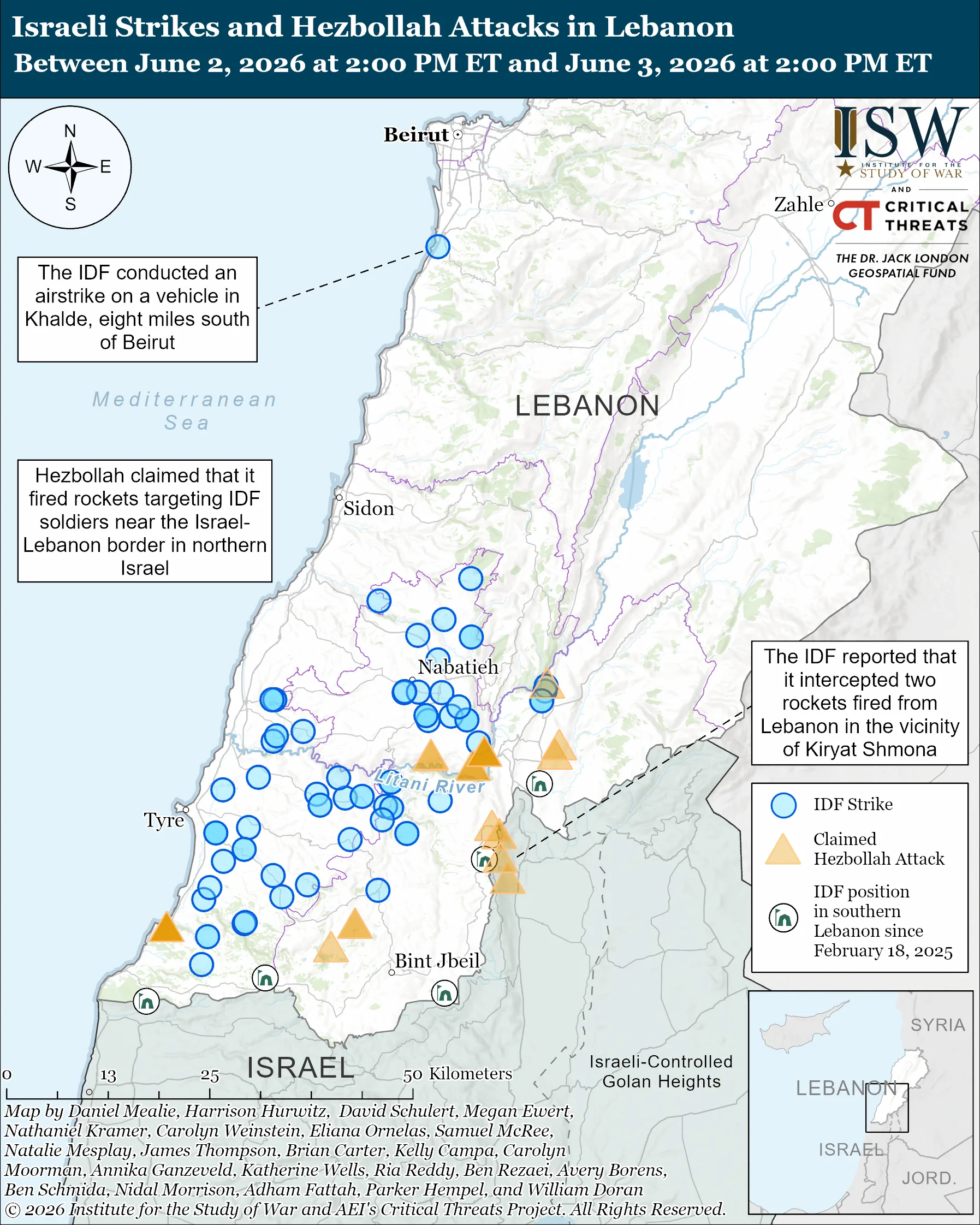
Senior Hezbollah officials have continued to demand a complete ceasefire and the withdrawal of Israeli forces from Lebanon. Hezbollah Political Council member Mahmoud Qamati told Western media that Hezbollah will not accept a partial ceasefire and later said that “there was no ceasefire agreement.”[9] Hezbollah officials have demanded that the IDF cease all military operations in Lebanon and fully withdraw from southern Lebanon and claimed that the group will make “whatever sacrifices are required” to expel Israeli forces from southern Lebanon.[10] A Hezbollah parliamentarian said on June 2 that one of Hezbollah's primary objectives is to obtain a timeframe for a full Israeli withdrawal from Lebanon.[11] These positions are consistent with Hezbollah Secretary General Naim Qassem’s demands that the IDF halt all operations against Hezbollah and withdraw from Lebanon.[12]
Iranian officials have echoed Hezbollah's maximalist demands for a complete ceasefire in Lebanon and withdrawal of Israeli forces from Lebanon as part of Iran's effort to create a protracted discussion about the Lebanon issue and thereby deflect attention from negotiations about the Strait of Hormuz and other key points of disagreement. Iranian Foreign Affairs Minister Abbas Araghchi told Hezbollah-affiliated media on June 3 that Iran and Lebanon are “linked” and that conflict with the United States and Israel will not end unless Israeli forces withdraw from southern Lebanon.[13] Iranian Parliamentary National Security and Foreign Policy Commission Chairman Ebrahim Azizi told Hezbollah officials on June 3 that ending the war with the United States and Israel on all fronts, “especially in Lebanon,” is at the “forefront” of Iran's ceasefire agreement with the United States.[14] Islamic Revolutionary Guards Corps (IRGC)-affiliated media outlet Tasnim News Agency argued on June 3 that there must be a complete ceasefire between Hezbollah and Israel and a complete withdrawal of Israeli forces from Lebanon. The outlet also highlighted how Iran can use Hezbollah to deter and preserve its leverage against Israel and the United States.[15] A political analyst close to the regime also noted on June 3 that the preservation of Hezbollah is “a geopolitical, strategic, and national security imperative for Iran.”[16]
The Iranian regime also likely calculates that it can preserve its leverage on other issues in negotiations with the United States, such as its nuclear program and control of the Strait of Hormuz, by deflecting talks to the war in Lebanon. The US-sanctioned Persian Gulf Strait Authority (PGSA) continued to post data on June 3 about ships requesting Iranian permission to pass through the strait.[17] Tasnim News Agency argued on June 3 that the PGSA’s reports “show the stabilization of Iranian sovereignty over the strait.” This comment is consistent with ISW-CTP’s assessment that Iran is using the ceasefire period to try to normalize Iranian control over the Strait of Hormuz.[18] Tasnim also stated that the Iranian regime is prioritizing achieving sovereignty over the strait over collecting tolls from vessels that transit through Iran's illegal traffic separation scheme. ISW-CTP assessed on May 14 that Iran may be prioritizing upholding the “legitimacy” of its claims to the Strait of Hormuz over toll collection.[19] These comments reflect how Iranian decision-makers are using the current situation to try to solidify de facto Iranian control over the Strait of Hormuz. A protracted discussion about Lebanon also deflects from negotiations over Iran's highly enriched uranium stockpile and ability to enrich uranium on Iranian territory, which Iranian decision-makers have refused to make concessions on.
The Iranian regime is trying to impose costs on the United States for continuing to enforce its blockade while also trying to strain Gulf states’ relations with the United States. US Central Command (CENTCOM) stated on June 2 that US naval forces disabled an Iranian-affiliated tanker, the Botswana-flagged M/T Lexie, that was transiting toward Iran's Kharg Island in violation of the US blockade.[20] Iranian forces then launched attack drones at civilian ships trying to transit the Persian Gulf. US forces intercepted three of the drones.[21] The IRGC also claimed that it launched anti-ship missiles at the Liberia-flagged MSC Panaya, which it claimed belongs to the United States and Israel.[22] US forces subsequently conducted self-defense strikes against drone ground control stations on Qeshm Island in the Strait of Hormuz.[23] Iranian forces then retaliated by firing ballistic missiles and drones at US bases in Kuwait and Bahrain.[24] The Kuwaiti Defense Ministry stated on June 3 that Kuwaiti forces intercepted 13 ballistic missiles and 17 drones.[25] Two Iranian missiles hit Kuwait International Airport, however, killing one person, injuring at least 63 others, and causing significant damage.[26] US and Bahraini air defenses also intercepted three ballistic missiles, one of which targeted the US Fifth Fleet Headquarters in Manama.[27] The Iranian regime's English-language media outlet, Press TV, claimed that Iran's attacks sent a message to Gulf countries that their “territory is not safe” if they continue to host US forces.[28] This comment reflects Iran's efforts to drive a wedge between the Gulf states and the United States by threatening to attack the Gulf states if they cooperate with the United States. Iran's efforts to sow divisions between the Gulf states and the United States are part of Iran's broader strategic objective to expel the United States from the Middle East.
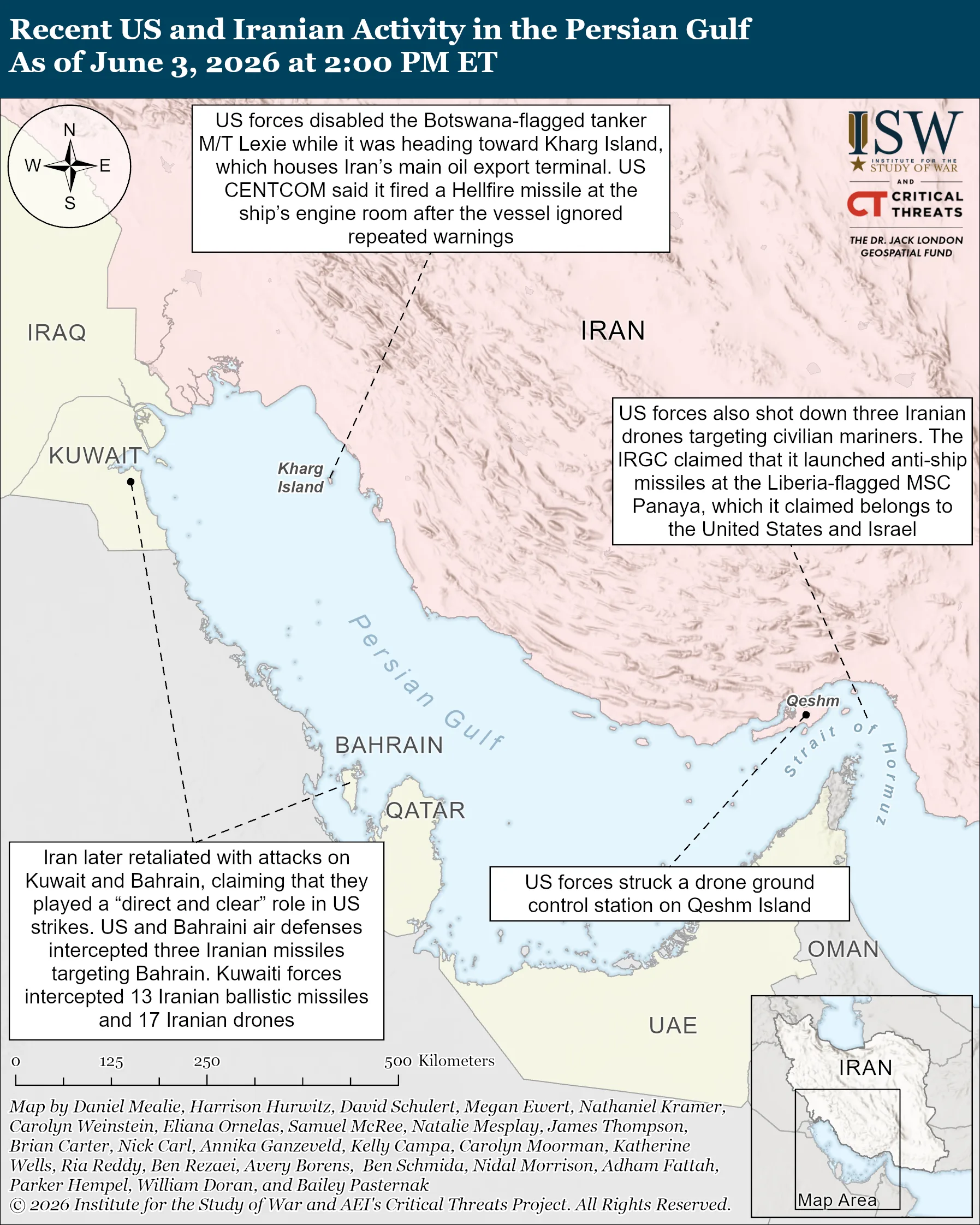
Iranian officials and media responded to these attacks with further threats, probably to try to deter the United States from enforcing its blockade on Iranian ports. Iranian Supreme Leader Mojtaba Khamenei’s military adviser, Mohsen Rezaei, stated on X on June 3 that Iran will not allow the United States to make “excessive demands” in negotiations and will respond to any US military action with a “barrage of missiles and drones.”[29] Press TV also argued that Iran will intensify its responses to US military action to deter the United States from taking such action.[30]
Iranian Parliament Speaker and Iran's Special Representative for the People's Republic of China (PRC) Affairs, Mohammad Bagher Ghalibaf, appears to be performing an executive-level role in Iran's economic and foreign policy. Ghalibaf convened the Iranian Central Bank governor, Planning and Budget Organization head, and oil, economy, and industry ministers on June 3 to coordinate Iran's economic policy toward the PRC.[31] This meeting marks the first meeting that Ghalibaf has convened as Iran's special representative for PRC affairs since Supreme Leader Mojtaba Khamenei appointed him to this position on May 17.[32] The meeting was unusual because parliament speakers in Iran do not normally convene government officials to coordinate and implement foreign economic policy. IRGC-affiliated Tasnim News Agency previously emphasized on May 17 that Ghalibaf’s new role carries a different “level of authority” than previous PRC-related representative roles.[33] The meeting to discuss Iran's economic policy toward the PRC also highlights how Ghalibaf seeks to deepen cooperation with US adversaries such as the PRC.
Ghalibaf’s meeting notably comes as President Masoud Pezeshkian appears to have been sidelined in the regime. Anti-regime media reported on May 31 that Pezeshkian recently submitted his resignation letter to Supreme Leader Mojtaba Khamenei due to IRGC officials’ growing dominance in the regime.[34] ISW-CTP continues to assess that IRGC Commander Major General Ahmad Vahidi and his inner circle are dominating regime decision-making and have gained the upper hand over Ghalibaf.[35] The fact that Ghalibaf appears to be playing an executive-level role does not mean that Ghalibaf holds the same influence over regime decision-making that Vahidi does.
Eighty-five Iranian parliamentarians implicitly called for the development of intercontinental ballistic missile (ICBM) capabilities in a letter to Supreme Leader Mojtaba Khamenei on May 31.[36] The parliamentarians stated that Parliament will support Iran's military forces and defense industry until Iranian missiles can reach the United States.[37] Iran's known longest-range missiles are the Emad, Sejjil, and Shahab-3, which have a reported range of 2,000 kilometers.[38] Iran attempted to launch two ballistic missiles targeting Diego Garcia in March 2026, which is approximately 3,700 kilometers from Iran's southern border, marking the furthest ever attempted Iranian missile strike.[39] One of the missiles failed in flight, while US forces intercepted the other.[40]
The United States continues to apply economic pressure on the Iranian regime by isolating the regime from international markets. The US Treasury Department sanctioned four major Iranian cryptocurrency exchanges and their leadership on June 2 for facilitating Iranian sanctions evasion.[41] The US Justice Department separately announced on June 3 that US law enforcement arrested a dual US-Iranian national and CEO of an Iran-based tech firm for evading US sanctions for more than a decade by covertly purchasing and exporting US-origin networking and encryption equipment to Iranian nuclear and military entities.[42] The CEO reportedly laundered over $15 million USD through international intermediaries.[43]
Hezbollah has continued to use first-person view (FPV) drones equipped with thermal cameras to conduct nighttime attacks targeting Israeli forces in southern Lebanon, likely in response to the IDF ground forces’ own tactical adjustments to operate at night to avoid Hezbollah FPV drone reconnaissance and attacks. Hezbollah posted footage from several FPV drones using thermal cameras to identify and strike Israeli positions at night on June 1 and 2.[44] Hezbollah has likely begun equipping FPV drones with thermal cameras for nighttime attacks on Israeli forces since at least May 23.[45] Hezbollah has primarily conducted nighttime FPV drone attacks on Israeli forces advancing north of the Litani River in recent days.[46] Hezbollah is also likely using FPV drones at night to degrade Israeli forces’ morale and maximize psychological distress, as these capabilities increase the risk of more frequent and unpredictable attacks.[47] Hezbollah may have posted footage of its nighttime FPV attacks to increase fear among the Israeli public and generate popular domestic pressure on Israeli political leaders to end the IDF’s campaign in Lebanon as well.[48]
https://understandingwar.org/research/middle-east/iran-update-special-report-june-3-2026/