Iranian Parliament Speaker Mohammad Bagher Ghalibaf emphasized on September 24 the strategic importance of maintaining an Iranian presence near Israel's borders to defend against Israel.[13] Ghalibaf claimed that Israel's recent campaign against Iran would “definitely not have occurred” and that Iran would have “confronted” Israel on its border with Syria if Iran still retained a presence in Syria.[14] Ghalibaf may have been arguing that Iran could have opened another front against Israel in Syria and thereby detracted Israel's attention and diverted its resources away from Iran during the Israel-Iran War if Iran maintained its foothold in Syria. Iranian-backed groups in southern Syria, including Lebanese Hezbollah and Palestinian militias, often launched munitions targeting Israel and the Israeli-controlled Golan Heights in the months following October 7, 2023. Iran's network in Syria remains extremely limited after the fall of Assad in December 2024, and Iranian-aligned militias in Syria did not participate in the Israel-Iran war.[15] Ghalibaf also claimed that Israel would advance to Iran's border if Iran does not “stand against [Israel] in the Golan [Heights].”[16] Ghalibaf’s comments reflect Iran's long-held objective to encircle Israel and to prevent conflicts with Israel from reaching Iran.
Ghalibaf also emphasized the need for Iran to strengthen its air power. Ghalibaf claimed that Iran's Bavar-373, Khordad, Sayyad, and Majid air defense systems operated effectively during the Israel-Iran War, but called on the regime to prioritize purchasing fighter jets.[17] Israel achieved air superiority in Iran within a few days of the start of the Israel-Iran War.[18] Ghalibaf’s statements come amid reports that Iran may have acquired Russian MiG-29 fighter jets from Russia.[19] Ghalibaf’s statements also come after Iranian armed forces-affiliated Defa Press expressed support for the purchase of Chinese fighter jets in June.[20]
The United States is continuing to pressure the Iraqi federal government to limit Iranian influence in the Iraqi federal government. Three unnamed Iraqi officials told UK-based, Qatari-owned media on September 24 that the United States asked the Iraqi federal government to reform the Iraqi judiciary and improve financial oversight as part of an effort to reduce Iranian influence over Iraqi state institutions.[21] Iranian-backed Iraqi actors have co-opted the Iraqi judicial system to issue rulings favorable to militia interests.[22] Iranian-backed Iraqi militias have also exploited loopholes within the Iraqi financial system to commit fraud and obtain funds to support Iranian and militia operations, including attacks on US forces and allies.[23] The US demand for improved financial oversight comes after Iraq's Rafidain Bank signed a “professional partnership agreement” with a US-based financial consulting firm on August 15 to combat money laundering and terrorist financing.[24] The Iraqi government previously used Rafidain Bank to process and distribute salaries to members of the Iranian-backed Popular Mobilization Forces.[25]
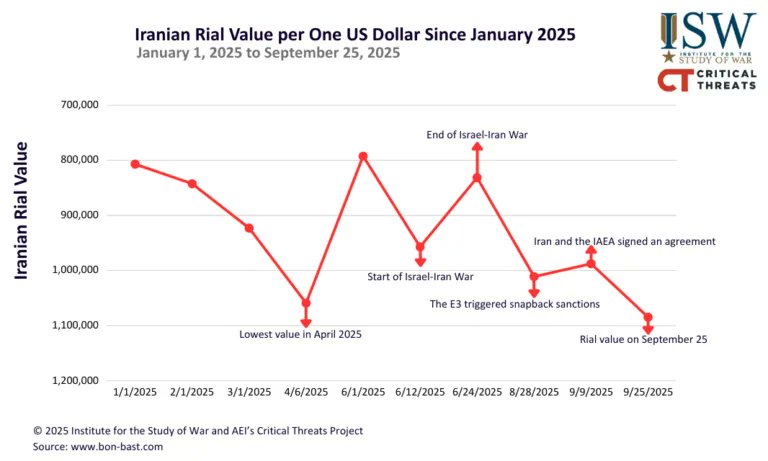
Iran is preparing economic measures to try to withstand the likely reimposition of UN Security Council (UNSC) sanctions on September 27. UNSC Resolution 2231 endorsed the 2015 Joint Comprehensive Plan of Action (JCPOA) and terminated six earlier UNSC resolutions.[26] The E3 (the United Kingdom, France, and Germany) triggered the 30-day JCPOA snapback process on August 28.[27] The UNSC will reimpose the six suspended resolutions, which include sanctions on Iranian military and nuclear entities, on September 27 unless Iran meets its obligations laid out under the JCPOA. Iranian Oil Minister Mohsen Paknejad claimed on September 24 that the Iranian government has developed contingency plans to counter snapback sanctions and claimed that oil sales will continue at their current rate despite sanctions.[28] Paknejad added that snapback sanctions will not directly target Iranian oil sales but could affect trade, finance, and shipping.[29] Central Bank Governor Mohammad Reza Farzin similarly stated on September 24 that the bank will stabilize the Iranian currency if UNSC sanctions are reimposed.[30] Farzin also claimed that the Central Bank will sell more gold coins and bullion to keep the gold market stable and control inflation.[31] The Iranian rial reached 1,085,000 rials per one US dollar on September 25, reflecting Iranian anticipation about imminent snapback sanctions.[32]
International Atomic Energy Agency (IAEA) Director General Rafael Grossi stated on September 23 that Iran still retains the capacity to advance its nuclear program after US and Israeli strikes targeted Iranian nuclear facilities in June 2025.[33] Grossi stated that the strikes may not have damaged all Iranian centrifuges and that Iran retains facilities to manufacture centrifuge components.[34] Grossi also stated that it would take Iran only “weeks” to enrich its uranium stockpile to 90 percent.[35] Israel struck the Iran Centrifuge Technology Company (TESA) workshop in Karaj, west of Tehran, and the Tehran Nuclear Research Center (TNRC) in Tehran Province during the Israel-Iran War.[36] Iran manufactured centrifuge components at TESA and manufactured and tested advanced centrifuge rotors at the TNRC.[37]
Iran showcased its nuclear technology at the 2025 Atom Expo in Moscow on September 25.[38] Atomic Energy Organization of Iran head Mohammad Eslami presented advancements in Iran's nuclear technology on September 25.[39] China, Belarus, Kazakhstan, and Uzbekistan also participated in the exhibition.[40] Eslami met with Russian President Vladimir Putin and IAEA Director General Rafael Grossi on the sidelines of the event.[41] Eslami announced that Iran plans to develop large nuclear power plants and small modular reactors (SMRs) with the help of Russian state-owned atomic energy corporation Rosatom.[42] Eslami and the Rosatom director general signed a memorandum of understanding on September 24 for Russia to build eight SMRs in Iran, including four at the Bushehr Nuclear Power Plant.[43]
Indian officials recently discussed the possibility of purchasing oil from Iran and Venezuela in exchange for reducing Russian oil imports with the Trump administration.[44] An anonymous source with knowledge of the discussion told Bloomberg on September 25 that an Indian delegation visiting the United States emphasized to the Trump administration that India must receive oil from Iran and Venezuela in order to be able to suspend oil imports from Russia without causing a spike in global oil prices. India has not purchased oil from Iran since 2019.
https://understandingwar.org/research/middle-east/iran-update-september-25-2025/