Skip to comments.
Iranian Regime tv Channel One hacked while it was airing Khamenie speech
various
| 10-8-22
Posted on 10/08/2022 1:05:38 PM PDT by nuconvert
Iranian Regime national tv Channel One hacked about an hour ago. During a broadcast of Khamenie speech, a red crosshair appeared over his face and chanting of Women. Life. Freedom. There was writing to the side saying "Rise up. Join us". Also 4 photos at the bottom of the screen of young people killed and additional writing: "The blood of our youth is dropping from your paws".
Also, there was a huge banner in the middle of Tehran highway today that read: We are no longer afraid of you. We will fight.
Also, attempted attack on IRI ambassador in Denmark. Her bodyguard was stabbed. Diplomatic Security intervened before the attacker could stab the ambassador.
TOPICS:
KEYWORDS: basij; deathtothemullahs; denmark; ebrahimrigi; erdogan; iran; iranprotests; iraq; irgc; iri; israel; khameini; khamenei; kurdistan; lebanon; mahsaamini; mullahloversonfr; mullahsmustbekilled; najisharifizindashti; protests; qudsforce; raisi; receptayyiperdogan; shahrammaroufmola; syria; turkey; yemen; zahedi
Navigation: use the links below to view more comments.
first previous 1-20 ... 1,761-1,780, 1,781-1,800, 1,801-1,820 ... 2,321-2,328 next last
To: nuconvert; gleeaikin; blitz128; BeauBo; PIF; ETCM; SpeedyInTexas; bert; GBA; Cronos
A sloppy AI disinformation campaign by the Iranians:
Mojtaba Ali Khamenei, son of Sayyid Ali Khamenei, says:
“In the name of Allah, greetings to the brave people of Iran who stay strong in hard times. As we take on this leadership, we promise to follow the path of our martyrs, working for honor, freedom, and dignity.”
https://x.com/TheAbdulSamad/status/2029310288164524180
This video is a combination of the supreme sh-t and his son, but they accidentally simulated Ali’s right arm as well. In 1981, a bomb exploded inside a mosque in Tehran, permanently paralysing his right arm. If MK succeeds his father, it will establish a dynastic Shiite kingdom.
1,781
posted on
03/06/2026 3:39:20 AM PST
by
AdmSmith
(GCTGATATGTCTATGATTACTCAT)
1,782
posted on
03/06/2026 9:14:42 AM PST
by
AdmSmith
(GCTGATATGTCTATGATTACTCAT)
To: AdmSmith; BeauBo; MalPearce; nuconvert; Jonty30; ETCM; PIF
If I remember correctly Ari Reza Arafi, who is mentioned on the first line of paragraph #4, is the father of Khamanei’s son’s wife. He is the son now being considered for the leadership. His wife and one son have just been killed by our or the Israeli bombs. Boy will he be a great guy to have a good relationship with after all that.
1,783
posted on
03/06/2026 3:56:16 PM PST
by
gleeaikin
(Question Authority: report facts, and post their links in your message.)
To: nuconvert; gleeaikin; blitz128; BeauBo; PIF; ETCM; SpeedyInTexas; bert; GBA; Cronos
Iran Update Evening Special Report, March 5, 2026
The Israel Defense Forces (IDF) has continued strikes targeting Iranian ballistic missile infrastructure in order to degrade Iranian missile capabilities. The IDF reported on March 5 that Israeli aircraft had struck hundreds of missile launch sites across Iran and rendered over 300 ballistic missile launchers inoperable since February 28. Degrading Iranian air defenses allows US and Israeli aircraft to operate with less risk and greater freedom of operation over Iranian airspace.
The US and Israeli combined force has advanced to the next phase of their campaign, which will focus on targeting Iranian defense industrial assets, especially missile production facilities. The first phase of the campaign suppressed Iranian air defenses, decapitated its command and control, and limited its ability to retaliate with ballistic missiles and drones. The IDF issued an evacuation warning on March 5 for the Abbas Abad Industrial Zone and Shenzar Industrial Zone in Pakdasht, Tehran Province, likely in preparation to target Iran's defense industrial base.
The combined force continues to conduct airstrikes targeting key internal security sites in and around Tehran City as well as Kurdish-populated areas of northwestern Iran. These targets range from regional Law Enforcement Command (LEC) and Islamic Revolutionary Guards Corps (IRGC) headquarters to local police stations in areas that have been hotspots for unrest.
The combined forces have continued to strike the IRGC Ground Forces’ special forces and rapid response units in southwestern Iran. The combined force has not yet struck other IRGC or Artesh special forces bases or infrastructure at scale across the country. The internet shutdown may be affecting ISW-CTP’s ability to observe these strikes, however.
US President Donald Trump said on March 5 that he would support Kurdish forces conducting an offensive into Iran. Trump told Reuters that he would be “all for” a Kurdish offensive into Iran but did not commit to supporting the operation with airstrikes. Senior Iraqi Kurdish officials have denied that Kurdish forces are deploying or planning to deploy into Iran, however.
US President Donald Trump told Western media on March 5 that the United States must be involved in the process of selecting a new supreme leader in Iran. Trump stated that he will not accept a new Iranian leader who will continue former Supreme Leader Ali Khamenei’s policies.
The Artesh and Iranian state media claimed that Iranian forces carried out drone strikes against US forces at Camp Buehring, Kuwait, on March 5. The Iranian Artesh separately launched drone strikes that targeted a US base in Erbil, Iraq, on March 5, according to Iranian media.
https://understandingwar.org/research/middle-east/iran-update-evening-special-report-march-5-2026/
Iran Update Morning Special Report, March 6, 2026
The combined force has targeted the Iranian internal security infrastructure on March 6 to degrade the regime's ability to maintain domestic control. The combined force targeted several law enforcement command and paramilitary facilities, including police stations in Kurdistan and West Azerbaijan Provinces, and two Basij Resistance bases in Tehran Province on March 6.
The combined force has targeted key Iranian military infrastructure across multiple provinces, including missile sites, command and control institutions, and naval facilities. The combined force struck a ballistic missile site in Zanjan Province and the Imam Ali Missile Base near Khorramabad in Lorestan Province.
Hezbollah claimed that the group conducted 18 attacks targeting Israel Defense Forces (IDF) positions and forces in northern Israel and southern Lebanon since ISW-CTP’s last data cutoff at 4:00 PM ET. Hezbollah claimed on March 5 that its fighters engaged and shelled Israeli ground forces in Markaba, Khiam, and Wadi al Asafir, Marjaayoun District.
https://understandingwar.org/research/middle-east/iran-update-morning-special-report-march-6-2026/
Iran Update Evening Special Report, March 6, 2026
Russia is reportedly sharing intelligence with Iran to support Iranian attacks against US forces in the Middle East, which highlights the deepening cooperation between two major US adversaries. Three officials familiar with the intelligence on Russia's support for Iran told the Washington Post on March 6 that Russia has given Iran the locations of US military assets, including warships and aircraft, since the US-Israeli February 28 strikes against Iran.[1] One of the officials characterized Russia's provision of targeting information to strike US forces in the Middle East as a “pretty comprehensive effort.”[2] The Washington Post noted that analysts indicated that Russia's reported intelligence sharing fits the pattern of Iran's strikes against US command and control infrastructure, radars, and temporary structures. The Center for Naval Analyses (CNA) Principal Research Scientist Mike Peterson stated that Russia could be giving Iran high-quality satellite imagery with which Iran could identify what bases the United States and its allies are currently using and other information, such as the location of aircraft, intelligence stations, and logistics flows.[3] Iran may not have regular access to high-quality satellite imagery, even from commercially available sources, and may be relying on Russia to get such imagery. Prominent commercial publisher of satellite imagery, Planet Labs, enacted a policy on March 6, subjecting all new imagery collected over the Gulf States and adjacent conflict zones, excluding Iran, to a mandatory 96-hour delay before making it publicly available, and other companies have held policies to never release images of US or allied bases.[4] Russian intelligence sharing, thus, may be supporting Iranian strikes on US military assets.
China may be preparing to provide Iran with support, according to multiple people familiar with US intelligence on this issue.[5] The intelligence suggests that China may be preparing to provide Iran with financial assistance and missile components.[6] China has historically provided Iran with sodium perchlorate to support Iran's ballistic missile program.[7] Sodium perchlorate is a chemical precursor for solid missile propellant. European intelligence sources told CNN in October 2025 that Iran received 2,000 tons of sodium perchlorate in several shipments that arrived in Bandar Abbas, Iran, from China.[8] These shipments came amid Iranian efforts to rebuild its ballistic missile program following the June 2025 Israel-Iran war.[9]
The US-Israeli combined force has continued strikes targeting Iranian ballistic missile infrastructure in order to degrade Iranian missile capabilities and ultimately destroy the Iranian ballistic missile program. US Central Command (CENTCOM) Commander Admiral Brad Cooper stated on March 5 that ballistic missile attacks from Iran have declined by roughly 90 percent since the strikes began. A campaign that destroys Iran's ballistic missile launchers, stockpiles, and production facilities would accomplish the US stated objective to “raze or level Iran's ballistic missile industrial base” and systematically dismantle Iran's missile production capability.
The combined force is continuing to target Iran's defense industrial base, especially facilities that support drone development. The IDF targeted the Shokouhiyeh Industrial Zone in Qom Province and the Esteghlal Industrial Zone in Tehran Province, as well as an ammunition production facility and an ammunition depot in Tehran and Fars provinces.
Iran has continued to retaliate against Israel, US bases in the Middle East, Gulf states, and other regional countries for the joint force strike campaign. Iran has launched at least six waves of ballistic missile attacks in the previous six days. The lower number of missile attacks further demonstrates the joint forces’ success in degrading Iran's number of missile launchers.
more + maps: https://understandingwar.org/research/middle-east/iran-update-evening-special-report-march-6-2026/
1,784
posted on
03/06/2026 11:05:52 PM PST
by
AdmSmith
(GCTGATATGTCTATGATTACTCAT)
1,785
posted on
03/06/2026 11:58:48 PM PST
by
AdmSmith
(GCTGATATGTCTATGATTACTCAT)
06MAR2026 Everyone talks about Iranian oil in barrels. Nobody talks about what is inside them. That difference is why Western refineries have been running shadow networks through Dubai for twenty years to get it despite the sanctions.

Crude oil is not a uniform commodity. It is a spectrum of hydrocarbons with different molecular weights, and the composition of a given crude determines how easily it converts into the products refineries actually want to sell: gasoline, diesel, jet fuel, heating oil. The measurement that captures this is API gravity. Higher API gravity means lighter crude with shorter carbon chains, which means lower energy cost to crack, lower processing cost to refine, and higher yield of the light distillates that carry premium pricing. Lower API gravity means heavier crude requiring more energy, more processing steps, more capital equipment, and producing a higher share of lower-value residuals.
Iranian Light crude runs at 33 to 36 degrees API gravity with sulfur content between 1.36 and 1.5 percent. That is the refinery sweet spot. It is light enough to yield high fractions of gasoline and middle distillates without excessive processing costs, but heavy enough to produce the full range of products that complex refineries are designed to process. It is what petroleum engineers call an optimal blend crude.
Now compare the alternatives.
Venezuelan Merey heavy crude runs at approximately 16 degrees API gravity with sulfur between 3 and 5 percent. Refining it profitably requires a coking unit, a hydrocracker, and an extensive desulfurization train. The equipment exists. The economics work for refineries purpose-built around Venezuelan feedstock. It is not a substitute for Iranian crude. It is a different product requiring different industrial infrastructure.
US West Texas Intermediate runs at 39 to 40 degrees API with sulfur below 0.25 percent. In theory, the cleanest and easiest crude to process. In practice, it is so light that it does not yield the heavier middle distillates a complex refinery needs to run at full capacity. European and Asian refineries built around medium crudes cannot switch to WTI without blending it with heavier crudes to achieve the molecular weight distribution their process units require. WTI is not a drop-in replacement for Iranian medium.
Iranian oil fits where both US shale and Venezuelan heavy do not. It is the liquid that flows through the middle of the global refining system without requiring either the coking infrastructure for heavy crudes or the blending operations for ultra-light shale. That molecular fit is why it commands a persistent premium above comparable grades. It is why Indian refineries maintained Iranian crude purchases through every round of sanctions and negotiated the logistics to keep that flow moving. It is why the Dubai shadow banking and trading network that the UAE is now considering dismantling existed in the first place.
The Strait of Hormuz does not just carry oil. It carries the specific category of oil that the global refining system was built to process most efficiently. Closing it does not just reduce supply. It removes the grade of crude that the system runs best on and forces every refinery in the world to run less efficiently on whatever it can find as a substitute.
That is the premium embedded in the $82 oil price. Not just volume. Molecular weight.
https://x.com/shanaka86/status/2029811061264896293
1,786
posted on
03/07/2026 12:01:29 AM PST
by
AdmSmith
(GCTGATATGTCTATGATTACTCAT)
To: AdmSmith; BeauBo; dennisw; george76
Are US refineries able to mix Venezuela heavy crude with lighter WTI and end up with a mix of the ideal API gravity for refining? What about those Canada tar sands? Can they be blended, or how are they refined?
1,787
posted on
03/07/2026 7:34:37 AM PST
by
gleeaikin
(Question Authority: report facts, and post their links in your message.)
To: gleeaikin
No need to do any mixing. We have the refineries that love heavy Venezuelan crude.>>>>>>>>>>>
-
-
-
-
-Yes, you’re spot on—Louisiana has several major refineries that are well-suited (and in many cases, historically built or optimized) to process heavy, sour crudes like Venezuela’s Merey, which runs around 16° API with 3-5% sulfur. These facilities feature the key units you mentioned: coking (for upgrading residues), hydrocracking (for converting heavy fractions into lighter products), and extensive desulfurization/hydrotreating trains (to handle the high sulfur and meet clean fuel specs).
Many Gulf Coast refineries, especially in Louisiana and nearby Texas, were designed during eras when Venezuelan (and similar heavy) crudes were a primary feedstock, before the shale boom shifted more supply to lighter oils. This makes them economically efficient for Merey-type feedstocks when available, often at a discount to lighter crudes.
Key examples in Louisiana include:ExxonMobil Baton Rouge Refinery (≈522,500 bpd): This large complex has previously processed Venezuelan heavy sour crude and was preparing to resume runs as of early 2026 reports, after sanctions limited it. It includes coking, hydrocracking, and desulfurization capabilities suited for heavy/sour feeds.
Phillips 66 Lake Charles Refinery (≈264,000 bpd): Explicitly noted as capable of running Venezuelan crude (part of Phillips 66’s system that can handle up to 250,000+ bpd of it across Gulf facilities). It has delayed coking, hydrocracking, and hydrodesulfurization units.
CITGO Lake Charles Refinery (≈460,000-463,000 bpd): Historically tied to Venezuelan feedstock (as CITGO was owned by PDVSA), optimized for heavy sour crudes like Merey. It has been positioned to resume or increase such processing post-sanctions changes, with appropriate upgrading and treating units.
1,788
posted on
03/07/2026 4:47:11 PM PST
by
dennisw
(There is no limit to human stupidity / )
Iran Update Morning Special Report, March 7, 2026
Iran continued drone and ballistic missile attacks on Gulf states despite President Masoud Pezeshkian’s order to suspend strikes unless attacks on Iran originated from their territory.
The combined force has continued to target Basij bases in Tehran to degrade the regime's ability to maintain domestic control. The Basij is a paramilitary force that is responsible for civil defense and social control.
Commercially available satellite imagery shows that the combined force has targeted at least nine of the 23 Basij regional bases in Tehran as of March 6.
The combined force struck two Artesh airbases in Esfahan Province on March 7 to suppress and destroy Iranian air defenses over the province and extend air dominance into central Iran. The combined force has established air superiority over Tehran and has likely done so over parts of western Iran.
The combined force struck an unidentified vehicle at the Mount Kolang Gaz La facility, south of the Natanz Enrichment Complex, on March 6. The Institute for Science and International Security reported that US-Israeli strikes targeted and destroyed a vehicle at the Mount Kolang Gaz La facility, citing March 6 satellite imagery. The Institute assessed that the vehicle may be related to air defense, but ISW-CTP could not come to an independent conclusion based on the available evidence.
https://understandingwar.org/research/middle-east/iran-update-morning-special-report-march-7-2026/
Iran Update Evening Special Report, March 7, 2026
Senior Iranian hardline officials are upset over Iranian President Masoud Pezeshkian’s March 7 statement about Iranian attacks on regional countries. Pezeshkian’s comments reiterated a long-standing regime policy rather than signal a policy shift, yet still drew criticism from hardliners, which highlights the extent of divisions within Iran's leadership.[1] Pezeshkian apologized on March 7 to regional countries that Iran has attacked since the start of the conflict and said that the Leadership Council, which assumed the duties of the supreme leader after his death, ordered the Armed Forces not to attack any country unless that country attacks Iran.[2] Pezeshkian clarified in a post on X that Iranian attacks on regional countries exclusively target US facilities rather than host countries themselves.[3] This claim is false. Iran has struck sites in Middle Eastern countries that are not US bases, including a drone strike on the Hayat Palace Hotel in Bahrain on March 3.[4] Pezeshkian’s statement echoes the regime's long-standing position on regional attacks. The regime has historically threatened or used military force to pressure Gulf countries to sever ties with the United States and to deter US action against Iran.[5] Iran and Iran-backed actors have previously cited the presence of US assets in Middle Eastern countries to justify indiscriminate attacks on those countries.[6] Hardline parliamentarian Hamid Rasaei dismissed Pezeshkian’s statement as “weak, unprofessional, and unacceptable” and urged the Assembly of Experts to select a new supreme leader soon so it can dissolve the Leadership Council.[7] An unspecified hardliner close to the office of former Supreme Leader Ali Khamenei told Reuters that several senior commanders in the Islamic Revolutionary Guard Corps (IRGC) were also upset with Pezeshkian’s statement.[8] Pezeshkian’s office released a readout of the speech after the backlash that once again reiterated the regime's position but notably omitted Pezeshkian’s apology to regional countries, which was almost certainly a response to the criticism.[9]
The combined force expanded its airstrike campaign to include Iranian oil production and storage facilities for the first time on March 7. The IDF struck two oil refineries and two oil storage facilities in Iran. Disruptions to Iran's energy sector will likely worsen the country's ongoing energy crisis and lead to more widespread and frequent electricity shortages and outages.
An Israeli journalist reported on March 7 that Israel estimates that Iran has about 120 missile launchers remaining. US Central Command (CENTCOM) Commander Admiral Brad Cooper stated on March 5 that ballistic missile attacks from Iran have declined by roughly 90 percent since the strikes began.
Ukrainian President Volodymyr Zelensky discussed the Iranian drone threat with Saudi Crown Prince Mohammad bin Salman al Saud on March 7.[21] Iranian drone strikes targeting Saudi territory have damaged civilian infrastructure and forced the closure of Saudi Arabia's largest domestic oil refinery and export terminal.[22] Zelensky said that Ukraine is “ready to help” Saudi Arabia address the threat posed by Shahed drones.[23] Ukraine has years of experience defending against almost nightly large-scale Russian drone and missile strike packages, which have included Iranian-origin strike drones much like those the United States and its allies currently face in the Middle East.[24] Ukraine has a reported 90 percent interception rate of such drones.[25] Reuters reported on March 5, citing a source familiar with the matter, that US and Qatari officials are in talks with Ukraine to purchase Ukrainian interceptor drones to intercept Iranian Shahed drones.[26]
USS George H. W. Bush Carrier Strike Group is reportedly expected to deploy soon, potentially to the Middle East.[27] The US Navy announced that USS George H. W. Bush Carrier Strike Group (CSG) completed Composite Training Unit Exercise on March 6.[28] CSG Commander Rear Admiral Alexis Walker said that the completion of the training exercise means that the CSG is “ready for major combat operations around the world.”[29] The US Naval Institute News said that the USS George H W Bush CSG is the “next expected [CSG] to deploy from the United States.”[30] The United States currently has two CSGs within the US Central Command area of responsibility in the Red Sea and Persian Gulf.[31]
The combined force struck the IRGC Aerospace Force infrastructure in Tehran on March 7, likely to degrade Iranian air defense capabilities and command and control. The IRGC Aerospace Force is the principal operator of the Iranian missile and drone arsenals.
more + maps https://understandingwar.org/research/middle-east/iran-update-evening-special-report-march-7-2026/
1,789
posted on
03/08/2026 5:49:40 AM PDT
by
AdmSmith
(GCTGATATGTCTATGATTACTCAT)
1,790
posted on
03/08/2026 5:53:21 AM PDT
by
AdmSmith
(GCTGATATGTCTATGATTACTCAT)
To: nuconvert
Iran apologises for strikes on Gulf states, but attacks continue: Who commands Guards amid Tehran power vacuum?
“The interim leadership council agreed yesterday [Friday] that no more attacks will be made on neighbouring countries and no missiles will be fired unless an attack on Iran originates from those countries,” he added, saying the issue should be resolved through diplomacy. However, despite the council’s decision, Iranian missiles and drones were reported targeting several Gulf states on Saturday as the conflict widened, triggering air defence responses in Bahrain, Saudi Arabia and the United Arab Emirates.
Iran’s paramilitary Islamic Revolutionary Guard Corps (IRGC), which has been at the forefront of the conflict, traditionally answers directly to the country’s supreme leader rather than the elected government. However, an Israeli airstrike at the start of the war killed Khamenei, leaving the position vacant and forcing Iran’s political leadership to rely on a temporary leadership council.
Under Iran’s constitution, a three-member interim council — including the president, judiciary chief Gholamhossein Mohseni Ejei and a senior cleric chosen by the Assembly of Experts — assumes the powers of the supreme leader until a successor is appointed.
Who commands Iran’s military now?
Normal command structure
In Iran’s system, the Supreme Leader serves as the commander-in-chief of the armed forces.
He directly controls the Islamic Revolutionary Guard Corps (IRGC), the regular army (Artesh) and the country’s missile forces.
The IRGC — which oversees Iran’s missile programme and many regional operations — normally answers only to the Supreme Leader, not to the elected government.
What happens if the Supreme Leader dies
Under Iran’s constitution, if the Supreme Leader dies or is unable to perform his duties, a temporary leadership council assumes his powers until a successor is chosen by the Assembly of Experts.
The council usually includes:
the President
the Chief Justice
a senior cleric selected by the Assembly of Experts
In theory, the council temporarily assumes the Supreme Leader’s authority, including command over the armed forces.
Analysts say the arrangement could complicate the chain of command during wartime. The powerful IRGC operates with significant autonomy, and battlefield decisions may still be taken by commanders on the ground.
President Masoud Pezeshkian’s reference to “miscommunication within the ranks” suggests that some recent attacks may not have been centrally coordinated as Iran’s leadership works to stabilise the command structure. Analysts also say Iran’s elected leadership has limited authority over military and strategic decisions, which are largely controlled by the office of the Supreme Leader and the powerful Islamic Revolutionary Guard Corps (IRGC).
https://gulfnews.com/world/mena/iran-apologises-for-gulf-strikes-but-attacks-continue-who-commands-guards-amid-tehran-power-vacuum-1.500466490
1,791
posted on
03/08/2026 9:51:34 AM PDT
by
AdmSmith
(GCTGATATGTCTATGATTACTCAT)
To: nuconvert; gleeaikin; blitz128; BeauBo; PIF; ETCM; SpeedyInTexas; bert; GBA; Cronos
1,792
posted on
03/08/2026 2:39:36 PM PDT
by
AdmSmith
(GCTGATATGTCTATGATTACTCAT)
1,793
posted on
03/08/2026 3:52:57 PM PDT
by
AdmSmith
(GCTGATATGTCTATGATTACTCAT)
Iran Update Morning Special Report, March 8, 2026
Geolocated satellite imagery published on March 7 confirms that the IDF struck the Shahroud Missile Facility in Semnan Province, northeastern Iran. The IDF struck buildings at the Shahroud Missile Facility during the June 2025 Israel-Iran War that had previously housed planetary mixers, which are essential for producing ballistic missile solid fuel. Satellite imagery published by the Associated Press in September 2025 showed that Iran had started repairing damaged mixer buildings at Shahroud.
The combined force has reportedly targeted at least five internal security sites in and around Esfahan City, central Iran, since CTP-ISW’s last data cutoff at 3:00 PM ET on March 7. These sites include the Esfahan Province Law Enforcement Command (LEC) Headquarters, which oversees LEC units in Esfahan Province.
The IDF has continued to conduct airstrikes against Hezbollah to degrade Hezbollah's ability to launch attacks against IDF forces and positions in northern Israel and southern Lebanon. The IDF stated on March 8 that it has struck more than 600 Hezbollah targets and killed more than 200 Hezbollah fighters in Lebanon since February 28.
Iran has continued to target regional countries and Israel since CTP-ISW’s last data cutoff at 3:00 PM ET on March 7.
Iran conducted two separate drone attacks against Kuwait on March 7, targeting the Kuwaiti Social Security Building and fuel storage tanks at the Kuwait International Airport. Unspecified security sources told Reuters that unidentified actors conducted a drone attack targeting the United Nations building in Sulaymaniyah, Iraqi Kurdistan.
Hezbollah has claimed 19 attacks targeting IDF positions and forces in northern Israel and southern Lebanon since CTP-ISW’s last data cutoff at 3:00 PM ET on March 7.
https://understandingwar.org/research/middle-east/iran-update-morning-special-report-march-8-2026/
Iran Update Evening Special Report, March 8, 2026
Iran's Assembly of Experts selected former Supreme Leader Ali Khamenei’s son, Mojtaba Khamenei, as the next Supreme Leader on March 8.[1] Mojtaba’s selection as the Supreme Leader represents a victory for hardline factions over more pragmatic figures within the regime. Mojtaba is a hardline cleric who will likely pursue similar domestic and foreign policies to those of his father. Mojtaba fought in the Iran-Iraq War and developed important relationships while serving in the Habib Ibn Mazahir Battalion under the 27th Mohammad Rasoul Allah Division.[2] Many members of the Habib Battalion went on to hold influential positions, particularly in the Islamic Revolutionary Guards Corps (IRGC) Intelligence Organization.[3] Mojtaba maintained ties to these individuals, such as former IRGC Intelligence Organization Chief Hossein Taeb. Mojtaba used these relationships to cement his role in Iran's security apparatus. Mojtaba reportedly played a leading role in securing former hardline President Mahmoud Ahmadinejad's victory in 2009 and subsequently took control of the Basij to crush the protests over Ahmadinejad's election, for example.[4] US President Donald Trump told Axios on March 5 that Mojtaba was an unacceptable candidate to become Iran's new Supreme Leader.[5]
Mojtaba will face several immediate challenges, including trying to establish his legitimacy and attempting to unite and gain the support of various regime factions. Mojtaba’s connections to the IRGC and the Office of the Supreme Leader may mitigate some of these challenges, however. Mojtaba is a mid-level cleric like his father was when he assumed the position, which has historically caused his candidacy to be controversial.[6] Prominent clerics have publicly questioned Mojtaba’s religious credentials, for example.[7] Mojtaba will also likely face criticisms that the Islamic Republic is transforming into a monarchy with hereditary succession, particularly because Ali Khamenei reportedly opposed hereditary succession.[8] Mojtaba will additionally have to contend with a very fractured regime and attempt to unite and gain the support of various factions at a point when the regime is facing unprecedented internal and external pressure. Anti-regime media recently reported that the IRGC pushed for Mojtaba’s selection.[9] It is unclear which specific factions within the IRGC support Mojtaba, but this support may mitigate some of the challenges Mojtaba will face.
Mojtaba’s selection represents a victory for hardliners over more pragmatic figures within the regime. Some Assembly of Experts members, such as hardline cleric Ayatollah Mohammad Mehdi Mir Bagheri, wanted the Assembly of Experts to quickly appoint a new Supreme Leader after Ali Khamenei’s death, likely, in part, to make it difficult for those who opposed Mojtaba’s candidacy to have sufficient time to convince others to oppose Mojtaba.[10] More pragmatic figures within the regime appear to oppose Mojtaba. Anti-regime media reported on March 6 that Supreme National Security Council Secretary Ali Larijani had wanted his brother, Sadegh Amoli Larijani, to become the next Supreme Leader, which would have given Ali Larijani immense power within the regime.[11] Anti-regime media previously reported in September 2025 that Ali Larijani was “competing to position [himself] for a potential succession.“[12] The New York Times reported on February 22 that Khamenei had tasked Ali Larijani with “steering the country” during the recent protests and that Larijani has “effectively been running the country” since then.[13]
Ukraine will send an unspecified number of Ukrainian military personnel with expertise in downing Shahed drones to Gulf states, underscoring how Ukraine's experience in defending against Iranian drones can strengthen the air defenses of the United States and its allies in the Middle East.
The US-Israeli combined force continued to target Iranian ballistic missile infrastructure in order to degrade Iranian missile capabilities and ultimately destroy the Iranian ballistic missile program. The IDF has attacked over 400 targets, including ballistic missile launchers and weapons production sites, in western and central Iran over the past day. The IDF has destroyed around 75 percent of Iran's missile launchers.
The combined force continued to target Iranian internal security institutions in Tehran City and western Iran. OSINT accounts reported combined force airstrikes targeting LEC headquarters in Borujerd, Lorestan Province, Kuhdasht, Lorestan Province, Eslamabad-e Gharb, Kermanshah Province, and Abdanan, Ilam Province.
Iran continued to attack regional countries on March 7 and
8. An Iranian drone damaged a desalination plant in Bahrain. The Saudi Civil Defense Authority reported on March 8 that an unspecified projectile fell on a residential area in Kharj, Saudi Arabia, killing two individuals and wounding 12 others.
The IDF has continued to conduct airstrikes targeting Hezbollah across Lebanon to degrade Hezbollah's ability to launch attacks targeting Israeli forces and positions in northern Israel and southern Lebanon. The IDF has conducted over 100 strikes in Lebanon in the past 24 hours and a total of 600 strikes using 820 munitions in Lebanon since the war began on February 28.
details https://understandingwar.org/research/middle-east/iran-update-evening-special-report-march-8-2026/
1,794
posted on
03/09/2026 12:43:18 AM PDT
by
AdmSmith
(GCTGATATGTCTATGATTACTCAT)
Iran Update Morning Special Report, March 9, 2026
The combined force has struck several key Islamic Revolutionary Guards Corps (IRGC) Ground Forces sites in Esfahan Province. The IDF struck the Seyyed ol Shohada Operational Base, which oversees IRGC Ground Forces units in three provinces. The combined force struck the IRGC Ground Forces 14th Imam Hossein Division, which operates under the Seyyed ol Shohada Operational Base and was deployed to Syria during the Syrian civil war. The IDF also struck the Saheb ol Zaman Provincial Unit, which has been involved in protest suppression.
Iran has continued to attack Israel and other regional countries since ISW-CTP’s last data cutoff at 3:00 PM ET on March 8. The Turkish Defense Ministry stated on March 9 that a ballistic missile launched from Iran entered Turkish airspace. NATO air defenses intercepted the missile, and some debris from the missile landed in Gaziantep Province, southeastern Turkey. Israeli media separately reported on March 9 that Iranian cluster munitions killed one person and wounded three others at six impact sites in central Israel.
The combined force also continued to strike Law Enforcement Command (LEC) institutions in central and western Iran. The IDF confirmed on March 9 that it struck the Esfahan City LEC Headquarters. The combined force previously struck the Esfahan Province LEC Headquarters.
Hezbollah claimed that its fighters have engaged Israeli forces advancing into Lebanon on three separate axes since ISW-CTP’s last data cutoff on March 8.
https://understandingwar.org/research/middle-east/iran-update-morning-special-report-march-9-2026/
Iran Update Evening Special Report: March 9, 2026
The US-Israeli combined force has severely degraded Iran’s missile and drone capabilities, which has limited Iran’s ability to launch retaliatory attacks in the region.
The combined force has degraded Iran’s internal security apparatus in Tehran and parts of western Iran. The combined force has struck dozens of internal security institutions across central and western Iran since February 28.
The combined force targeted a company in Tehran that is involved in the regime’s censorship and filtering of the internet. The combined force struck the Sahab Pardaz Company, which the United States sanctioned in October 2022 for providing “censorship, surveillance, and espionage tools” to the Iranian regime.
The IDF confirmed that Hezbollah is using long-range projectiles to attack Israel. Senior Israeli officials said that they expect Hezbollah to increase the volume of its rocket and drone attacks against Israel in “the coming days” as part of an effort to “draw Israeli attention away” from Iran.
more + maps : https://understandingwar.org/research/middle-east/iran-update-evening-special-report-march-9-2026/
1,795
posted on
03/10/2026 9:53:46 AM PDT
by
AdmSmith
(GCTGATATGTCTATGATTACTCAT)
To: nuconvert
Iran Update Morning Special Report, March 10, 2026
The combined force struck several targets in Tehran overnight on March 9 and 10, including the IRGC “Quds Force headquarters” and an IRGC weapons research and development facility.
The combined force struck multiple sites in Bandar Abbas, Hormozgan Province, on March 10, which may have included the Artesh Air Force 9th Tactical Airbase. ISW-CTP has recorded combined force airstrikes targeting 11 out of Iran’s 17 Artesh Air Force tactical airbases since February 28.
Iran launched three missile barrages at Israel between 3:00 PM ET on March 9 and 8:00 AM ET on March 10. US Defense Secretary Pete Hegseth noted during a Pentagon briefing on March 10 that Iran had fired its lowest number of missiles since the war began over the last 24 hours. The IDF said on March 10 that Iranian missile barrages in recent days have included only a few missiles at a time, but that around 50 percent of Iranian ballistic missiles fired at Israel have contained cluster warheads.
Hezbollah has claimed 18 attacks targeting IDF positions and forces in northern Israel and southern Lebanon since ISW-CTP’s last data cutoff at 3:00 PM ET on March 9. The IDF confirmed that Hezbollah is using long-range projectiles to attack Israel, after Hezbollah claimed that it launched “high-quality missiles” targeting the IDF Rehavam Camp in Ramla, Central Israel, on March 9.
The IDF has continued to conduct airstrikes targeting Hezbollah across Lebanon to degrade Hezbollah’s ability to launch attacks targeting Israeli forces and positions in northern Israel and southern Lebanon. The IDF has reportedly continued to advance into southern Lebanon on three separate axes since ISW-CTP’s last data cutoff on March 9.
https://understandingwar.org/research/middle-east/iran-update-morning-special-report-march-10-2026/
Iran Update Evening Special Report, March 10, 2026
US Central Command (CENTCOM) reported on March 10 that US forces destroyed 16 Iranian minelayers near the Strait of Hormuz. Iranian mining efforts are part of a broader Iranian effort to disrupt maritime traffic in the Strait of Hormuz and the Persian Gulf to try to impose a cost on the Gulf states and the United States. Iranian efforts to mine the Strait of Hormuz will also likely further hinder Iran’s ability to export oil, including shipments to China, the largest importer of Iranian oil.
The Iranian regime is expanding securitization efforts amid the ongoing conflict, which likely reflects the regime’s paranoia about US-Israeli infiltration and signals a shift to prioritization of counterintelligence. The regime similarly prioritized regime security following the June 2025 Iran-Israel War and arrested hundreds of individuals in the days after the conflict as part of a broader effort to strengthen internal control and expand securitization measures.
The combined force targeted Iranian internal security institutions in western and northwestern Iran. Refer to the graphic below to see key Iranian internal security sites that have been struck since the start of the war.
The combined force continues to strike Iranian-backed Iraqi militia targets in Iraq to limit the ability of Iranian-backed Iraqi militias to conduct retaliatory attacks against the United States and Israel.
Hezbollah claimed 29 attacks targeting IDF forces and positions in northern Israel and southern Lebanon between 3:00 PM ET on March 9 and 3:00 PM ET on March 10. Hezbollah’s 29 claimed attacks are the highest number of claimed attacks in a 24-hour period that ISW-CTP has observed since the start of the conflict.
https://understandingwar.org/research/middle-east/iran-update-evening-special-report-march-10-2026/
1,796
posted on
03/11/2026 1:03:30 AM PDT
by
AdmSmith
(GCTGATATGTCTATGATTACTCAT)
To: nuconvert
1,797
posted on
03/11/2026 8:19:57 AM PDT
by
AdmSmith
(GCTGATATGTCTATGATTACTCAT)
To: AdmSmith
I’ve been monitoring their posts
1,798
posted on
03/11/2026 8:27:51 AM PDT
by
nuconvert
( Warning: Accused of being a radical militarist. Approach with caution.)
1,799
posted on
03/11/2026 8:33:30 AM PDT
by
AdmSmith
(GCTGATATGTCTATGATTACTCAT)
Iran Update Morning Special Report, March 11, 2026
Iran has deployed fewer than 10 naval mines in the Strait of Hormuz. Iran's reticence to deploy the naval mines en masse indicates that while Iran is willing and capable of mining the strait, it remains hesitant to do so due to the far-reaching political and economic costs Iran would incur in doing so.
Iran is continuing to target commercial vessels in the Persian Gulf and Strait of Hormuz as part of its effort to disrupt maritime traffic and threaten freedom of navigation. Iranian media published images on March 11 that show a likely Iranian unmanned surface vessel (USV) impact along the waterline of the Thai-flagged MAYUREE NAREE cargo ship.
The US and Israeli combined force has continued to target Iranian internal security and military targets. ISW-CTP has observed strikes in 10 provinces since March 10 at 3:00 PM ET.
Iran continued to attack the Gulf States and Israel. The Saudi Defense Ministry stated on March 10 that it intercepted 13 Iranian drones targeting multiple locations, including the Shaybah oil field.
Hezbollah has claimed 13 attacks targeting IDF positions and forces in northern Israel and southern Lebanon since ISW-CTP’s last data cutoff at 3:00 PM ET on March 10. Israeli media reported that Hezbollah has reportedly fired more than 850 rockets at Israel since March 2.
https://understandingwar.org/research/middle-east/iran-update-morning-special-report-march-11-2026/
Iran Update Evening Special Report, March 11, 2026
Iran's attacks targeting radars and other missile defense equipment in the Gulf have not achieved the regime's objective of degrading air defenses enough to reliably penetrate them. Interception rates of ballistic missiles have not changed significantly.
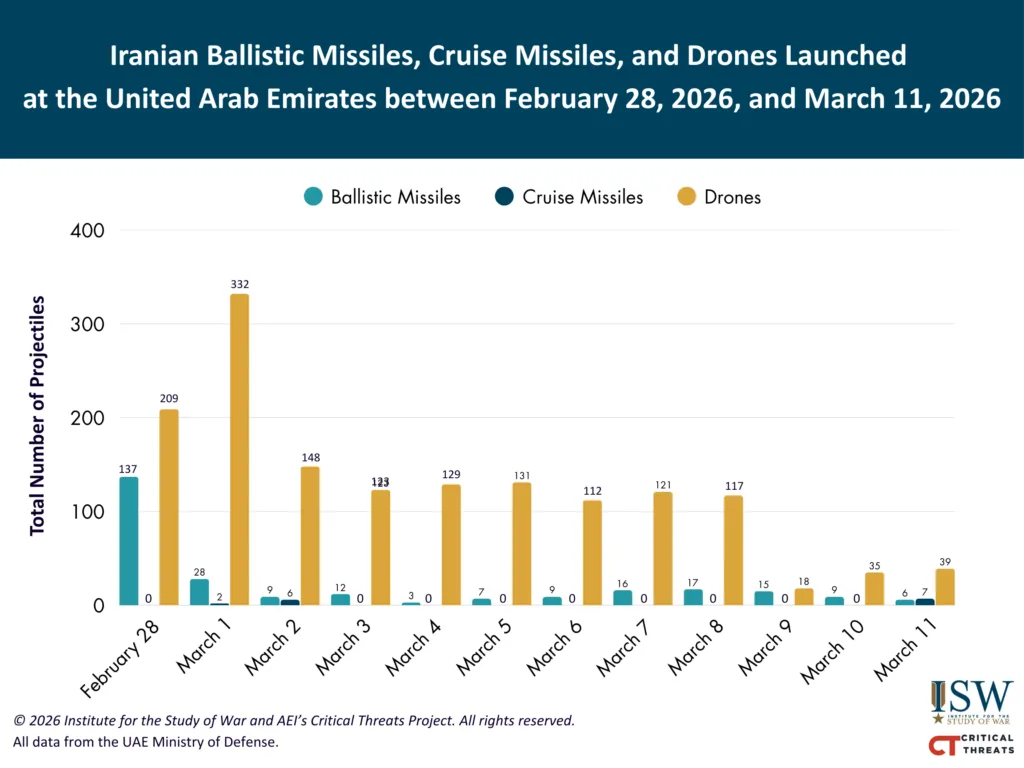
Iran likely seeks to preserve the option to threaten, disrupt, and selectively control traffic through the Strait of Hormuz without fully halting Iranian crude exports that still rely on the waterway by mining it heavily.
The combined force continues to target several key internal security sites in Tehran City and Kurdish-populated areas in northwestern Iran. An open-source intelligence (OSINT) analyst reported that the combined force struck several internal security sites in Marivan City, Kurdistan Province, which is about 10 miles east of the Iran-Iraq border in northwestern Iran. Marivan City and other mountainous cities in Kurdistan Province are hotspots for anti-regime protests and clashes between Iranian security forces and Kurdish anti-regime groups.
Russia is reportedly sharing advanced drone tactics with Iran to support Iranian attacks against US forces and assets in the Middle East, which highlights deepening cooperation between key US adversaries. An unspecified Western intelligence official told CNN on March 11 that Russia is helping Iran develop advanced drone tactics based on its experience from its war in Ukraine.[31] The CNN report comes after three unspecified officials told the Washington Post on March 6 that Russia has provided Iran with the locations of US military assets, including warships and aircraft, since the war started on February 28.[32] Iran and Russia signed a Comprehensive Strategic Partnership Agreement in January 2025 that outlines bilateral knowledge and technology transfers, among other forms of cooperation.[33]
China continues to supply Iran with precursors for solid fuel to support Iran's ballistic missile program.[34] An OSINT analyst reported on March 11 that the Iranian cargo vessel Barzin departed Gaolan Port in China, likely carrying a shipment of missile fuel precursors, and is now en route to Iran.[35] Gaolan Port is a Chinese port that loads chemicals, including sodium perchlorate, a key precursor for solid missile propellant. The Barzin has completed several trips between China and Bandar Abbas in southern Iran in the past year, according to Starboard Maritime Intelligence. The Barzin most recently left Gaolan Port on March 1. China has previously supplied sodium perchlorate to support Iran's ballistic missile program.[36] These shipments follow a March 6 report that China may be preparing to provide Iran with financial assistance and missile components.[37]
Some elements of Hezbollah's political support appear to be fracturing due to Hezbollah's participation in the war. Hezbollah ally, the Amal Movement, recently voted in favor of the Lebanese cabinet's decision to ban Hezbollah's military activity. The Amal Movement has been Hezbollah's key political and strategic ally since 2005.
https://understandingwar.org/research/middle-east/iran-update-evening-special-report-march-11-2026/
1,800
posted on
03/12/2026 12:22:32 AM PDT
by
AdmSmith
(GCTGATATGTCTATGATTACTCAT)
Navigation: use the links below to view more comments.
first previous 1-20 ... 1,761-1,780, 1,781-1,800, 1,801-1,820 ... 2,321-2,328 next last
Disclaimer:
Opinions posted on Free Republic are those of the individual
posters and do not necessarily represent the opinion of Free Republic or its
management. All materials posted herein are protected by copyright law and the
exemption for fair use of copyrighted works.
FreeRepublic.com is powered by software copyright 2000-2008 John Robinson
 >
> >
> >
>