Sure, but from the beginning it was never a question of just North vs. South.
As early as 1800 there were two distinct parties, the old Federalists and Jefferson's new Democratic-Republicans.
Both parties had voters North & South, but Democrats were by far the stronger, their constant victories first driving Federalists out of business and later Whigs, though in both cases internal factors also broke them apart.
Pick almost any presidential election you wish and you'll see the nearly solid Democrat South in alliance with some Northern states carried their party to victory.
The only exceptions were the very confused 1824 election and the elections of popular Whig generals in 1842 and 1848.
And in those cases the opposition put together a winning alliance of Southern & Northern states.
Indeed, both Harrison & Tyler were Southerners and slave-holders, so they were in no way threatening to the South.
So, if you study the Presidents, Congresses and Supreme Court from, say 1800 until secession in 1861, what you'll see is that Democrats were almost never totally out of power, very frequently controlled all branches of Federal government, and were always themselves controlled by their majority faction: Southern Democrats.
FLT-bird: "Democrats were the dominant party.
Your claim however that Southerners always ran things and could just snap their fingers and Northern Democrats would do their bidding is absurd."
You're right, they couldn't just "snap their fingers", sometimes they had to crack their whips, sometimes (i.e., Brooks) they raised cain, and who knows, sometimes they might have to schmooze their Doughfaced Northern allies.
So what do you think, was that too much to ask?
FLT-bird: "Things like the grossly unequal federal expenditures and the tariff of Abominations never would have passed at all had Southerners been that influential in Washington DC."
Wrong again.
The so-called Tariff of Abominations only passed in 1828 because of the strong initial backing from Vice President Calhoun (South Carolina) and future President Jackson (Tennessee).
And it was opposed by the vast majority of New Englanders.
So it was not a simple issue of North vs. South, rather there were many complex issues at play, and the most important to President Jackson was his intention to abolish the National Bank and pay off the national debt (Jackson was the only president ever to do that), and for that he needed very high tariffs.
Jackson also wanted to "make America great", the first time, and so favored protecting US manufacturing, North, South, East & West.
After 1830 Southerners were the driving force behind a steady reduction in overall tariffs which by 1860 brought them near their lowest levels ever.
As for alleged "unequal Federal spending", here again is the data I have on that and it shows: long term, there was no such thing.
Sure, if you carefully pick & chose your data points, you can "prove" most anything, but in the big picture the South received its "fair share" and then some.
FLT-bird: "Even after it was agreed to lower tariffs as part of the compromise that ended the Nullification Crisis, the rates were still considerably higher than would have been ideal for Southern economic interests."
Yes, but Southerners steadily and drastically reduced those tariffs over the following 30 years.
FLT-bird: "Then as the North steadily grew bigger and bigger it sought to impose sky high tariffs once again and this time the Southern states saw they weren’t going to be able to stop it so they seceded."
But the initial Morrill proposal, the one Southerners defeated in 1860, was far from "sky high", it merely returned average rates to roughly their levels of 1850.
And Morrill only passed Congress in 1861 after Southern Democrats walked out.
Further, both Morrill's passage and secession were results of Democrat party self destruction engineered by Fire Eaters in their 1860 presidential conventions.
So Southern Democrats had only themselves to blame for both the passage and higher rates in the 1861 Morrill tariff.
FLT-bird: "Seeing their cash cows departing was intolerable to Lincoln and his corporate fatcat supporters."
So our Lost Cause mythologizers keep posting, but Lincoln himself was focused on other issues, specifically what to do about Confederate demands for the surrender of Fort Sumter, and other Federal properties.
FLT-bird: "More rubbish, nonsense and economic illiteracy.
Where a cargo lands and thus where the tariff is paid is irrelevant.
WHO owns the goods and thus pays the tariff is what is relevant.
Likewise who buys those manufactured goods is irrelevant.
Who owned those goods?
Southerners."
And you have data somewhere to support your claim that "Southerners" owned all (or nearly all) US imports?
FLT-bird: "They were the ones who contracted with the shipping companies to ship their cash crops across the Atlantic.
They were the ones who had to find something to fill the cargo holds of those ships with to help pay for the cost on the return journey.
Obviously the thing that made sense to fill the cargo holds with was manufactured goods..."
Now you've stumbled into DiogenesLamp's self-proclaimed "expertise" and I doubt if he agrees with you.
In DiogenesLamp's world-view, Southerners themselves owned nothing, it was all those evil, nasty, greedy "New York power brokers" who owned everything, extracted their pound of flesh from every transaction and oppressed the pooooor, poooor Southern planters.
That's why they had to secede, says DiogenesLamp, to get out from under the thumbs of evil New Yorkers.
So here we see FLT-bird claiming, no, it wasn't New Yorkers in charge, it was actually the Southern planters themselves.
Hmmmmm...
FLT-bird: "Your claim that because Northern shipping companies were still able to export decent quantities of rice, indigo, sugar and tobacco that means that the North somehow produced these goods is laughable.
Firstly things do get stored in warehouses.
You realize that right?
Secondly even during the war there was trade going on between both sides.
Gee....what’s the South going to be offering in trade?"
Sure, warehousing does explain the fact that cotton exports fell only 80%, not 100%, I get that.
But warehousing cannot possibly explain:
- rice fell only 46%
- turpentine fell only 40%
- manufactured cotton products fell only 25%
- tobacco fell only 14%
- clover seed increased 85%
- brown sugar increased 178%
- hops multiplied 60 times!
So clearly, it's all about factors other than warehousing.
As for your alleged "trade between both sides", no, I don't think so.
For one thing, the vast Mississippi River watershed (over a million square miles!) was cut off from trade from New Orleans north to almost St. Louis.
So exporters were forced to extra expense & trouble of using railroads to transport products to Eastern seaboard cities.
That does not sound to me conducive to "trade between both sides".
So what I think happened was products like, say, tobacco were grown in Confederate Virginia, but also in Union regions of Kentucky, Tennessee, Missouri, Indiana & Ohio.
In 1861 those regions planted enough extra tobacco to almost entirely offset the loss of Virginia tobacco.
So my point here is that all this talk about "Southern products" accounting for, what, 80% or 90% of US exports is just bogus nonsense.
Yes cotton did amount to 50% (including specie), but everything else could be and was produced in regions outside the Confederate South.
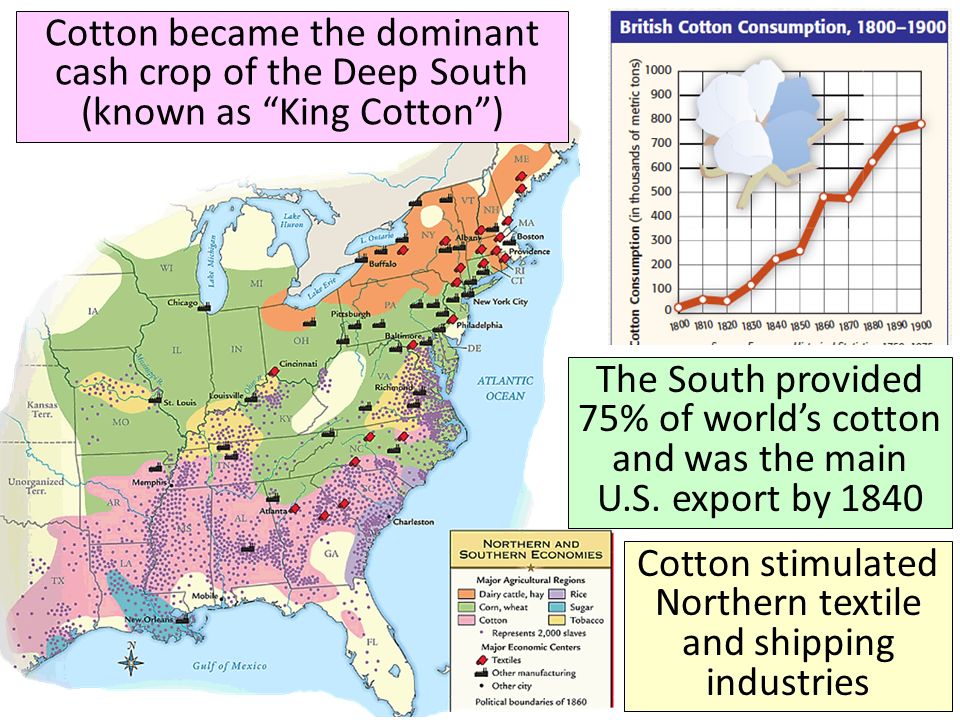
FLT-bird: "I can cite any of a number of Northern newspapers at the time which also openly admitted the South was providing the vast majority of exports for the whole country and when we look at what was exported its not difficult to see that cash crops comprise most of it."
Sure, I "get" that, but am thinking those people could not see the forest for the trees.
Once again, this site breaks down the actual products of each region.
It does show "Southern products" predominate, but it also shows just what I posted above.
When Confederate exports were deleted in 1861, "Southern exports" excluding cotton net-net fell only $3 million.
So even if those were "Southern products" they weren't Confederate products.
FLT-bird: "There was some trading between both sides during the war as well.
The vast majority of the exports were provided by the Southern states though (including border states)."
But certainly not by Confederate states, which is my point here.
Plus, at the same time that "Southern products" (excluding cotton) net-net fell only $3 million in 1861, Western and Northern exports increased $61 million or almost 60%.
So the whole claim that the 1860 US economy was somehow dependent on "Southern products" is just bogus to the max.
When push came to shove, the US economy got along perfectly well without Confederate exports.
FLT-bird: "As for federal expenditures, those were totally unbalanced in favor of Northern states and had been since the beginning.
For example: From 1789 to 1845, the North received five times the amount of money that was spent on southern projects.
More than twice as many lighthouses were built in the North as in the South, and northern states received twice the southern appropriations for coastal defense."
Sure, if you cherry pick your data, you can "prove" pretty much anything.
But when you look at the whole picture here, it turns out Federal spending balanced out, over time.
For examples, over time the South got nearly 40% more in fortifications, 20% less in lighthouses and 30% less in internal improvements.
But for any particular time period, i.e., 1834 - 1847 the South got more in internal improvements.
Overall, by my calculations, the South got 52% and the North 48% of Federal spending, not including pensions.
FLT-bird: "The fact that NONE of the 6 who openly supported and financed a terrorist who launched an attack with the express aim of killing Southern civilians were arrested says it all."
No, it says nothing except Democrats playing politics, as usual.
Federal marshals were only sent to arrest one of the six, Sanborn, and they were so clumsy about it, a crowd of 150 friends & neighbors gathered to protect him, so they gave up.
No attempts were even made to arrest the others, and whose fault is that?
The Feds of course, and who controlled the Feds?
Washington, DC, Democrat administration under substantial control of Southern Democrats.
For examples, President Buchanan's cabinet Southerners included V.P., Secretaries of Treasury, War, Interior & Postmaster General.
Buchanan's Attorney General was his fellow Pennsylvania Democrat, Jeremiah Black.
So it seems to me that had serious demands been made to arrest all six Brown backers, it would happen, but they weren't.
FLT-bird: "Firstly you don’t know that no compromise offered after secession would have been sufficient to entice the original 7 seceding states to come back.
What we know is that the slavery with massively high tariffs carrot was offered and they refused it."
We know for certain that Confederates in 1861 never asked for terms & conditions of return.
And we know they never seriously considered anything the Union did as enticement to return.
Indeed it has been argued that one reason Jefferson Davis needed war in April, 1861, was to cement the loyalties of any Southerners who might be somehow tempted to reunite with their Northern brethren.
Once the Confederacy declared war on the United States, May 6, 1861, then any such talk would be treasonous.
FLT-bird: "That both the North was willing to offer it and that the Southern states rejected it says a lot.
Slavery was simply not what was motivating most people on either side."
Sure, once secession was declared, then other matters became primary in the Confederacy.
But the fact remains that protecting slavery was the number one reason given by all secessionists, and for many the only reason.
FLT-bird: "Wrong.
Georgia talked extensively about both the tariffs and the unequal federal expenditures. "
OK, one more time: the Georgia "Reasons for Secession" document has 14 paragraphs, with 3,300 words.
Only the second paragraph with 111 words is devoted to tariffs, and even it ends with the following words:
- "...the act of 1846 was passed.
It avoided sudden change, but the principle was settled, and free trade, low duties, and economy in public expenditures was the verdict of the American people.
The South and the Northwestern States sustained this policy.
There was but small hope of its reversal; upon the direct issue, none at all."
Sure, "duties" are mentioned, briefly, and "protection", but neither "tariff" nor "Morrill" are.
By contrast slavery is mentioned in every paragraph except the second.
As for alleged "unequal expenditures", those are not mentioned at all by Georgia.
So any claims that Georgia's "Reasons for Secession" document is not "all about slavery" is simply bogus to the max.
FLT-bird: "Texas talked about that as well as the failure to provide border security as well as the Northern states refusing to act against terrorists based there who had attacked the South."
OK, Texas: In 22 shorter reasons paragraphs, 1,644 words, two of those paragraphs (#6 & 19) refer to RE Lee's failure to protect Texans against "Indian savages" and "banditti".
One (#18) does briefly mention "unequal legislation".
None mention tariffs, taxes, duties, bounties, or protections for Northern industries.
All the rest which give reasons talk about slavery.
So there's no way you can seriously claim that Texans were not, first & foremost, concerned to protect slavery.
FLT-bird: "South Carolina attached Rhett’s address which talked extensively about tariffs and unequal federal expenditures."
OK, once again, on Rhett's address to the slave-holding states, 14 long paragraphs with 4,200 words, the first eight paragraphs do indeed discuss taxes and compare 1861 to 1776, making out the North to be the new Great Britain.
It's all nonsense, of course, because there was zero actual similarities, none.
Rhett does complain briefly of "duties on imports", but Morrill is not mentioned, nor is even a threat of higher duties.
But where Rhett spends only 1,400 words comparing the North & taxes to 1776 Britain, when he starts in paragraph 9 to discuss slavery, then his natural verbosity comes out and it takes him twice the number, 2,800 words, to tell us his concerns to protect slavery.
So, even where, exceptionally, Rhett makes slavery play second fiddle to taxes, slavery still plays twice as long & loud as all other issues combined.
FLT-bird: "I’m saying that’s laughable BS and that Rhett had said he would support secession on economic grounds alone."
Maybe he did, maybe he didn't, but if he did, it wasn't in this document.
It's a simple fact: economic issues were not extensively used to sell secession, but slavery certainly was.
FLT-bird: "His claim is clearly true.
By 1860, the South’s wealth was only on par with that of the North even though it was the South which produced the vast majority of the valuable exports.
Clearly a lot of money had been drained out of Southerners’ pockets over the years for that to happen.
Such numbers were true as I have demonstrated from multiple sources from all sides."
Certainly not just "on a par" among Deep South planters.
Statistically they were on average far and away the wealthiest people ever, to that time.
Of course, if you average them in with, for example, Appalachian mountain people, then overall the South was indeed "on a par".
But it was the Deep South planters who called all the political shots and they were far better off than, for examples, average farmers up North.
Yes, some Northern industrialists might be compared to Southern planters, but there were a lot more planters and they were, along with their neighbors, on average better off.
So all claims that Southern wealth was somehow being "drained" are simply hokum.
As for your alleged "multiple sources", none of them -- not one -- provides actual verifiable data.
But scholars who have studied 1850s era economics tell us the Deep South especially was doing very well, thank you.

FLT-bird: "Lincoln....brace yourself.....I hope you are sitting down for this......Lied!
I know it will come as a great shock to you to learn that... "
No "shock" here because you've offered no evidence, merely an unsupported assertion.
FLT-bird on Corwin: "Nope!
I’m right on both counts.
The Northern dominated Congress passed it, The Northern president signed it and multiple states ratified it.
It was a bona fide offer."
Sorry, but you're wrong on both counts.
There was no "offer" to Confederate states, they weren't even recognized.
Rather, the Corwin Amendment was intended to hold the loyalties of Union slave states, like Kentucky & Maryland.
And it helped do just that.
FLT-bird: "You just claim the original 7 seceding states were not going to come back no matter what.
You don’t know that. "
But of course we do know it, because no seceding state ever suggested a willingness to rejoin the Union short of Unconditional Surrender.
FLT-bird: "But its not because multiple Northern states passed state laws forbidding cooperation with the feds over return of escaped slaves.
In several cases mobs had prevented federal agents from capturing escaped slaves and state courts had excused all of it.
The breech of faith was by the Northern states as they have long bragged about."
Maybe, but consider our situation today with so-called sanctuary cities or state.
Despite the Constitution's clear language giving primacy to Federal law, they defy it, so what do we do?
If you answer, "well, we must declare secession", that's absurd, insane.
What we must do is enforce Federal laws and that's what should also have happened during the 1850s.
FLT-bird: "Most certainly did not.
As I’ve already shown, your 50% claims are pure BS.
What we know is that slave ownership was in the single digit percentages among the white population."
No, you've "shown" nothing, zero, nada.
You've only claimed what you don't know and is certainly false: that no slave holders were heads of large families and therefore slave ownership was single digits. Nonsense.
The far more realistic model is that one person per family owned all the slaves and the family sizes averaged four people, totally reasonable assumptions.
It means that in Deep South states like South Carolina and Mississippi nearly 50% of families owned slaves.
In Upper South states like Virginia & Tennessee about 25% of families owned slaves and in Border states like Kentucky & Maryland, fewer than 15%.
And that explains why those states did not secede with the others.
FLT-bird: "Missouri did eventually secede and Maryland was occupied and its legislature jailed by Lincoln without charge or trial before they could vote on the matter."
No Border State ever voted for secession.
Yes, the Confederacy did claim Kentucky and Missouri, but it was totally bogus, nothing more than a few slaveholders who got together and said, "we're Confederates".
But neither the voters nor legislatures of either state ever voted for secession, just the opposite.
And all the Border States, including Maryland & Delaware, provided more Union troops than confederates by a factor of at least two to one.
So Border states not only said they wanted to be Union, they were willing to fight & die for it.
And like Kentucky & Missouri, Maryland's legislature also voted decisively against secession, while it was still lawful to do so.
But once Confederates formally declared war on the United States, May 6, 1861, then it became, by definition, an act of treason for Marylanders to "provide aid & comfort" or vote for secession.
FLT-bird quoting: "Why did this war come?
There was a widely shared feeling among many in the Confederacy that their liberty and way of life were being overpowered by northern political, industrial, and banking powers." (Davis, Don’t Know Much About the Civil War, p. 152)"
Sure, but "Liberty and way of life" is code-talk for slavery.
FLT-bird quoting: "The decision to allow free states to join the Confederacy reflected a hope that much of the old Union could be reconstituted under southern direction.” (Robert A. Divine..."
Which is what DiogenesLamp most curiously claims would have happened, had not that evil Lincoln started war to prevent it.
But it's all total BS, cockamamie nonsense because the new Confederate constitution was dedicated first & foremost to protecting slavery, and no state or territory would ever be allowed to join without recognizing full "rights" in African slavery.
FLT-bird quoting: "...no protective tariff was to be passed..."
Which implies that unless Confederates intended to industrialize with slave labor, there would be no industrialization period.
Of course, slaves did serve very well in Southern factories which means there was no reason not to use them, and no possibility that slavery would ever become obsolete in the Confederacy.
FLT-bird: "and you want to just scream 'slavery slavery slavery!!!' like a wind up doll whose string has been pulled.
Don’t tell me these people did not care about the overcentralization of power, wasteful expenditures under a broad interpretation of the 'general welfare' clause exactly as Patrick Henry had warned about when he urged rejection of the Constitution..."
But of course it was all about "slavery, slavery, slavery".
Explicit protections for slavery were first & foremost in the Confederate constitution.
Then they got down to saying, "how can we improve on our forefathers' constitution," and yes, they did devise some minor changes, which may have improved something, or not.
My own opinion is that such specific forms of government are, in the end, far less important than the good will, honesty and honorable intentions of its members.
FLT-bird: "All true - just inconvenient for you to admit.
The motives of the federal government and the special interests who backed them was the same as it is everywhere......money and power."
Only to the most cynical, and I'm not one.
Consider our current President.
He earned all the money, power & prestige anyone could want, but he won election at least in part for saying he wouldn't accept his government salary and would devote 100% of his efforts to make America great again by putting Americans first.
That has been the Federalist, Whig and Republican message from Day One of the Republic.
The Democrat message was always different and went, in one expression or another of it: vote for us, we'll make those other people pay for your free stuff.
Confederates were all, to a man, Democrats.
That's my case in a nutshell.