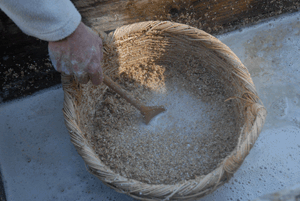
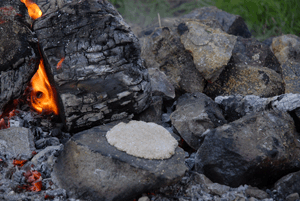
Quinn and Moore added malted barley (top) to water that had been heated in their fulacht fiadh by stones fired on a nearby hearth (above). (Courtesy Declan Moore and Billy Quinn)
Quinn and Moore added malted barley (top) to water that had been heated in their fulacht fiadh by stones fired on a nearby hearth (above). (Courtesy Declan Moore and Billy Quinn)
fiadh (pronounced FULL-ahk FEE-add),
I’m not a scholar but iirc that’s not the correct pronunciation of Fiadh.
http://www.forvo.com/word/fiadh/
I hope it was a brewery. I’d like to think they were creating Guinness.
Tannin is often found in bogs and swampy water. And tannin was a important part of the ‘tanning’ process for curing and preserving skins for usable leather.
Since the timeline is right for a culture that used a lot of skins for clothing and other paraphernalia, it’s possible that these Fiadhs were used for tanning skins.
Another point for my theory is that they were also built near—but not in—village sites. Tanning raw skins can produce some nasty smells that you wouldn’t want inside the living compounds.
Sounds more logical than giant soup pots or beer breweries.
They`re prehistoric Irish hockey goals-
It sounds like an ost house and place to kiln the malt.
To malt barley you put it on a concrete or stone floor. You soak the barley and allow it to germinate overnight. In the presence of water the hull breaks down, more water enters, the germ begins to sprout, and enzymes are produced that start to convert starch to sugar. During the process heat is produced and you rake the pile around to encourage even germination.
You do not want this to go on too long. At some point you need to kiln the sprouting barley to stop the germination. We do this on large metal trays heated underneath. Since metal was not common In ancient Ireland, I would not be surprised if they heated rocks and placed them on the ost house floor with the malting barley. You need to heat your barley until your malt is dried and/r carmelized for a darker ale. When this is done you can store it for longer periods until you are ready to make your beer.
I once malted my own barley one time on a tray in the kitchen oven. Someone had given me half a bag of raw barley. The beer was a bit on the skunky side, but it had a kick. (It was the Belgian yeast.) I don’t drink so much now, but I know that when the time comes there will be room in someone’s compound for someone who knows a bit about brewing!
I loved my five years in the UK, and dragged my girls to every castle, museum and archeological site I could find.