DeoVindiceSicSemperTyrannis:
"Of course the difference is in the code, not the letters themselves.
But for evolution to happen, gains DO have to happen in the DNA." So why do you keep saying "gains" or "additions", when you just admitted there's no such thing?
In strict scientific terms, there are no "gains", no "additions" and no "losses", only changes from one set of instructions, to something a bit different.
Whether these changes can be classified as "gains" or "losses" by humans is strictly a function of natural selection -- does a DNA change help or hurt an individual's chances for survival?
For a very simple example, consider the mutations which cause sickle-cell anemia -- yes, they help individuals to survive malaria, but at the cost of shortened, less healthy lives.
So, is that a "gain" or "loss" -- all depends on your perspective.
DeoVindiceSicSemperTyrannis: "You keep trying to bring up examples where the DNA expressed different variants within itself.
All of us have variations and recessive qualities in our DNA that is typically not expressed but can be brought out at times.
But this is not a DNA gain.
It is just the DNA using info it already has."
You ignore the basic facts.
The fact is that today DNA analysis can be used to convict criminals of murder, or prove a man's paternity of a child.
This same type of analysis can establish just when, recent or ancient, certain mutations appeared in a person's DNA.
The fact is that a small number (a handful out of over three billion total base pairs), of more-or-less random DNA mutations appear in every generation -- mostly harmless mutations -- which can be tracked back to the first generations where they appeared.
Such mutations tell us which ethnic groups are closely related, which more distantly related, and approximately when each group's common ancestors split apart.
All this is not just evolution "theory", it's evolution fact -- observed, confirmed facts.
DeoVindiceSicSemperTyrannis: "...unless sea creatures had all the info in their DNA already to code for winged and legged creatures, this argument falls apart."
Of course, ancient sea creatures had no "land-creature DNA", but they did have, for example, fins which even today some fish use to "walk" on land.
Some of these ancient appendages looked more like fins than legs & feet, but others are more obviously legs & feet than residual fins.
And the same thing happens in reverse, when land-creatures learned, adapted & evolved back into sea-creatures.
In no case was DNA ever "gained" or "lost", only changed in ways which allowed individuals to more or less successfully adapt to their life's conditions.
DeoVindiceSicSemperTyrannis: "Oh but positive DNA changes came on small and gradual you say?
Then how could partially-evolved plant and animal species survive over millions of years when their basic organs and tissues were still in the process of evolving?
How, for example, were animals breathing, eating, and reproducing if there respiratory, digestive, and reproductive organs were still evolving?"
Today's living creatures, plus fossil records and DNA analysis tell us a lot in answer to such questions.
Just looking at today's creatures we see many, many "transitional forms" between, for example, those which live in the sea, and those on land.
And fossil records, incomplete as they are, provide many, many more "transitional forms".
If your question here is strictly internal-organs, then every "lower form" of life provides examples of simpler, more basic organs, organs which are steadily more advanced in higher animals.
For just one example, "breathing" and blood circulation amongst insects is as basic as can be, so basic it helps limit the natural size insects can grow.
But even insects are vastly more complex than, for example, sponges or star-fish.
Point is: terms like "advanced" or "simple" are strictly relative to others -- in a world of sponges & star-fish, even the most primitive fish is highly advanced.
DeoVindiceSicSemperTyrannis: "Also, there is no scientific evidence that a species can change the number of chromosomes within the DNA.
The chromosome count within each species is fixed. Each species is locked into its chromosome count that cannot be changed.
If an animal developed an extra chromosome or lost a chromosome because of some deformity, it could not successfully mate.
The defect could not be passed along to the next generation.
The chromosomes make crossing of the species an un-crossable barrier."
Careful DNA analysis of human versus great-ape chromosomes shows that in humans, two ape chromosomes (#12 & #13) fused making our one chromosome #2, our second-largest chromosome.
This chromosomal difference is said to make interbreeding practically impossible.
We can see other examples of the same thing -- horses with 64 chromosomes, donkey's with 62, African & Indian elephants with 56 chromosomes but woolly-mammoths with 58.
So the splitting or fusing of chromosomes is not so unusual, though so far as I know, just how it happens is not known.
In ancient times everyone believed, and today many still do, including me, that all reproduction is accomplished with God's help.
Seems to me that changing chromosome counts is one way to be certain beneficial mutations don't "revert to type" by interbreeding with others less endowed...
DeoVindiceSicSemperTyrannis: "About fakes.
Nebraska man was just an example.
The popular display of horse evolution is also an example...."
But your list of alleged "fakes" is mostly itself a fake, hoax & fraud.
You use lies to accuse others of lying, so what's up with that?
Of course, nobody denies that all humans -- scientists or otherwise -- are capable honest mistakes.
But most of us, at least, are also born with the "honesty gene", which drives us to correct our own, and more importantly, others mistakes.
So doubtless some mistakes were made in past analyses and preparations of fossils, but your accusations of "fake" are themselves lies, which you offer up uncritically for sake of... of what?
Doubtless, an ideology less than totally committed to the truth, I'd suppose.
DeoVindiceSicSemperTyrannis: "Please explain to me how all this stuff is scientific?
Or was it just simply a "mistake"?"
What is certainly unscientific are the lies you repeat against science.
The facts are quite different from those you suggest.
DeoVindiceSicSemperTyrannis: "Also, you say those list of skulls you have on your picture are all in order of their date/age? Oh really?
You do know that the dating system is highly flawed you know.
Often times, several dates will come out for one specimen.
And which one do the "scientists" pick?
The one that fits their assumptions of course."
Regarding dating of ancient materials: what's certainly true here is that scientists cannot always depend on a single method to consistently provide accurate results; and so they must take input from every available method, before deciding which methods provide the best dating.
And there are, all told, dozens of different methods available.
When several converge on a date for some item, that is likely the range to be selected.
DeoVindiceSicSemperTyrannis: "Did you know that scientists got dates of 169 million and 3 billion years for two Hawaiian lava flows that had happened only in 1800 and 1801?
Awful accurate isn't it?"
A case of G.I.G.O. -- if you provide a dating lab with less than completely accurate information about samples, it will result in "garbage out".
And, the converse is true: when you provide complete and accurate information along with your samples, results will usually be consistent and accurate.
DeoVindiceSicSemperTyrannis: "So not only is your line up of skulls likely to be misdated (they keep changing the dates on those things all the time...you should know that at least), they were all found on different continents in different layers and yet you expect me to believe that they form a legitimate line of descent?
LOLOLOLOLOL"
No, not "line of descent", but they are certainly "transitional forms" which you people keep claiming don't exist.
And why do you keep saying "found on different continents", as if that mattered?
The fact is, the earliest remains were found in Africa, but more recent remains (i.e., Neanderthals) are found in Europe and Asia -- so what exactly is your problem with that?
As for the accuracy of dating of those particular skulls, it is totally consistent with the dating of everything else we know about earth's "deep-time" history.
Of course, for people who deny there is such a thing as "deep-time", you are totally free, if you wish, to hand-wave all that evidence away.
What you can't do is pick & chose to accept just some evidence that might suit your beliefs, but not the rest.
DeoVindiceSicSemperTyrannis: "That has got to be one of the most arrogant things I have ever heard.
What about all the thousands of instances of more “highly evolved” organisms being found in undisturbed layers BELOW their “less evolved” ancestors?"
Sorry, pal, but the only "arrogance" at play here is your own, and that of your teachers, insisting their religion-based science-opinions somehow invalidate all of real science.
They don't.
The fact is, there is not a single scientifically confirmed example of fossils found where they don't belong -- i.e., of undisturbed human and dinosaur remains found originally buried together.
Yes, sure, some natural events can put unrelated fossils in the same geological stratum -- examples from plate tectonics and erosion relocations come to mind.
But none has ever been confirmed scientifically as being "out of place" in its original burial.
DeoVindiceSicSemperTyrannis: "And what about fossilized remains that still contain soft tissue?
Soft, flexible and transparent tissue was found in a t-rex that was supposedly 68 million years old."
First, you must remember, there is far less genuinely "soft tissue" confirmed than is sometimes alleged.
We are really dealing here with only a handful of small examples.
Second, remember, all of this alleged "dino soft-tissue" is still controversial, not yet fully confirmed as being what's claimed, pending the finding of a good many more such examples.
Third, the tissues found are a simple organic material called "collagen", lacking DNA, but does seem to confirm dinosaurs' relation to modern birds like chickens.
Finally, the preservative preventing decomposition seems to be iron in the soil, and demonstrates convincingly that under very rare conditions, organic material can survive a very long time indeed.
DeoVindiceSicSemperTyrannis: "Also, how come life appears in the fossil record all of a sudden with a lot of diversity & complexity, & without any predecessors.
Where are the transitional fossils?"
Of course, every fossil, without exception, is a "transitional form" between its ancestors and descendants, if any.
But, perhaps you've heard that dinosaurs disappeared around 65 million years ago?
That sounds like a long time ago, doesn't it?
And perhaps you even learned that mammals arose from little mouse-like creatures under the dinosaurs, to everything you see today, during the past 65 million years?
So, you'd admit that 65 million years seems like a pretty long time for creatures to adapt, change and evolve, right?
So, now consider what's called the "Cambrian Explosion" around 530 million years ago.
It actually began around 580 million years ago, with the first complex organisms' remains, and lasted until around 420 million years ago, with the first toothed fish fossils.
That's over 160 million years of "explosion", more than twice as long since dinosaurs disappeared.
And the "explosion" never stooped, except for periods of mass extinctions, related-but-new species continued to appear in fossil records ever since.
Finally, remember that, based on the number of species alive today (i.e. 50,000 vertebrate species) and the average rate of evolution (a million years per species), our fossil record, large as it is, clearly represents less than 1% of all species which ever existed.
So the appearance of "suddenness" in that record is largely an illusion based on the 99% of "missing link" species.
DeoVindiceSicSemperTyrannis: "All assumed transitional creatures are absent.
The fact is that the billions of known fossils do not include a single unequivocal transitional form with transitional structures in the process of evolving."
First of all, the numbers of "known fossils" is large, but certainly not "billions" -- thousands or tens of thousands would be accurate, speaking of larger critters, like dinosaurs, birds & whales.
Second, the fact is that every fossil, without exception is a "transitional form" between its ancestors and descendants, if any.
That means: every fossil can be compared for similarities and differences to those which went before and those which came after.
So there are no -- zero, zip, nada -- non-transitional fossils.
All belong to known biological classifications dating back to the earliest days of complex life on earth.
All have "transitional structures in the process of evolving."
The fact that we've found fewer than 1% of all fossil species which ever existed does not make any fossil less "transitional".
DeoVindiceSicSemperTyrannis: "These aren’t the only examples of oddities that have been found & ignored by the media & evolutionary scientists.
Human skeletons & tools have been found deep down in coal mines....
These are just a few in the long list of anomalies."
Yes, certainly, and if you read the magazines found in super-market check-out lines, you can find hundreds of similar new stories, every week.
But the fact remains that not one such story has ever been strongly confirmed scientifically.
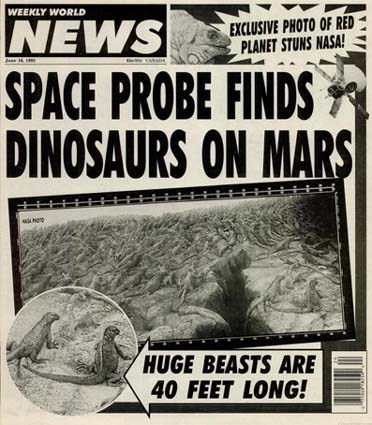
Of course, you might blame scientific "preconceived ideas", but I think it's just a matter of very few scientists who actually read the The National Enquirer, Star, The Globe, National Examiner, ¡Mira!, Sun, Radar or Weekly World News. ;-)
So, maybe there's an untapped source of new scientific data which you could apply for government grants to help fund research in?
DeoVindiceSicSemperTyrannis: "A tenable theory also needs to be able to make predictions that are later proven to be true.
Darwin predicted that thousands of transitional forms would soon be found to back up his theory of the evolution of one species into another and we have yet to find a fossil of a creature in the process of evolution."
In fact, every creature, living and fossilized, "is in the process of evolution".
You are in the process of evolution -- you are not exactly the same as your parents, and your children are (or will be) not the same as you.
They will be slightly changed, sometimes for the worse, but occasionally for the better, and that is the beginning, the root-source of long-term evolution.
It's not a "theory", it's an observed, confirmed fact.
DeoVindiceSicSemperTyrannis: "Everything in the fossil record shows up abruptly, there are no transitional forms.
Evolution, contrary to being the scientific law that many try to claim it is, is really in fact a highly untenable theory with numerous findings that fly in its face."
Look, when you're hoping to debate scientific subjects, first and foremost you need to pay careful attention to scientific definitions.
So evolution theory was not, is not and never will be a scientific "law" -- by definition, it can't be.
But evolution certainly is a valid scientific hypothesis which has been confirmed innumerable times, making it a recognized theory.
And that's about as good as it can ever get... except for the fact that much of evolution theory is also observed and confirmed, making those elements facts.
Yes, any theory, including evolution, can be, and some have been, falsified, which then demotes it back down to discredited hypothesis.
Has evolution theory ever been seriously falsified?
No, never, but it is daily reconfirmed by scientific observations of its predictions.
Are there still many unconfirmed hypotheses relating to evolution theory?
Of course, most notably in the area of numerous Origen of Life hypotheses, none of which have ever been strongly confirmed, and indeed, may not ever be confirmed.
Only time can tell...