To: Darksheare
rough {off top of head) 50° change in courseIson orbital inclination is 62.4 degrees. In other words, the orbit would need to be bent some 60 degrees - and 60 degrees in the correct direction - to 'straioghten' it out to the plane of the elliptic so that an intersection with anything orbiting the sun in that plane (which is pretty much all the planets) possible at all. Otherwise it would pass through the plane of the elliptic going 'down' to the sun and pass back through the plane of the elliptic going 'up' away from the sun and the longer it goes 'up' away from the sun, the further away from the plane of the elliptic it gets.
As it gets further from the plane of the elliptic, which it will as it 'climbs' away from the sun, the more radical a course change is required to aim it at Earth or any planet. The one big energy sink that Ison passed was the sun and its input would be + g going 'down' and -g going 'up'. In other words, now that the Is one pebbles are climbing up the gravitational hill away from the sun, energy is being subtracted from the Is one system. There is no additional source of + energy to alter the course.
Unless of course, you really think those Nubirans are going to interfere...
219 posted on
12/12/2013 12:26:13 AM PST by
NoCmpromiz
(John 14:6 is a non-pluralistic comment.)
To: NoCmpromiz
Then WHY ISN'T ISON's DEBRIS WHERE NASA predicted it to be?
It's currently reported to be about 2 days ahead of their schedule, now, and off course.
And as a side note, read this

BOOM! Meteor explodes over Arizona; big meteor shower begins, 9:02 pm, December 11, 2013
(CNN) — A resounding boom over Tucson, Arizona, roused residents from their dinner tables Tuesday and had them pointing up to the sky.
With the largest meteor shower of the year around the corner, the heavens seemed to be giving them a sneak preview.
A whopper of a fireball roared over their heads and exploded, rattling their houses.
A dash cam captured it on video as it vanished in a bright blaze.
The spectacular annual Geminid meteor shower kicks into high gear Thursday night, NASA said, and people around the world will be able to enjoy it.
Some of its meteors have already been dashing through Earth’s atmosphere. The agency recorded nine of them Tuesday night.
But the Tucson meteor did not appear to be one of them, said NASA meteor expert Bill Cooke, who analyzed the flying space rock after two NASA cameras in Arizona recorded it on video.
Traveling at 45,000 mph, it was too slow.
“A Geminid moves at 78,000 mph,” he said.
And the direction it came from was not typical for a meteor from the big shower.
The Arizona fireball was just one of the handful of “sporadic background” meteors that whiz through the atmosphere every day.
But this was a big one, Cooke confirmed.
It weighed about 100 pounds and was about 16 inches thick.
It made quite a bright flash, as it burned up in the atmosphere.
Even with 100 to 120 meteors per hour coming down during its peak on Friday and Saturday, the Geminid shower now has a tough act to follow.
Read
Phaethon confirmed as rock comet by STEREO vision Sep 10, 2013
Also read
Asteroid Vs. Comet: What The Heck Is 3200 Phaethon?.
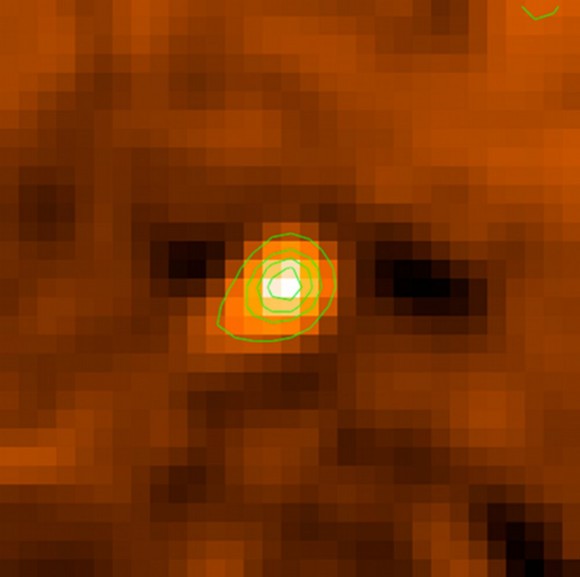 A very zoomed-in image of Phaethon from NASA’s STEREO spacecraft, showing a comet-like extension. Credit: Jewitt, Li, Agarwal /NASA/STEREO
224 posted on
12/12/2013 1:24:53 AM PST by
Yosemitest
(It's Simple ! Fight, ... or Die !)
To: NoCmpromiz
"The one big energy sink that Ison passed was the sun and its input would be + g going 'down' and -g going 'up'.
In other words, now that the Is one pebbles are climbing up the gravitational hill away from the sun, energy is being subtracted from the Is one system.
There is no additional source of + energy to alter the course."
IF SO, THEN WHY does NASA slingshot their satellites bound for other planets or into deep space around other planetary bodies,
if not to gain speed and lessen the cost of a direct path to their destination?
226 posted on
12/12/2013 1:34:25 AM PST by
Yosemitest
(It's Simple ! Fight, ... or Die !)
FreeRepublic.com is powered by software copyright 2000-2008 John Robinson
