
NASA’s Dirty Secret: Moon Dust
- "... To make matters worse, lunar dust suffers from a terrible case of static cling. UV rays drive electrons out of lunar dust by day, while the solar wind bombards it with electrons by night.
Cleaning the resulting charged particles with wet-wipes only makes them cling harder to camera lenses and helmet visors.
Mian Abbas of the National Space Science and Technology Center in Huntsville, Alabama, will discuss electrostatic charging on the moon and how dust circulates in lunar skies.
Luckily, lunar dust is also susceptible to magnets.
Tiny specks of metallic iron (Fe0) are embedded in each dust particle’s glassy shell.
Taylor has designed a magnetic filter to pull dust from the air, as well as a “dust sucker” that uses magnets in place of a vacuum. ..."

The Mystery of Moon Dust
- " ... “The invasive nature of lunar dust represents a more challenging engineering design issue, as well as a health issue for settlers, than does radiation,” wrote Harrison (Jack) Schmitt, an Apollo 17 astronaut, in his 2006 book, “Return to the Moon.”
The dust sullied spacesuits and ate away layers of moon boots.
Over the course of six Apollo missions, not one rock box maintained its vacuum seal.
Dust followed the astronauts back into their ships, too.
According to Schmitt, it smelled like gunpowder and made breathing difficult.
No one knows precisely what the microscopic particles do to human lungs.
The dust not only coats the moon’s surface, but floats up to sixty miles above it—
- as part of its exosphere, where particles are bound to the moon by gravity, but are so sparse that they rarely collide.
Later, Apollo 17 astronaut Gene Cernan, while orbiting the moon, recorded a similar phenomenon at the sharp line where lunar day meets night, called the terminator.
Cernan sketched a series of pictures illustrating the changing dustscape;
- streams of particles popped off the ground and levitated, and the resulting cloud came into sharper focus as the astronauts’ orbiter approached daylight.
It’s presumed that they’re made of dust, but no one fully understands how or why they do their thing.
It’s possible that an electrical field forms at the terminator line—where sunlight meets shadow—that could knock dust particles aloft.
Mihály Horányi, a physicist at the University of Colorado, in Boulder, has demonstrated that moon dust can indeed respond to such electric fields. ... "
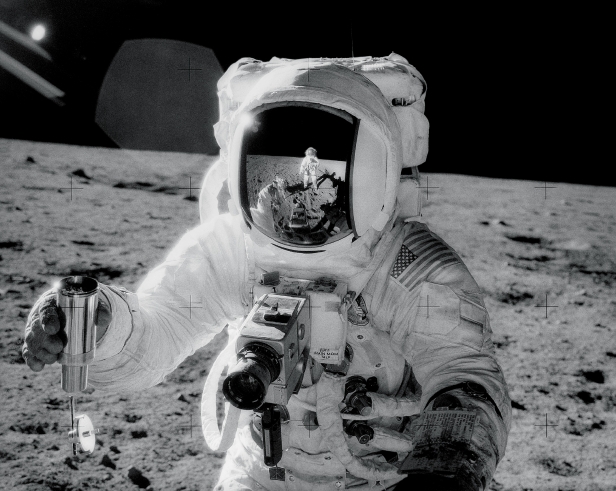
How hazardous was lunar dust for Apollo astronauts on the Moon? - See more at: http://www.spaceanswers.com/space-exploration/2029/how-hazardous-was-lunar-dust-for-apollo-astronauts-on-the-moon/#sthash.Br0KAgUd.dpuf
- " ... Moon dust is almost half silicon glass, while it also contains iron, calcium and magnesium.
Owing to its composition, it can be quite problematic.
For one thing, it clung to the Apollo astronauts’ space suits, in part due to the static charge in the dust.
They would often get into their module covered in the stuff, which was reported to smell like burnt gunpowder as it reacted with oxygen within the Lunar Module. ..."

Tiny dust grains, empowered by the sun, pose big problems on the moon
- " ... Without the benefit of a robust atmosphere, the lunar surface is bombarded with energetic solar radiation, which lends a clingy electrostatic charge to the dust grains, O'Brien found.
"Analyses imply this adhesive force weakens as solar angle of incidence decreases," his study says. ...
... O'Brien writes, "future lunar astronauts may have greater problems with dust adhesion in the middle half of the [lunar] day than faced by Apollo missions, ... "

