
Higher tides occur with a full moon because the Sun's gravity is added to the "pull"
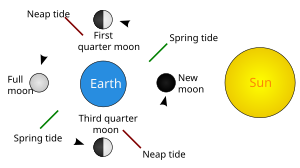
The semidiurnal range (the difference in height between high and low waters over about a half day) varies in a two-week cycle. Approximately twice a month, around new moon and full moon when the Sun, Moon and Earth form a line (a condition known as syzygy[8]) the tidal force due to the Sun reinforces that due to the Moon. The tide's range is then at its maximum: this is called the spring tide, or just springs. It is not named after the season but, like that word, derives from an earlier meaning of "jump, burst forth, rise" as in a natural spring. When the Moon is at first quarter or third quarter, the Sun and Moon are separated by 90° when viewed from the Earth, and the solar gravitational force partially cancels the Moon's. At these points in the lunar cycle, the tide's range is at its minimum: this is called the neap tide, or neaps (a word of uncertain origin). Spring tides result in high waters that are higher than average, low waters that are lower than average, slack water time that is shorter than average and stronger tidal currents than average. Neaps result in less extreme tidal conditions. There is about a seven-day interval between springs and neaps.