Free Republic
Browse · Search
General/Chat
Topics · Post Article

To: Justa
Actually, Lunar tides occur on both sides of the planet. High tides are 180 degrees apart as are the low tides.

Higher tides occur with a full moon because the Sun's gravity is added to the "pull"
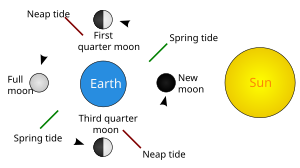
The semidiurnal range (the difference in height between high and low waters over about a half day) varies in a two-week cycle. Approximately twice a month, around new moon and full moon when the Sun, Moon and Earth form a line (a condition known as syzygy[8]) the tidal force due to the Sun reinforces that due to the Moon. The tide's range is then at its maximum: this is called the spring tide, or just springs. It is not named after the season but, like that word, derives from an earlier meaning of "jump, burst forth, rise" as in a natural spring. When the Moon is at first quarter or third quarter, the Sun and Moon are separated by 90° when viewed from the Earth, and the solar gravitational force partially cancels the Moon's. At these points in the lunar cycle, the tide's range is at its minimum: this is called the neap tide, or neaps (a word of uncertain origin). Spring tides result in high waters that are higher than average, low waters that are lower than average, slack water time that is shorter than average and stronger tidal currents than average. Neaps result in less extreme tidal conditions. There is about a seven-day interval between springs and neaps.

72 posted on 03/10/2011 5:48:49 PM PST by hattend (Obama got his 3am call about Egypt. The call went right to the answering machine.- Sarah Palin)
[ Post Reply | Private Reply | To 64 | View Replies ]


To: hattend

Yes, I know lunar tides occur on both sides of the planet. I grew up on the ocean. However, only during a new moon is the sun’s gravitational pull added to the moon’s high tide at noon for an extreme high tide.

I’ll see your syzygy and raise you a Proxigean:

“The Proxigean Spring Tide is a rare, unusually high tide. This very high tide occurs when the moon is both unusually close to the Earth (at its closest perigee, called the proxigee) and in the New Moon phase (when the Moon is between the Sun and the Earth). The proxigean spring tide occurs at most once every 1.5 years.”

http://home.hiwaay.net/~krcool/Astro/moon/moontides/

There will be no exceptionally high tide on March 19th. Both high tides for the 19th are predicted to be nearly equal due I suspect to it being full moon.


81 posted on 03/10/2011 6:14:50 PM PST by Justa
[ Post Reply | Private Reply | To 72 | View Replies ]

Free Republic
Browse · Search
General/Chat
Topics · Post Article


FreeRepublic, LLC, PO BOX 9771, FRESNO, CA 93794
FreeRepublic.com is powered by software copyright 2000-2008 John Robinson