
Posted on 04/12/2010 10:44:11 AM PDT by Ernest_at_the_Beach
From the National Science Foundation via press release:
Scientists explore origins of ’supervolcanoes’ on the sea floor
Ancient goliaths blamed for multiple mass extinctions
“Supervolcanoes” have been blamed for multiple mass extinctions in Earth’s history, but the cause of their massive eruptions is unknown.
Despite their global impact, the eruptions’ origin and triggering mechanisms have remained unexplained. New data obtained during a recent Integrated Ocean Drilling Program (IODP) expedition in the Pacific Ocean may provide clues to unlocking this mystery.
To explore the origins of these seafloor giants, scientists drilled into a large, 145 million-year-old underwater volcanic mountain chain off the coast of Japan.
IODP Expedition 324: Shatsky Rise Formation took place onboard the scientific ocean drilling vessel JOIDES Resolution from September 4 to November 4, 2009. Preliminary results of the voyage are emerging.
“‘Supervolcanoes’ emitted large amounts of gases and particles into the atmosphere, and re-paved the ocean floor,” says Rodey Batiza, marine geosciences section head in the National Science Foundation (NSF)’s Division of Ocean Sciences, which co-funded the research.
The result?
“Loss of species, increased greenhouse gases in the atmosphere, and changes in ocean circulation,” says Batiza.
In fall 2009, an international team of scientists participating in IODP Expedition 324 drilled five sites in the ocean floor. They studied the origin of the 145 million-year-old Shatsky Rise volcanic mountain chain.
Located 1,500 kilometers (930 miles) east of Japan, Shatsky Rise measures roughly the size of California.
This underwater mountain chain is one of the largest supervolcanoes in the world: the top of Shatsky Rise lies three and a half kilometers (about two miles) below the sea’s surface, while its base plunges to nearly six kilometers (four miles) beneath the surface.
Shatsky Rise is composed of layers of hardened lava, with individual lava flows that are up to 23 meters (75 feet) thick.
“Seafloor supervolcanoes are characterized by the eruption of enormous volumes of lava,” says William Sager of Texas A&M University, who led the expedition with co-chief scientist Takashi Sano of Japan’s National Museum of Nature and Science in Tokyo. “Studying their formation is critical to understanding the processes of volcanism, and the movement of material from Earth’s interior to its surface.”
About a dozen supervolcanoes exist on Earth; some are on land, while others lie at the bottom of the ocean. Those found on the seafloor are often referred to as large oceanic plateaus.
Current scientific thinking suggests that these supervolcanoes were caused by eruptions over a period of a few million years or less–a rapid pace in geologic time.
Each of these supervolcanoes produced several million cubic kilometers of lava–about three hundred times the volume of all the Great Lakes combined–dwarfing the volume of lava produced by the largest present-day volcanoes in places like Hawaii.
Since the 1960s, geologists have debated the formation and origin of these large oceanic plateaus. The mystery lies in the origin of the magma, molten rock that forms within the Earth.
A magma source rising from deep within the Earth has a different chemical composition than magma that forms just below Earth’s crust. Some large oceanic plateaus show signs of a deep-mantle origin. Others exhibit chemical signatures indicative of magma from a much shallower depth.
The IODP Shatsky Rise expedition focused on deciphering the relationship between supervolcano formation and the boundaries of tectonic plates, crucial to understanding what triggers supervolcano formation.
What do you ride?
I ride a 93 FXR Superglide!
What could possibly go wrong? (I see a movie in the making.)
What built Shatsky Rise, a mantle plume or ridge tectonics?
A quick 1 page read....
World's deepest undersea vents discovered in Caribbean
************************************EXCERPT*********************************
The vents, known as black smokers, were located 5,000m (3.1 miles) down in the Cayman Trough.
The volcanic chimneys, which spew out water hot enough to melt lead, were caught on film by a British-led team.
Marine biologist Dr Jon Copley said: "Seeing the world's deepest black-smoker vents looming out of the darkness was awe-inspiring."
He added: "Super-heated water was gushing out of their two-storey-high mineral spires, more than three miles beneath the waves."
Expedition leader Doug Connelly said: "We hope our discovery will yield new insights into biogeochemically important elements in one of the most extreme naturally occurring environments on our planet."
The team, led by the National Oceanography Centre (NOC) in Southampton, is sailing across the Caribbean and the Southern Ocean on the scientific research vessel the James Cook.
 |
 It was like wandering across the surface of another world It was like wandering across the surface of another world  Bramley Murton, scientist
 |
Previously, the deepest smokers were found in the Ashadze vent field in the mid-Atlantic Ridge at a depth of 4,040m.
The discovery was made with the help of two deep-sea vehicles.
Firstly, a robotic submarine called Autosub6000 enabled the team to map the seafloor of the Cayman Trough in fine detail. Then a vehicle called HyBIS equipped with hi-definition cameras, was lowered down and captured detailed images of the smokers.
OK, that does it - sic the EPA on it.
Will throw massive moisture into the air. What happens if
its winter in the US when that happens.??
Guess we get lots of snow somewhere.
***********************************EXCERPT*************************************
The mid-Cretaceous (~125-85 Ma) and early Paleogene (~60-45 Ma) were characterized by some of the most equable climates of the Phanerozoic and are among the best known ancient "greenhouse" climate intervals. In addition, these intervals contain some of the most abrupt and transient climatic changes in the geologic record, including the late Paleocene thermal maximum (LPTM), the mid-Maastrichtian deep-water event (MME), and the early Aptian oceanic anoxic event (OAE1a). These critical transitions involved dramatically modified oceanic circulation patterns, profound changes in geochemical cycling, and abrupt turnover in marine biotas.
The objectives of ODP Leg 198 on Shatsky Rise were to address the origin and consequences of both the abrupt climatic events and the long-term climatic transition into and out of "greenhouse" climate. Shatsky Rise, a medium-sized large igneous province (LIP) in the west-central Pacific (Figure 1), contains sediments of Cretaceous and Paleogene age at relatively shallow burial depths on three prominent highs. As a result, sediments of both ages could be reached readily through drilling, and fossil materials are sufficiently well preserved for stable isotope and trace element analyses and for faunal and floral assemblage studies.
Eight sites were drilled during Leg 198 on a broad depth transect designed to characterize changes in the nature of surface and deep waters through time, including vertical gradients of temperature, oxygenation, and corrosiveness. Six sites were cored on the Southern High, and one each on the Central and Northern Highs (Figure 2).
A summary of the Leg 198 scientific results can be found in the Preliminary Report

Earth has eaten too many vegetables, and has to let out a little gas once in a while.
Extreme Warmth in the Cretaceous and Paleogene: a Depth Transect on Shatsky Rise, Central Pacific

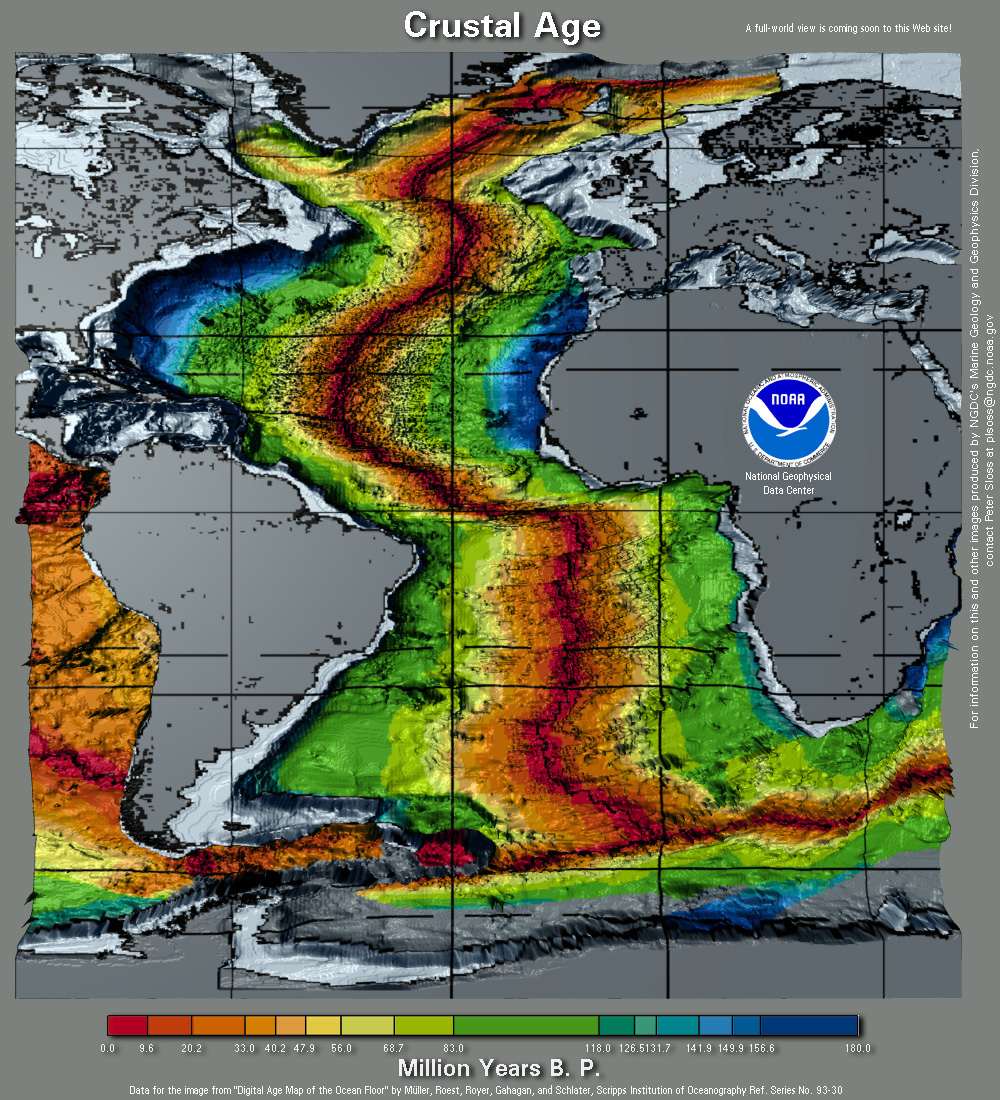
Interesting article. Of course we have known for a long time about these sea floor volcanic systems. It is not like it is new news.
See post #20...2nd and 3rd link.
The first of the three links at #20 is fascinating...but lengthy history....of the Naval programs .
And the observation ...not summarized that well by the Author...that the current theory...plate Tectonics... had some problems based on what he was seeing by observation....
Suggest you start with the 2nd and 3rd links.
Oh well. Guess I have no choice but to walk to the refrig and take my brain out of cold storage for a few hours. I had big plans of laying low tonight. heheh.
Excellent article, Ernest! BTTT!
Disclaimer: Opinions posted on Free Republic are those of the individual posters and do not necessarily represent the opinion of Free Republic or its management. All materials posted herein are protected by copyright law and the exemption for fair use of copyrighted works.
