To: mysterio; TADSLOS
Thunderbirds are crafty creatures. They manage to exist without being detected, they are unphotographable, and they leave no bones behind when they die. Are you certain of that? Teratorns are well known.
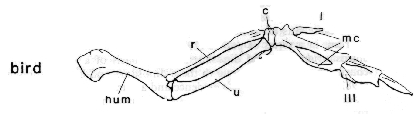
Generic avian wing diagram shows the position
of the humerus, marked "hum"
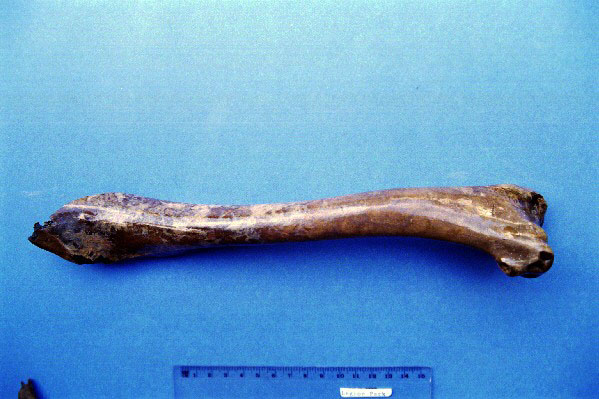
Partial Teratorn humerus is 14 inches in length and is from
a Teratorn with a wingspan of 15-16 feet, 50% larger than
the modern Turkey Vulture. Rule is 15 cm (~5.9")
The Argentavis Magnificens is a Teratorn whose humerus bones, found on the plains of Argentina, have been measured up to 22" in length. That length of a humerus belongs to a bird with a 24-25 foot wingspan and flight feathers as long as five feet. Using the cube-square law, that translates to a bird weighing in at 170 lbs... that still could fly.

Dr. Kenneth E. Campbell, (one of the discoverers) in front of
the 25 ft. wingspan Argentavis Magnificens (life size model).
Display seen at the Natural History Museum, Los Angeles.
35 posted on
11/25/2008 6:53:54 PM PST by
Swordmaker
(Remember, the proper pronunciation of IE is "AAAAIIIIIEEEEEEE!)
To: Swordmaker
Unfortunately, they've been extinct since the beginning of the Pleistocene epoch.
Here's the problem with cryptozoology :
If some ancient organism (like a dinosaur) has survived, it can't be just one. It has to be a population of them. So that means not just one Nessie in Loch Ness. That means a bunch of them. A bunch of massive birds / pleisaurs / dragons / bigfeet can't remain undetected. One might be able to. But not a population of them.
The only ancient organisms you're going to find are going to be in places where humans aren't, like the bottom of the ocean. They're not trotting around the backwoods of Washington state.
I spent my whole childhood reading books about this stuff. Space monsters included. It all boiled down to a bunch of hoaxes.
38 posted on
11/25/2008 7:04:59 PM PST by
mysterio
FreeRepublic.com is powered by software copyright 2000-2008 John Robinson