To: Alamo-Girl; albee; AnalogReigns; AnAmericanMother; Angelas; AniGrrl; annyokie; Aquinasfan; ...
Dr. John Jackson's new hypothesis PING!
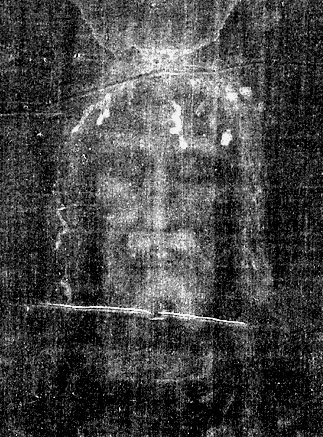 If you want on or off the Shroud of Turin Ping List, Freepmail me.
|
|
|
2 posted on
05/12/2008 2:05:37 AM PDT by
Swordmaker
(Remember, the proper pronunciation of IE is "AAAAIIIIIEEEEEEE!)
To: All
While this hypothesis has been argued on the basis of indirect chemistry, it can be discounted on the basis of evident bandings in the 1978 radiographs and transmitted light images of STURP. These data photographs show clearly that the banding structures (which are in the Shroud) propagate in an uninterrupted fashion through the region that would, ten years later, be where the sample was taken for radiocarbon dating.
Dr. Jackson's is mischaracterizing Raymond N. Rogers' peer-reviewed chemical tests as "indirect chemistry." As a matter of fact, Rogers' tests were done on the remaining sample cut from the Shroud in 1988 for the Carbon Dating tests and threads and small pieces of the main body of the Shroud. Rogers' chemistry analysis showed that the sample that was C-14 tested was both physically and chemically not the same as the main body of the Shroud, regardless of the radiographic and transmitted light photographs showing a continuation of "banding structures" cited by Dr. Jackson as if that alone was proof that the sample was the same as the main body of the Shroud. The banding structures are visible to the naked eye and could have been incorporated into the repaired repaired areas by the extremely skilled French weavers who apparently repaired the cloth in the mid 16th Century.
Among the discrepancies where the tested area differ from the main body of the shroud are:
- Slightly smaller thread diameters than the main body of the Shroud.
- Significant differences in ultraviolet fluorescence of the cloth where sample was taken compared to the main body of the Shroud.
- The presence of an Alum Mordent (a retting agent [softener] used only after the 15th Century).
- Energy-dispersive x-ray analysis found up to 2% Aluminum in the test sample area but only insignificant aluminum on the main body of the Shroud.
- Cotton twisted into the threads of linen (not present in any other area of the Shroud).
- Microphotographic evidence of spliced threads where newer threads were "rewoven" into older, original threads. (loom thread joins on the main body of the Shroud are overlays, not splices.)
- Rose Madder-root Dye (alizarin and purpurin) in a Gum Arabic base apparently used to "retouch" the newer threads to match the surrounding original threads and base color of the Shroud.
- The presence of significant quantities of Vanillin (C8H8O3 or 4-hydroxy-3-methoxybenzaldehyde) in the lignin of the tested area, while the main body shroud's linen lignin shows no trace of vanillin. (Vanillin, is present in all vegetable matter but diminishes [evanesces] over long periods of time until none is left after about 1,300 years.)
All of these show that the sample that was tested is not homogenous (the same) as the Main body of the Shroud.
3 posted on
05/12/2008 2:51:57 AM PDT by
Swordmaker
(Remember, the proper pronunciation of IE is "AAAAIIIIIEEEEEEE!)
To: Swordmaker
Thanks for the ping. Also, since we know that the Sudarium and the Shroud both have AB blood type, why can’t we connect them by DNA and prove an exact match? After all, one is in Italy and the other in Spain!
There wouldn’t have to be any further testing at all. Just the samples that have “already” been taken from both samples. You can’t ruin the DNA.
I’ve often wondered why this approach hasn’t been taken.
FRegards
9 posted on
05/12/2008 11:11:20 PM PDT by
Vets_Husband_and_Wife
(We stand firm with the President and the troops, We never waiver! We VOTED McCain!)
FreeRepublic.com is powered by software copyright 2000-2008 John Robinson