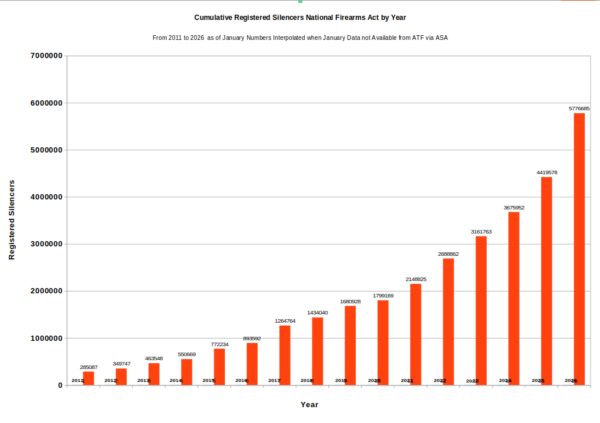
 Cumulative Registered Silencers National Firearms Act by YearImage by Dean Weingarten
 Posted on 04/22/2026 4:14:22 AM PDT by marktwain
According to the American Suppressor Association (ASA), the number of silencers/suppressors registered in the United States of America was 5,776,685 as of the time the Bureau of Alcohol, Tobacco, Firearms, and Explosives (ATF) responded at the SHOT Show in January of 2026.
This correspondent obtained information from the ATF on January 22, 2026. At that time, it was stated that the information had already been released and that over 150K National Firearms Act (NFA) applications had been approved through January 2026.
The graph of registered silence numbers was created using cumulative January counts from 2011 to 2026. When numbers were unavailable for January, linear interpolation was used to estimate the January number. Each year had at least one reference number. 2017 had three reference numbers, none of them for January.Cumulative Registered Silencers National Firearms Act by YearImage by Dean Weingarten
It is unlikely there will be 50 million registered silencers ten years from now. This correspondent believes the registration requirement will be removed well before 10 years. It could be removed within two years, given the lawsuits now in play. 50 million silencers in the hands of American gun owners, ten years from now, is plausible.
(Excerpt) Read more at ammoland.com ...

Silencer numbers from 2011 to 2026 as of January.
Almost 6 million. That is more than I would have thought.
Time to remove the necessity for registration too
Yes. There are several court cases persuasively arguing there is no power to require registration because there is no more tax.
It has been three months since January, so the numbers are well over six million by now.
Agreed, prices should fall. In our neck of the woods a suppressor for an AR15 ranges from $700 - $1,000.
At a gun show a few weeks ago a guy took one apart for me to see the inner workings. For a weapon as popular as the AR15 that is waaaaay toooo much. The suppressor costs more than the AR15 which probably has 10 times the machine work.
With a different adapter a single suppressor can fit several weapons. We are talking mass production here, which should further reduce price.
They should be an item found in the AR15 accessories department at sporting goods stores.
Wouldn’t that qualify them as “arms in common use for lawful purposes,” making at least this part of the NFA un-Constitutional?
Possible… you can search up some lower-cost offerings.
For, say, a rimfire suppressor in the 300-500 range the removal of the stamp tax is a 30%-40% total cost break right there.
What’s not in the article is how many people are buying new barrels, having barrels threaded, or even buying new arms where previously quiet range time was only a dream.
Just got my Sandman X out of jail. Agonizing seven day wait but beats the 11 months for the last one!
5.7 million REGISTERED. The ATF is licking it’s lips.
Almost SIX MILLION gangsters and murderers that will go free because no one will hear the gunshots until they’re miles away in their flivvers.
I didn’t get the supressor need until I used one.
No muffs, no ringing ears.
Now I get it.
A bottom ranked can for a .22 is in the $200 range still having to do the paperwork. I’m still not going forward.
Me neither. No registration. Know freedom.
I’ve been told it will take over 6 weeks just to have my barrel threaded by Silencer Central. And that’s just for a muzzle brake. I can’t legally own a suppressor here in Illinois.
L
Exactly...
Look at Pistol Braces right now !
Back and forth “legal”.
Things go Leftists and Your sweating
Bullets.
.
CRS’s Matt Hoover was jailed with felonies over ‘Card Key’ !
.
If They want You,they SWAT You.
Waiting on range report from buddy that is mating M249 semi with FRT. About to get on ATFs radar if I can get to range with him.
They're indespensible in the desert because the dust kicked up by your muzzle blast will give away your FFP from a mile away.
And they also tend to very slightly improve precision when used on a centerfire rifle because they reduce that blast of turbulent air that leaks past the bullet before it exits the muzzle.
But it's not all candy and nuts. They're costly. They take some maintenance. They add length and weight to the gun which, depending on your application, might make it "un-handier." And they get hotter'n a back-alley craps game.
But other than that, saul good.
The suppressor market is like any other commercial enterprise. When you're flush, you invest in improving your product or marketing or both. As the market gets bigger, it also gets more competitive, and racing improves the breed. And the industry obviously is pretty fat right now.
And now their product suddenly comes to the consumer $200 cheaper.
In the last 20 years suppressors in general have improved while costs have not risen in proportion. Twenty years ago, centerfire suppressors were mostly made from separate steel components that were welded together. In the higher-end cans, the first baffle beyon the muzzle of the barrel (known as the "blast" baffle) was made from a material called "inconel," which is harder than chinese math. Which gave the baffle significantly longer lifespan because it was more wear resistant. But it also is notoriously difficult to machine, which makes it expensive.
And designs (particularly the baffles themselves) tended to be invented from whole cloth or copied from something else. For the longest time the best baffle was known as a "clipped 'K' baffle," not because it was scientifically tested and proved best but because it had peoduced the lowest sound pressure levels in real life testing. What was truly "best" was still anybody's guess.
Now they're switching from separate components bonded together to 3d-printing. Which removes the need for bonding, which makes the overall structure lighter and stronger, plus it makes it possible to create (quieter) internal structures that couldn't be mass produced from separate components.
They're now 3D-printing entire suppressors from inconel, and from titanium (I don't know of any steel cans that are 3-d printed, but that doesn't mean there aren't any). And they're using CFD, sometimes done by big science labs, to take the guesswork out of what design is best.
One big change in the past decade is that the industry has agreed to a standard for adapters to allow suppressors to be used with various muzzle devices. At one time all suppressors threaded directly onto the barrel (except some auto-loading pistol suppressors, which had to be mounted to a "booster," which, in turn, was threaded onto the barrel).
But direct threading was a less than ideal solution because it limited which arms the can could be mounted on. For starters, the OD and the thread pitch on the barrel and the suppressor have to match. And the can for your AR couldn't be mounted on your AK because those accursed Rooskies use left-hand threads. So some manufactuers started making muzzle devices that threaded onto the barrel, but those muzzle devices could only be mounted to their mirror image, which, at that time was built into the butt-end of the suppressor.
Except each manufacturer went their own way with their designs, so there was limited interchangeability. Now the industry has cooperatively created a new standard for a new adapter, one that mounts onto the suppressor, not onto the muzzle.

The new style suppressors come with a great gaping hole in the butt-end. And all the companies use the same diameter hole and thread pitch so one company's adapters will fit on another company's can. So with one adapter your can becomes direct thread, like the old style. That's the lightest and shortest combination possible, but it's also limited in its usefulness. And because it necessarily uses a fine pitch thread, it has to be attached with some care to avoid cross-threading.
And for best results -- better security and repeatablity -- it needs to be torqued on each time it's attached to the muzzle.
With the older suppressors, the "quick disconnect" muzzle devices usually were either flash hider or muzzle brake designs. That goes on the muzzle via a fine pitch thread but the can goes onto the adapter via a coarse pitch thread. So you can attach the can quicker with no danger of cross-threading. Plus. it's the muzzle adapter that gets torqued on, not the can itself, so you can remove/replace the can all you want without re-torqueing.
And if you have a direct-thread suppressor and you remove it from the rifle, that leaves those fine-pitch threads exposed and vulnerable to damage. They make a sort of a cross between a nut and a sleeve called a "thread protector" you can put on to keep the threads pristine when the can is removed, but that's a one-trick pony. It serves no other function and it's another part you have to keep track of when it's not on the gun.
So using a muzzle device (like a QD) saves you having to re-torque each time you remove the can, and it protects the fine pitch threads on the muzzle. And when you use a muzzle device, you've still got a functional flash hider/brake attached when the suppressor is removed.
But that system still was limiting because you might want or need an adapter that your can's manufactufacturer isn't making. No problemo now because everybody's adapters are (almost) universally interchangeable.
But the suppressor adapters aren't free. The can you buy likely will come with one but that isn't necessarily the one you need. And buying extras runs $100-$150 (but they're non-NFA devices). Which, admittedly, is an added expense, but it's cheaper (and less hassle) than having to buy a new suppressor for every gun.
With the new system, adaptability is extreme. You can buy a 9mm can rated for 16" .308 pressures and use the standard QD adapter to mount it on your AR-10. And you can take the same suppressor, switch to the 3-lug adapter and mount it to the 3-lug muzzle device on your 9mm PCC.

This is the 3-lug adapter that goes in the butt of the suppressor. It fits on a mirror image muzzle device threaded onto the barrel. It was developed by our friends the sausage-eaters for the MP-5, and it's the 2nd greatest thing to come out of the MP-5, second only to the "MP-5 slap." It takes about two seconds to attach or remove. But it's held on by spring pressure which unfortunately makes it unsuitable for centerfire pressures.
But it's the schiz for a PCC, and it's like owning two suppressors for the price of one and a fifth.

Or use this adapter ^^^^^^ and your suppressor also works as direct thread.
Yes, it sounds complicated, and it can be intimidating. And that's the thing about all this innovation. If you only have one mission for your suppressor, most of this is wasted on you. But if you have a gun rack full of stuff just begging to be suppressed, there's no time like the present.
And if you want to suppress a semi-auto pistol with a Browning-style tilting barrel, you need to read up on something variously called a Nielsen adapter, a booster, or a linear inertial decoupler. They're all the same thing and you probably would need one to get your pistol to run suppressed.
What you see in the movies, the guys screwing a can directly onto a Glock, or a Beretta 92, that's either a single-shot pistol or a Hollywood lie.
All images in my previous post were pilfered from www.silencershop.com
Disclaimer: Opinions posted on Free Republic are those of the individual posters and do not necessarily represent the opinion of Free Republic or its management. All materials posted herein are protected by copyright law and the exemption for fair use of copyrighted works.