|
Posted on 03/10/2004 12:00:55 AM PST by SAMWolf
|
|
 are acknowledged, affirmed and commemorated.
|

| Our Mission: The FReeper Foxhole is dedicated to Veterans of our Nation's military forces and to others who are affected in their relationships with Veterans.
Where the Freeper Foxhole introduces a different veteran each Wednesday. The "ordinary" Soldier, Sailor, Airman or Marine who participated in the events in our Country's history. We hope to present events as seen through their eyes. To give you a glimpse into the life of those who sacrificed for all of us - Our Veterans.
|
|
The Coast Guard's first major participation in the Pacific war was at Guadalcanal. Here the service played a large part in the landings on the islands. So critical was their task that they were later involved in every major amphibious campaign during World War II. During the war, the Coast Guard manned over 350 ships and hundreds more amphibious type assault craft. It was in these ships and craft that the Coast Guard fulfilled one of its most important but least glamorous roles during the war--that is getting the men to the beaches. The initial landings were made on Guadalcanal in August 1942, and this hard-fought campaign lasted for nearly six months. Seven weeks after the initial landings, during a small engagement near the Matanikau River, Signalman First Class Douglas Albert Munro, died while rescuing a group of marines near the Matanikau River. Posthumously awarded a Medal of Honor, he lived up to the Coast Guard's motto--"Semper Paratus."  Douglas Munro grew up in the small town of Cle Elum, Washington. Enlisting in September 1939, Munro volunteered for duty on board the USCG cutter Spencer where he served until 1941. While on board he earned his Signalman 3rd Class rating. In June, President Roosevelt directed the Coast Guard to man four large transports and serve in mixed crews on board twenty-two naval ships. When word arrived that these ships needed signalmen, Munro, after much pleading with Spencer's executive officer, was given permission to transfer to the Hunter Liggett (APA-14). This 535 foot, 13,712 ton ship, was one of the largest transports in the Pacific. She carried nearly 700 officers and men and thirty-five landing boats including two LCTs. In April 1942, the "Lucky Liggett" sailed to Wellington, New Zealand, to prepare for a major campaign in the south pacific. On 7 August 1942, the United States embarked on its first major amphibious assault of the Pacific War. After the successes at Coral Sea and Midway the United States decided to counter Japanese advances in the Solomon Islands. These islands form two parallel lines that run southeast approximately 600 miles east of New Guinea. Tulagi and Guadalcanal, both at the end of the chain were picked for an assault. Guadalcanal was strategically important because the Japanese were building an airfield, and if finished would interfere with the campaign.  Douglas Munro and his sister in Elum Eighteen of the twenty-two naval troop carrying ships attached to the campaign's task force carried Coast Guard personnel. These men were assigned an integral part in the landings--the operation of the landing craft. Many of the Coast Guard coxswains had come from Life-Saving stations and their experience with small boats made them the most seasoned small boat handlers in government service. The Coast Guard manned transports played a prominent role in the initial landings at Guadalcanal, Tulagi and other nearby islands. As the task force gathered, Munro, now a signalman first-class, was assigned to temporary duty on the staff of Commander, Transport Division Seventeen. During the preparations for the invasion, Munro was transferred from ship to ship, as his talents were needed. The task force rendezvoused at sea near the end of July and on 7 August the Liggett led the other transports to their anchorage off Guadalcanal. Hunter Liggett served as the amphibious force command post until the Marines secured the beaches.  LCPL - Landing Craft, Personnel, Large At he time of the invasion, Munro was attached to the staff of Rear Admiral Richmond Kelly Turner on board McCawley (APA-4). Munro made the landing on Tulagi Island where fierce fighting lasted for several days. About two weeks later Munro was sent twenty miles across the channel to Guadalcanal where the Marines had landed and had driven inland. One of the bloodiest and most decisive battles ensued. The Americans quickly seized the airfield on the island but for six months both the U.S. and the Japanese poured troops onto Guadalcanal in an attempt to gain control and force the other off. After the initial landings at Guadalcanal, Munro and twenty-four other Coast Guard and Navy personnel were assigned to Lunga Point Base. The base was commanded by Commander Dwight H. Dexter, USCG, who was in charge of all the small boat operations on Guadalcanal. The base, situated on the Lever Brothers coconut plantation consisted of a small house with a newly constructed coconut tree signal tower. Munro was assigned here because of his signalman rate. The base served as the staging area for troop movements along the coast. To facilitate this movement, a pool of landing craft from the numerous transports lay there to expedite the transportation of supplies and men.  Site of Douglas Munro's battle today A month into the campaign, the Marines on the island were reinforced and decided to push beyond their defensive perimeter. They planned to advance west across the Matanikau River to prevent smaller Japanese units from combining and striking American positions in overwhelming numbers. For several days near the end of September, the Marines tried to cross the river from the east and each time met tremendous resistance. On Sunday, 27 September, Marine Lieutenant Colonel Lewis B. "Chesty" Puller embarked three companies of his 7th Marines in landing craft. They planned to land west of the river, drive out the Japanese, and establish a patrol base on the west side of the Matanikau. The landing craft were dispatched from Lunga Base. Douglas Munro, just two weeks short of his twenty-third birthday, took charge of ten LCPs and LCTs (tank lighters) to transport Puller's men from Lunga Point to a small cove west of Point Cruz. The Marines landed with the support of the destroyer U.S.S. Monssen which laid down a covering barrage with her five inch batteries shortly after twelve o'clock. Major Ortho L. Rodgers, commanding the landing party reached the beach in two waves at 1:00. The 500 unopposed Marines pushed inland and reorganized on a ridge about 500 yards from the beach. At about 1:50, approximately the same time they reached the ridge, their gunfire support was disrupted by a Japanese bombing raid. Monssen had to withdraw to avoid seventeen high level Japanese bombers. Unfortunately, this occurred at the same time that the Marines were struck by an overwhelming Japanese force west of the river. This situation deteriorated when Major Rodgers was killed and one of the company commanders was wounded.  After the Marines landed, Munro and the boats returned to Lunga Point Base. A single LCP remained behind to take off the immediate wounded. Coast Guard petty officer Ray Evans and Navy Coxswain Samuel B. Roberts manned the craft. They kept the craft extremely close to the beach to take off the wounded as quickly as possible. The Japanese, meanwhile had worked behind the Marines and without warning a machine gun burst hit the LCP parting the rudder cable and damaging the boat's controls. After jury rigging the rudder, Roberts was struck by enemy fire and Evans managed to jam the controls to full ahead and sped back to Lunga Point Base. Unable to stop, the LCP ran onto the beach at 20 mph. Roberts later died but won the Navy Cross posthumously. As Evans arrived at the Lunga Point base, word arrived that the Marines were in trouble and were being driven back toward the beach. Their immediate plight had not been known. The bombing raid had driven Monssen out of range to visually communicate with shore. Furthermore, the three companies of Marines had failed to take a radio and were unable to convey their predicament. Using under-shirts they spelled out the word "HELP" on a ridge not far from the beach. Second Lieutenant Dale Leslie in a Douglas SBD spotted the message and passed it by radio to another Marine unit. At 4 P.M. Lt. Colonel Puller, realizing that his men were isolated, embarked on Monssen to direct personally the covering fire for the marines who were desperately trying to reach the beach.  1st Battalion, 7th marines withdraws from its expossed position West of Point Cruz under artillery and Naval gunfire support On this beach Companies A,B and D of the 1st Battalion / 7th Marines landed on 27 September 1942.They moved 500 yards inland to the top of Hill 84 (where the King Solomon is now) , where they were trapped by the Japanese. Supported by naval gunfire they withdrew to the beach area between the tennis club and the Mendana Hotel (now the site of the National Gallery and Prime Ministers offices) The landing craft had meanwhile been readied at Lunga Point Base. Again, virtually the same boats that had put the Marines on the beach were assembled to extract them. Douglas Munro, who had taken charge of the original landing, volunteered to lead the boats back to the beach. None of these boats were heavily armed or well protected. For instance, Munro's Higgin's boat had a plywood hull, it was slow, vulnerable to small arms fire, and was armed only with two air-cooled .30 caliber Lewis machine guns. As Munro led the boats ashore the Japanese fired on the small craft from Point Cruz, the ridges abandoned by the Marines, and from positions east of the beach. This intense fire from three strong interlocking positions disrupted the landing and caused a number of casualties among the virtually defenseless crews in the boats. Despite the intense fire Munro led the boats ashore. Reaching the shore in waves, Munro led them to the beach two or three at a time to pick up the Marines. Munro and Petty Officer Raymond Evans provided covering fire from an exposed position on the beach.  DOUGLAS A. MUNRO COVERS THE WITHDRAWAL OF THE 7th MARINES AT GUADALCANAL by Bernard DAndrea As the Marines reembarked, the Japanese pressed toward the beach making the withdrawal more dangerous with each second. The Monssen and Leslie's Douglas "Dauntless" dive bomber provided additional cover for the withdrawing Marines. The Marines arrived on the beach to embark on the landing craft while the Japanese kept up a murderous fire from the ridges about 500 yards from the beach. Munro, seeing the dangerous situation, maneuvered his boat between the enemy and those withdrawing to protect the remnants of the battalion. Successfully providing cover, all the Marines including twenty-five wounded managed to escape. With all the Marines safely in the small craft, Munro and Evans steered their LCP off shore. As they passed towards Point Cruz they noticed an LCT full of Marines grounded on the beach. Munro steered his craft and directed another tank lighter to pull it off. Twenty minutes later, the craft was free and heading to sea. Before they could get far from shore, the Japanese set up a machine gun and began firing at the boats. Evans saw the fire and shouted a warning to Munro. The roar of the boat's engine, however, prevented Munro from hearing and a single bullet hit him in the base of the skull. Petty Officer Munro died before reaching the operating base, but due to his extraordinary heroism, outstanding leadership and gallantry, Munro posthumously received the Medal of Honor.  Reverse of Douglas Munro’s Medal of Honor The Coast Guard continued to provide valuable service in all theaters of the war. The Coast Guard's motto "Semper Paratus" provided inspiration and guided other men to perform heroic acts demonstrating that they were indeed "Always Ready."
|
LOL. That's about all we can say about our state!
Both flew SBD's in combat... Make's you go Hmmmmmmm.
|
Air Power |
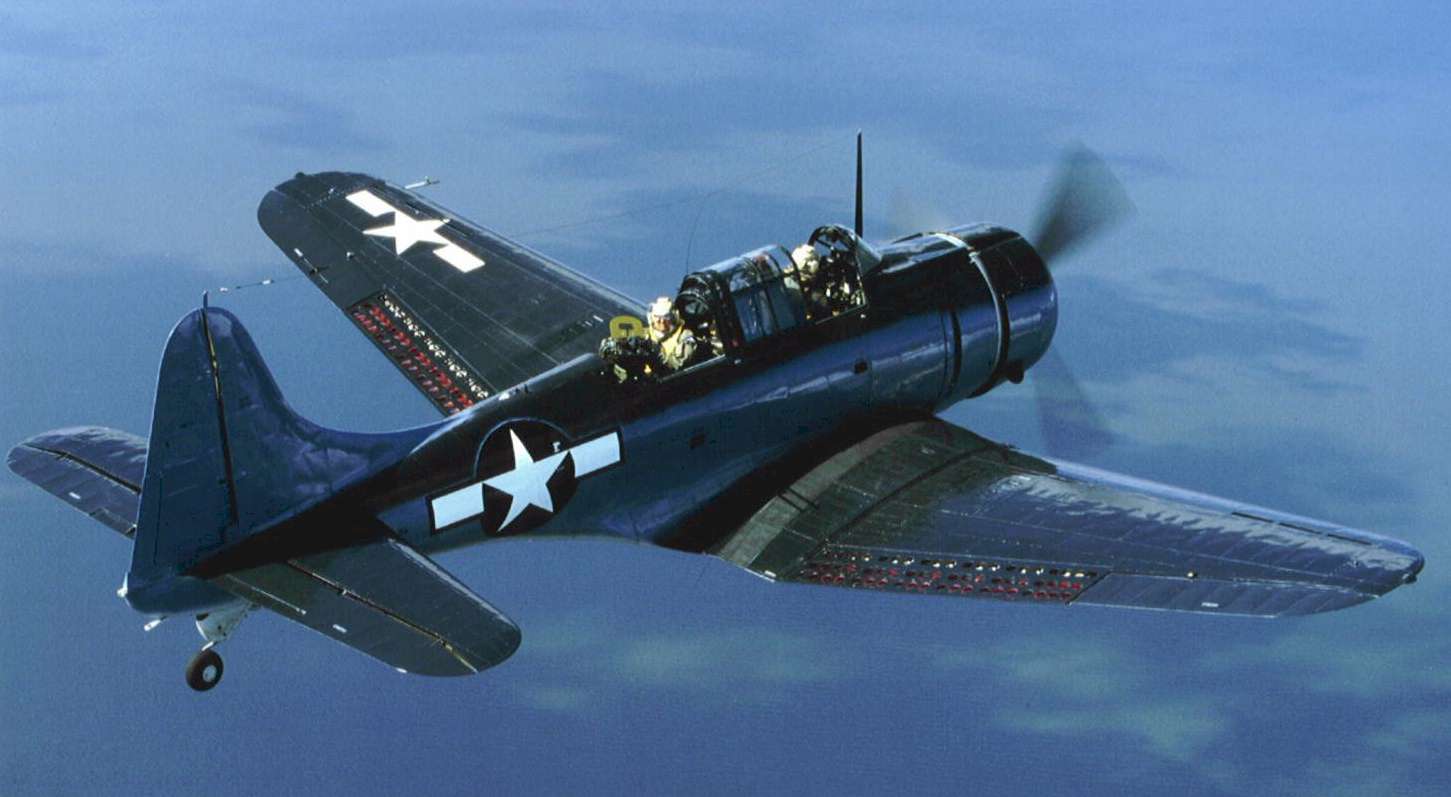
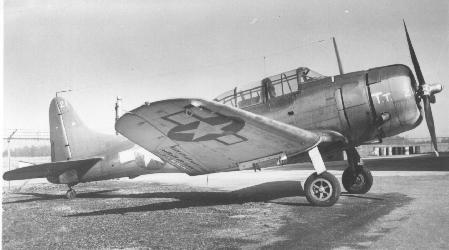
The right plane at the right time. That's what the "Slow But Deadly" SBD Dauntless was. When the US Navy was forced to go to war it did so in an aircraft that was considered by many to be obsolete. By the end of the war this "obsolete" plane was responsible for sinking more enemy ships than any other aircraft in the US inventory.
The first version of the Dauntless was the dash one and was found to be unsuitable for Navy service. As was Navy tradition, these first 50 aircraft were destroyed on the gound at Pearl Harbor. The most produced versions were the improved dash three and dash five aircraft. These planes ranged from the skies over the Coral Sea to the final victory flight over the USS Missouri in Tokyo Bay and are now recognized as treasured museum pieces.
The SBD Dauntless was a two-place, low-wing Navy scout bomber, powered by a single Wright R1820, 1200-horsepower engine. The Dauntless became a mainstay of the Navy's air fleet in the Pacific, with the lowest loss ration of any U.S. carrier aircraft. A total of 5,936 SBDs were delivered between first delivery in 1940 and the end of production in July 1944.
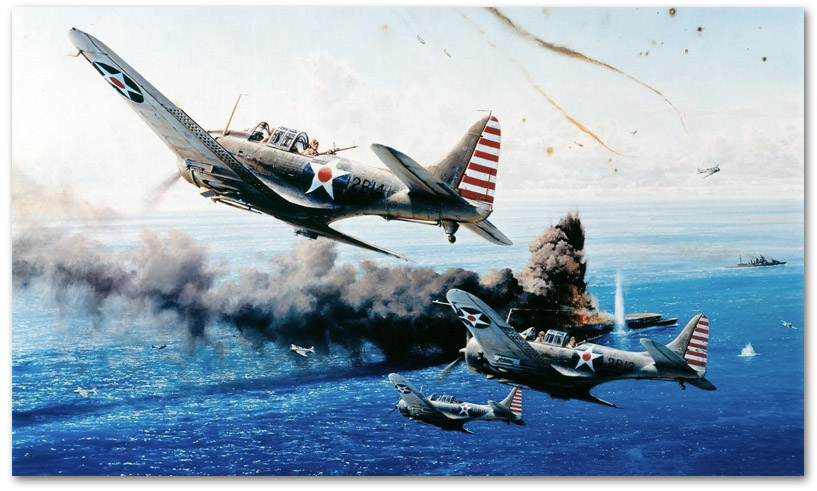
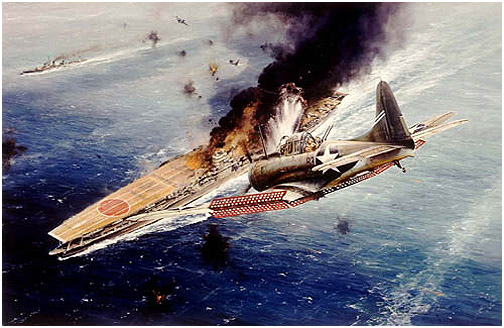
The Dauntless was the standard shipborne dive-bomber of the US Navy from mid-1940 until November 1943, when the first Curtiss Helldivers arrived to replace it. The SBD was gradually phased out during 1944, and the June 20 strike against the Japanese Mobile Fleet - in the Battle of the Philippine Sea - was therefore its last major action. In 1942-43, in the Battle of the Coral Sea, in the bitter Guadalcanal campaign and - most of all - at the decisive Battle of Midway, the Dauntless did more than any other aircraft to turn the tide of the Pacific War. At Midway it wrecked all four Japanese carriers, and later in the battle sank a heavy cruiser and severely damaged another. From 1942 to 1944, in addition to its shipboard service, the SBD saw much action with the Marine Corps flying from island bases.
In the Guadalcanal Campaign the Dauntless - operating from US carriers and from Henderson Field on Guadalcanal itself - took a huge toll of Japanese shipping.
It sank the carrier Ryujo in the battle of the Eastern Solomons, and damaged three other Japanese carriers at Eastern Solomons and in the Battle of Santa Cruz. In the Naval Battle of Guadalcanal SBDs sank the heavy cruiser Kinugasa and, in company with TBD Avengers, sank nine Japanese transports
The Dauntless was older and slower than its Japanese opposite number, the Aichi D3A2 "Val" - but the SBD was far more resistant to battle damage, and its flying qualities perfectly suited it to its role. In particular - as Dauntless pilots testified - it was very steady in a dive. When the more modern and powerful Helldiver went into action alongside the SBD it was soon realized - particularly at Philippine Sea - that the new aircraft was inferior to the Dauntless. However, the Helldiver was already well into large-scale production, and it was too late to reverse the decision that it should supplant the SBD.
Specifications:
Manufacturer: Douglas Aircraft
Type: Two-seat carrier-based and land-based dive-bomber
Powerplant: One Wright R-1820-66 Cyclone , 1,350 hp (1007 kw), 9-cylinder radial, air cooled engine.
Crew: Two - some models had Three
Dimensions:
Wing span: 41 ft 6 in (12.65 m)
Length: 33 ft 0 in (10.06 m)
Height: 12 ft 11 in (3.94 m)
Weights: Empty: 6,535 lb (2,964 kg) Max T/O: 9,519 lb (4,318 kg)
Performance:
Maximum Speed: 255 mph (410 km/h) @ 14,000 ft (4,265 m)
Service Ceiling: 25,200 ft (7,680 m)
Range: 773 miles (1,244 km)
Armaments:
Two forward firing .50 inch (12.7 mm) machine guns
Two 0.30 inch (7.62 mm) machine guns on flexible mounts.
Fuselage mount for up to 1,600 lbs (726 kg) of bombs,
And up to a total of 650 lbs (295 kg) of bombs carried on the wings.



Somehow I knew this was gonna be a tear jerker before I started reading the thread. Thanks for the story Sam.
Chuck Norris named ‘Veteran of the Year’

Gen. John Handy, Air Force vice chief of staff, congratulates actor Chuck Norris as the “Veteran of the Year” for 2001.
BEVERLY HILLS, Calif. (AFPN) — Chuck Norris is an international action star best known for his roles in movies like “Delta Force” and “Missing in Action” and the “Walker, Texas Ranger” television series. But few people know he’s an Air Force veteran who served with security forces in South Korea in the early 1960s. Or that he started studying the martial arts while there.
Fewer people know of his philanthropic work with children and military veterans. He’s the spokesperson for the Department of Veterans Affairs. And in 1990, he established the “Kick Drugs out of America” Foundation.
Because of his work, the Veterans Foundation Inc. chose him “Veteran of the Year” for 2001. A national selection committee representing the entertainment industry, the military and corporate America chooses the honoree.
Gen. John W. Handy, Air Force vice chief of staff, presented Norris the award at the American Veteran awards show in Beverly Hills, Calif.
The taped show will air on The History Channel, Feb. 11. The show is designed to commemorate America’s past, present and future military members, raise awareness and encourage public support for the 26.4 million veterans and present service members.
Thanks for profiling the "workhorse" of the Pacific. I had the Monogram model of the Dauntless and the HellDiver. Definately liked the looks of the Dauntless better.

Disclaimer: Opinions posted on Free Republic are those of the individual posters and do not necessarily represent the opinion of Free Republic or its management. All materials posted herein are protected by copyright law and the exemption for fair use of copyrighted works.