HAPPY PURIM!
Posted on 03/14/2019 12:14:37 PM PDT by Ezekiel
Purim and the MEMORY of Amalek
Parshat Zachor
This being the Shabbat before Purim, on which we celebrate the foiling of Haman the Amalekite's plot to destroy the Jewish people, the weekly Parshah is supplemented with the Zachor reading (Deuteronomy 25:17-19) in which we are commanded to remember the evil of Amalek and to eradicate it from the face of the earth.
https://www.chabad.org/calendar/view/day.asp?tdate=3/16/2019
Deu 25
17. Remember [zachor! זכור] what Amalek did to you by the way, when you came forth out of Egypt:
18. How he met you by the way, and struck at your rear, all who were feeble behind you, when you were faint and weary; and he did not fear God:
19. Therefore it shall be, when the Lord your God has given you rest from all your enemies around, in the land which the Lord your God gives you for an inheritance to possess, that you shall blot out the remembrance* of Amalek from under heaven; you shall not forget it:
*the word for remembrance is zecher [זכר], which also means memory. This is an important nuance, because a remembrance is what other people remember. "Memory" could be that as well, but a memory is also a person's own memory. Here is a simple explanation for what seems to be a confusing command to remember and forget at the same time:
Amalek's own memory.
blot out the MEMORY of Amalek from under heaven; you shall not forget it.
Do not forget Amalek's memory. There is a certain character type who has a keen (but highly selective) memory. He is eager to dredge up any negative incident or data point from the past in order to make a mountain out of a molehill. He'll dig deep, even going back to a yearbook from 1984. He will bring 1984 back to life to teach the folks how ugly the accused is in the present.
His purpose is to cast doubt on another's character because it works. There are those of feeble character who are all agog to hear such reports, because these "proofs" validate what they have already decided to believe. For example, God is perpetually accused of being an ogre, or of not even existing, because look around at all the misery, etc. "Ergo", the world is a product of random chance, without any real purpose or substance. Nobody could possibly be on a mission from God.
Those who lack any interest in discernment of sources and truth are manipulated by emotion and therefore easily swayed by misinformation, gossip, and megadoom. Doubt is sewn. Never mind weighing evidence, context and the possible motives of the accuser, it's all about the seriousness of the charge.
Haman was an AGAGite, a descendant of Amalek:
Esther 3
8. And Haman said to king Ahasuerus, There is a certain people scattered abroad and dispersed among the people in all the provinces of your kingdom; and their laws are different from those of every other people; and they do not keep the king's laws; therefore it is not for the king's profit to tolerate them:
9. If it please the king, let it be decreed that they may be destroyed; and I will pay ten thousand talents of silver to the hands of those who have the charge of the business, to bring it into the king's treasuries:
10. And the king took his ring from his hand, and gave it to Haman the son of Hammedatha the Agagite, the Jews' enemy:
11. And the king said to Haman, The silver is given to you, the people also, to do with them as it seems good to you:
Remember what Amalek did to you by the way... how he met you by the way...
Oh "by the way", there's a rogue entity in your kingdom that is downright lawless, and therefore highly dangerous...
Haman the son of Hammedatha the AGAGite:
Agag (/ˈeɪɡæɡ/; Hebrew: אֲגַג ʾĂḡāḡ, Arabic: يأجوج) is a Northwest Semitic name or title applied to a biblical king. It has been suggested that "Agag" was a dynastic name of the kings of Amalek, just as Pharaoh was used as a dynastic name for the ancient Egyptians.[1][2] The etymology is uncertain, according to John L. McKenzie (1995),[3] while Cox (1884) suggested "High."[4]
In the Torah, the expression "higher than Agag, and his kingdom will be lifted up" was uttered by Balaam in Numbers 24:7, in his third prophetic utterance, to describe a king of Israel who would be higher than the king of Amalek. This is understood to mean that Israel's king would take a higher position than even Amalek himself, and would exercise a wider authority. The writer uses an allusion to the literal significance of the word "Agag", meaning "high", to convey that the king of Israel would be "higher than High". A characteristic trait of biblical poetry is to use puns.[4]
https://en.wikipedia.org/wiki/Agag
AGOG: very eager or curious to hear or see something.
Very eager to hear something, such as lashon hara.
It runs in that family.
Amalek's power is in his [selective] memory. He becomes powerless to create doubt if people pay no mind to his dramatic and convincing accusations, because... "Game Over". Everyone has caught on, recognizing the source, the evil intent, and its destructive result. The seriousness of the charges now go in one ear and out the other. "So what!" The reaction to Haman becomes, appropriately, "Hang him post haste, and all of his sons (fellow travelers) too."
Remember what Amalek did to you by the way... how he met you by the way, and struck at your rear [1984], all who were feeble behind you, when you were faint and weary; and he did not fear God:
Therefore it shall be, when the Lord your God has given you rest from all your enemies around, in the land which the Lord your God gives you for an inheritance to possess, that you shall blot out the MEMORY of Amalek from under heaven; you shall not forget it:
The Scroll of Esther documents the reversal of fortunes for Haman the AGAGite, who thought his [ACME] plot to destroy the people of Mordecai was a done deal.
Mordecai refused to bow. Mordecai was the face of the people who would not make obeisance to Haman. Mordecai's mere presence at the gate was a daily reminder to Haman of that inescapable fact. Mordecai didn't have to say a word. His existence was enough to trigger Haman's wrath.
The spirit of Purim is to make merry and drink until one does not know the difference between "Cursed be Haman" and "Blessed be Mordecai". I find this odd because are they not the same statement? No alcohol is required to comprehend that one man's curse is another man's blessing, at the same time. Haman's descent was Mordecai's ascent.
A characteristic trait of biblical poetry is to use puns.
AGOG: From Middle English, from Old French, en + gogues (“in a merry mood”). See also the Italian agognare (“to desire eagerly”?).
GOGUE: From Old French gogue (“joke, fun”). Compare gogo and goguenard.
Haman, the Agagite. His was the family line of A GAG:
The verb is from 15th-century Middle English gaggen, Early Modern English gagge, possibly imitative or perhaps related to or influenced by Old Norse (Old Icelandic) gag-háls ("with head thrown backwards"; > Norwegian dialectal gaga (“bent backwards”)). The intransitive sense "to retch" is from 1707.
The noun is from the 16th century, figurative use (for "repression of speech") from the 1620s. The secondary meaning "(practical) joke" is from 1863, of unclear origin.
1863. Unclear origin. But is says right there that the meaning of "practical joke" goes back aways, back to 1863. And that's all we really need to know!
A gag, a dynastic name of the kings of Amalek.
("Trump!")
Therefore, forget Amalek's memory and choose instead to
Be excellent to each other.
♥
It's an important history lesson, the final exam actually.
1863
HAPPY PURIM!
There is a prophecy for modern times in the Book of Esther that predicts the end of the 20th Century Holocaust. I decided not to extract it, because Haim Shore puts the case so perfectly. The Hebrew letters didn’t come over, but you can get the whole book on Amazon.
16.2 The Case of Haman’s Sons This section has been the most difficult, and at times distressful, to write. There are two interrelated reasons for this. First, this section is related to the Holocaust. Second, my families, both on my late father’s side (my father’s name was Daniel, deceased 1967) and on my late mother’s side (my mother’s name was Havah, deceased 2005), both families perished in the Holocaust. Therefore, writing about the Holocaust, and suggesting that somehow a most bizarre coincidence in the Bible insinuates a forthcoming Holocaust, looks like an outrageous— perhaps even offensive— assertion.
After much hesitation and deliberation, I have decided to proceed with detailing this coincidence. This was done for two reasons.
First, the coincidence to be expounded in this section is not new, and it is well-known, at least in Israel. It had previously been recounted in various publications (for example, Katz 1991, 1996), and is routinely taught in seminars for nonreligious Jewish Israelis, delivered by religious not-for-profit organizations, like Arachim. 13 In discussing this coincidence, therefore, I am not introducing controversy or an as-yet-unknown coincidence.
Second, the reader was assured in the introductory chapter that we would expose Bible-related and biblical-Hebrew-related coincidences of any sort known to us, leaving the reader to decide the nature of the coincidence, whether random or otherwise (as alluded therein, the results of the statistical analyses are exempt from this characterization). Faithful to this principle of censorship-free exposure to all known curious coincidences in the Bible, the coincidence regarding Haman’s sons is expounded in this section, notwithstanding the personal difficulty that I experience in detailing that coincidence.
Esther, Mordechai, and Haman are the three central figures and heroes of the book of Esther. However, there is one more hero— hidden, unspecified, not mentioned even once. But the whole book is focused about how He conducts his world, in hidden ways, as is revealed only in the name of the book. As related elsewhere in this book (chapter 20), according to Jewish tradition, the name Esther is related to the verse in Deuteronomy, where God conveys to the people of Israel that in the face of their moral transgressions, he would hide his face from them— furthermore, he would even hide the hiding. This is succinctly summarized in Hebrew in three words: “Haster astir panai” 14 (Deutronomy 31: 18), commonly inaccurately translated as “And I will surely hide my face” (“… on that day for all the evils which they have perpetrated”). The root of the haster astir is S.T.R, which means “to conceal.” This is also the root of the name Esther, and the whole book is an allegory to the Divine’s ways of conduct that look random to us. How the Bible refers to the concept of randomness has been alluded to at some length in section 3.3. The reader may wish to review this section, where verses in the Bible that relate to randomness are addressed.
The coincidence of Haman and his sons is now expounded (refer to subsection 20.2.1, where the details of the story, though not the coincidence, is introduced in more detail). Haman is first mentioned in the book of Esther thus: “After these things King Ahasuerus promoted Haman, the son of Hammedatha the Agagite, and advanced him and set his seat above all the princes that were with him. And all the king’s servants that were in the king’s gate bowed, and reverenced Haman; for the king had so commanded concerning him. But Mordechai bowed not, nor did him reverence” (Esther 3: 1— 2). So we know that Haman was of an Amalekite origin (Agag was king of Amalek— 1 Samuel 15: 8), and that he is in a supreme position in the king’s court. Then the book of Esther relates how Haman had initiated a plot to murder all Jews in the king’s kingdoms: “Letters were sent by couriers to all the king’s provinces, to destroy, to slay, and to annihilate all Jews, young and old, women and children, in one day, the thirteenth day of the twelfth month, which is the month of Adar . And the king and Haman sat down to drink” (Esther 3: 13, 15). How very familiar …
The extermination plot, however, failed, by coincidence (or was it?). In a bizarre twist of events, the king changes his taste (perhaps following the drink he had with Haman), and both Haman and his sons are hung by the king. As the latter chain of events is recounted in Esther, “So they hanged Haman on the gallows which he had prepared for Modechai. Then the king’s wrath was pacified” (Esther 7: 10). And later, Haman’s sons were also killed: “The ten sons of Haman the son of Hammedata, the enemy of the Jews, they slew; but they did not lay their hands on the plunder” (Esther 9: 10). The king then reassures Esther, the queen: “And the king said to Esther the queen, The Jews have slain and destroyed five hundred men in Shushan the capital, and also the ten sons of Haman … now what is thy petition? and it shall be granted thee …” (Esther 9: 12).
Esther’s answer starts the bizarre coincidence. What does she ask the king to do? The answer is given in the next verse: “Then Esther said, If it please the king, let it be granted to the Jews who are in Shushan to do tomorrow also according to this day’s decree, and let Haman’s ten sons be hanged upon the gallows. And the king commanded it so to be done: and the decree was given at Shushan; and they hanged Haman’s ten sons” (Esther 9: 13-14).
The biblical narrator was very explicit to notify us that Esther knows that Haman’s sons were already dead. So what is the sense in asking the king, in reply, to hang them on a tree?
Rashi (1040-1105), the most prominent Jewish interpreter of the Bible, is aware of the difficulty, and he is very succinct in explaining the hanging of Haman’s sons: “those that were killed.” Other interpreters are mute about it, though the Malbim (1809-79) explains that the objective of “hanging the dead” was to intimidate the enemies of the Jews who had thought that the “Jews Annihilation Decree” was still valid.
We may consider another perspective, also based upon well-established Jewish tradition. We have alluded elsewhere (chapter 20) to the fact that in the book of Esther, the name of the Divine is not mentioned. It is therefore traditionally assumed that when the king’s name is explicitly mentioned— namely the king “which reigned from India even unto Ethiopia, over an hundred and seven and twenty provinces” (Esther 1: 1), this implies that Ahasuerus is intended. Elsewhere, when only the word “king” appears, reference is to the King of Kings (for example, consider Esther Rabbah 3: 10). Thus, the king’s decree to hang Haman’s sons (giving an impression of a second execution) is in fact a decree from the Divine. Furthermore, Jewish scholars lay a rule regarding the appearance in biblical text of the word “tomorrow” (a rule not relating explicitly to Esther): “There is tomorrow now and there is tomorrow after some time” (Midrash Tanchuma, Parashat BA, 13). Thus, when Esther requests of the Divine to hang Haman’s sons “tomorrow” (Esther 9: 13), this can be in the future and not necessarily the next day.
Hanging of Haman’s sons may be interpreted, in the framework of the coincidence that we expound here, as a decree from God (Esther 9: 14, where only “king” is referenced), and it may be sometime in the future, consistent with how tomorrow is sometimes used in the Bible.
Who might these ten men, to be hanged on the tree some time in the future, be— and why is this important?
We have earlier referred to the position of the Talmud that special letters in the Bible were given to Moses from Sinai. Such special letters appear in relative abundance next to the listing of the names of Haman’s sons (Esther 9: 7— 9).
There are four such letters.
The letter vav, enlarged, appears in the name of Vajezatha (Vayzata15 in the Hebrew text). The letter tav appears small in the name Parshandatha. 16 The letter shin appears small in the name Parmashta. 17 Finally, the letter zayin appears small in the name Vajezatha (Vayzata15 in Hebrew).
Four letters: one large (vav, which has a value of 6) and the other three small letters (tav, shin, and zayin, in that particular order).
Rewritten together, we have (read from right to left): [picture here]
This looks amazingly similar to how a Hebrew calendar date is read. (Refer for an explanation of the Hebrew calendar to subsection 2.1.2.) For example, the Jewish year starting October 4, 2005, is which in Hebrew-calendar count is 5766 (the 766th year of the sixth thousand).
Similarly, the above first letter may be perceived as implying the sixth thousand, and the other three letters give the year 707 (of the sixth thousand)— in other words, a Hebrew calendar year of 5707.
Employing the Hebrew Date Converter (http:// www.hebcal.com/ converter), one finds this year to correspond to the year 1946.
On October 16, 1946, newspapers world over notified their readers that ten Nazi criminals were hanged after being indicted in the famous Nuremberg trials.
Were only ten charged?
Not at all. In the Nuremberg trials, twenty-three Nazi war criminals were charged. Whose verdict was it to go to the gallows? The New York Times headline, in a late city edition from that day, tells it all:
“Goering Ends Life By Poison, 10 Others Hanged In Nuremberg Prison For Nazi War Crimes; Doomed Men On Gallows Pray For Germany.”
Out of twenty-three charged, eleven had a verdict to be executed on the gallows. However, two hours prior to execution time, Nazi criminal Goering succeeded in committing suicide. This brought down the number of men hanged to exactly ten, in the year 1946, Hebrew date [picture here]
Haim Shore (2012-12-11). Coincidences in the Bible and in Biblical Hebrew (Kindle Locations 6313-6273). iUniverse. Kindle Edition.
unfortunately, it does very little good to constantly “remember” the evil anti-Semites of history....
if Jewish people won’t learn the intended lesson of these observances.....
and start defending themselves better. much much better.
1. stop enabling the enemy, whether by voting for the anti-Semitic SorozNazi party in USA or the Nazified Labour party in UK.....
2. or (for Israel)...stop protecting, enabling, “negotiating with” the enemy terrorist gangsters and start eliminating them AT LONG LAST
2.
Isn’t Purim a hand sanitizer?
Fantastic! Thanks for posting it.
Also, IIRC, the original Amalek was a grandson of Esau, the rival twin of Jacob (Israel). The original Amelek was the father of Eliphaz, too, who gave more than a little grief to poor old Job while he was down, presaging the picking off the weakest of the Israelites in their journey. The same Eliphaz was roundly condemned by God Himself for all his falsehoods.
But the amazing connection with Nuremberg is stunning!
I second your post! I can’t understand why Jews are Democrats. If I were Jewish, I would be a lifetime NRA member. Evangelical Christians are their best friends, but the left wing collar wearing liberal baby killers take the Palestinian lovers vote against them every time. Just Democrats loving the UN should make Jews permanent Republicans.
Do what God tells you to do!
Who many Catholics vote RAT?? The same RAT Party who just joyously supported the murder of babies up to birth and appeased anti-Semitism with Congress women who proudly show their disdain for the USA and our Constitution!! How many Mormons voted for Romney last November? The same Mittens who is trying to destroy our Donald?
There’s enough blame to go around these days. So, lumping all Jews as Liberal is about the same. There are just fewer Jews than the others thanks to their being slaughtered for centuries.
That’s right. Similarly, Hezekiah begged for longer lifetime; and it was during the grant of longer life that he sired the infamous Manasseh.
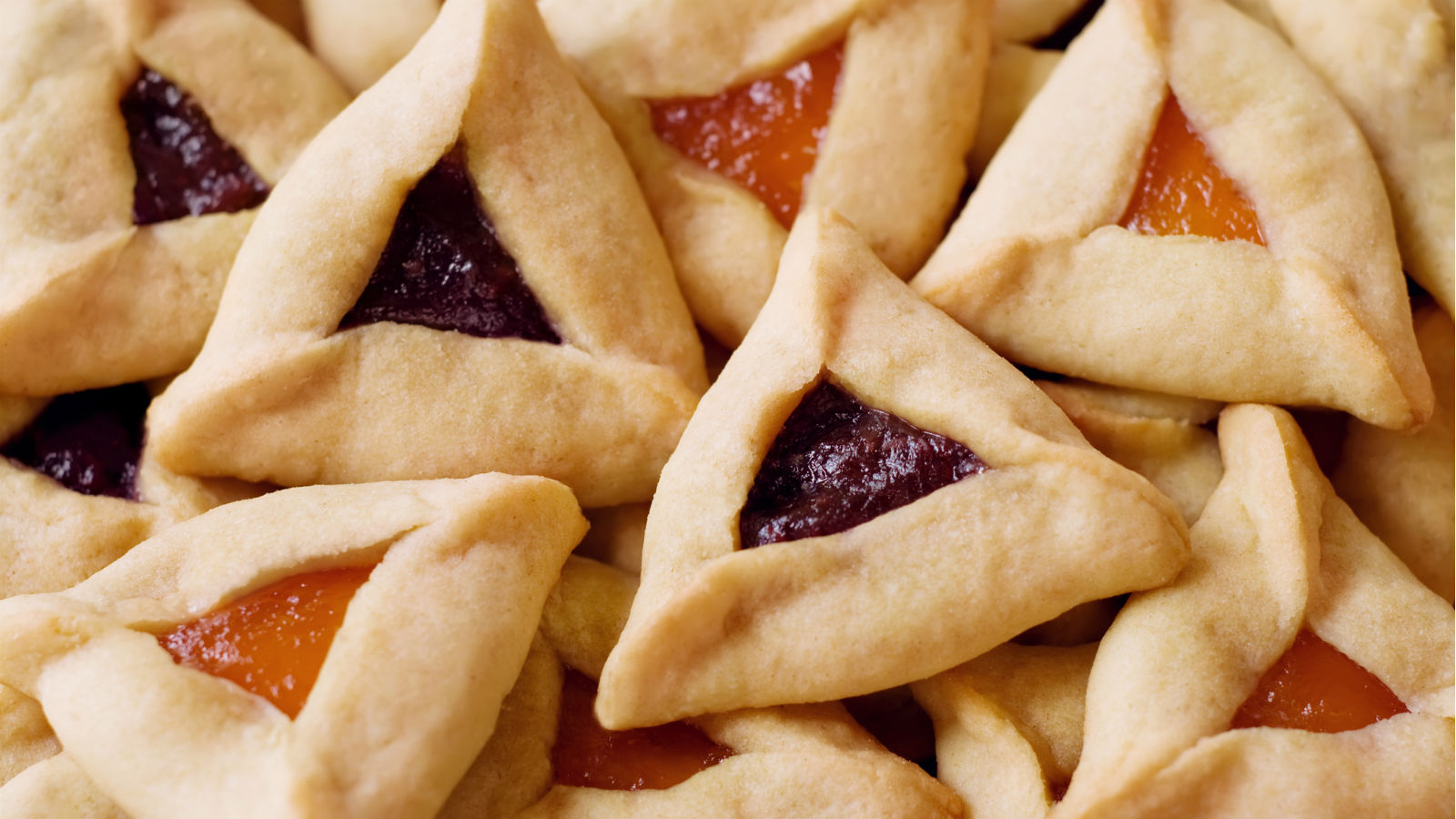
 i'll prolly get slapped for this, but... bring on the Hamantaschen!!!
:)
(Israel = 541, the 10th star number.)
Megillat Esther [מגילת אסתר] is alternately translated as the revealing of the hidden.
Megillat Esther = 1144, which is the same as Mordecai [מרדכי] spelled out:
מם ריש דלת כף יוד
The Torah is a scroll containing 304,805 letters. After the last Parsha is read (the 54th), the first is read right afterwards ("In the beginning..."), connecting the last to the first as the "end is wedged in the beginning."
54 followed by 1 is 541, Israel. The message is repeated because...
...when the end is of the Torah is connected to the beginning the word is "All Israel in the beginning."
Yet the concept of a wedge is of something driven in, not merely two ends touching end to end. Thus it is interesting that if the last five letters of the Torah are merged with the first five (like overlapping a strip of paper by a small amount in order to secure the ends together)...
The length - the number of words in the loop - is reduced to 304,800. Now that's not the same as lopping off five letters, rather that they are now hidden behind the first five. They are most definitely there, just not counted in the sum. Hidden Yidden:
The Medina (Israel) is therefore hidden in the beginning. Best I can do for a visual is code the last letters of the Torah scroll ("in the sight of/for the eyes of all Israel") in blue, and the first letters ("in the beginning created God") in red:
לעיני כל בירשארשאילת ברא אלהים
The reason I am doing this is because the Megillah is all about what's going on in the 127 medina (singular) in which the people of Mordecai were scattered, such that Haman could bring his accusation. "The Medina" means the state, and is the general name for [the State of] Israel. If it is hidden in the beginning,
304,800 = 127 x 2400.
Mathematically speaking, the Torah - the Word of the Lord - then becomes the "Day" of the Lord, as it can be divided into 24 "hours" by way of the Medina, which is hidden in the beginning (how 304,805 becomes 304,800).
12700 letters per hour. An hour is 3600 seconds, so 1/100 of an hour (127 letters) = 36 seconds.
This picks up on the commentaries that involve the number 36 and how it relates to Chanukah and the first light/first day of Creation. Example.
The set up with the letters is such that Israel at the end is one with the beginning. The first light before the light was spoken into existence was actually the thought behind it. The last in deed is the first in thought.
A nice discussion about that concept is HERE.
The Sabbath (1951), Abraham Joshua Heschel
The meaning of the Sabbath is to celebrate time rather than space. Six days a week we live under the tyranny of things of space; on the Sabbath we try to become attuned to holiness in time. It is a day on which we are called upon to share in what is eternal in time, to turn from the results of creation to the mystery of creation; from the world of creation to the creation of the world.
Genesis 2:2
(2) On the seventh day God finished the work that He had been doing, and He ceased on the seventh day from all the work that He had done.Shabbat is about completion. It is about the completion of an idea, that was created with the words of HaShem. It is how HaShem completed the creation process. It is a mitzvah before shabbat to feel as if you have completed your work for the week; there is a saying: "first in thought, last in deed" What does that mean to you? (which means that your first thought is your last deed- it was your idea that came into fruition at the end of your work. )
Part of keeping Shabbat is connecting to the Jewish community.
Puns for the win, because the face of God ("Peniel") is Puniel, as puns are all about turning words and letters every which way (mixing hearing and sight, of seeing sounds and hearing sight), to laugh and have fun. Laughter is the medicine. Sarah laughed and lived to be 127. There are "70 faces of Torah", so somebody should be able to find the Rx in all that medicine you think?
Peniel is the same as saying the Shekhinah, because the "face" of God is the same word as presence, and the Shekhinah is the Divine Presence (face, panim).
Peniel is where Jacob was named Israel because he "had the power". Peniel is where Israel came into existence. It's the simple meaning. Even happening before first light:
Gen 32
27. And he said, Let me go, for the day breaks; And he said, I will not let you go, except you bless me:
28. And he said to him, What is your name? And he said, Jacob:
29. And he said, Your name shall be called no more Jacob, but Israel; for as a prince you have power with God and with men, and have prevailed:
30. And Jacob asked him, and said, Tell me, I beg you, your name; And he said, Why is it that you ask after my name? And he blessed him there:
31. And Jacob called the name of the place Peniel; for I have seen God face to face, and my life [nefesh] is preserved:
32. And as he passed over Penuel the sun rose upon him, and he limped upon his thigh:
Penning letters, and the power therein:
Esther 3.13. And the letters were sent by couriers to all the king's provinces, to destroy, to kill, and to annihilate all Jews, both young and old, little children and women, in one day, on the thirteenth day of the twelfth month, which is the month Adar, and to plunder their goods:
Esther 8.5. And said, If it please the king, and if I have found favor in his sight, and the thing seem right before the king, and if I am pleasing in his eyes, let it be decreed to revoke the letters devised by Haman the son of Hammedatha the Agagite, which he wrote to destroy the Jews who are in all the king's provinces:
Esther 9.25. But when Esther came before the king, he commanded by letters that his wicked plot, which he devised against the Jews, should return upon his own head, and that he and his sons should be hanged on the gallows: 26. Therefore they called these days Purim after the name of Pur; Therefore for all the words of this letter, and of that which they had seen concerning this matter, and which had come to them:
Lots more going on in the Megillah with regards to letters and turning them about face.
Gallows = Hangman, the game about discovering the right letters.
NG
2.(Internet slang) Initialism of no good.
Haman IS no good. More simple meanings, hiding in plain sight in the little paper and pencil game of Hangman. See it's just what I keep saying, God's a funny guy!
Take the words Pur, ha-Pur, and Purim...
The permutations in those letters lead right to the verbs and derived terms that are all about loosening, relaxing, and healing. They are interconnected in the sound action (onomatopoeia) of slackening and then tightening, repeating over and over, sewing together. It leaves people in stitches. See a brief overview at the Gesenius' Hebrew-Chaldee Lexicon entry HERE.
Here go the groggers, raf raf raf, Purim time is here. It's a shaking [ra'ash] when the name of Haman is spoken, a coming together, what Ezekiel said. The word flips over to sha'ar, gate.
Sarah laughed. Anyone consider this was the first thought in action that conceived Isaac ("he will laugh"), in whom Abraham's seed is called? Because if no one is laughing, it's a real dead zone, a cemetary. There's no life there.
Life from the dead is when people lighten up. Is everyone Psycho, that is to say, named Francis? So yer.. Francis...
God's people are supposed to have a sense of humor. It runs in His family. A dominant theme (lament) in this very day, is that no one can be safe in laughing about anything anymore. It's why Mel Brooks couldn't make a movie today. Someone from the lineage of Haman is always at the ready to be offended and triggered and set on retaliation. Haman is gallows-ready, so many are afraid of joking and laughing, lest Haman make an accusation about "those people" who aren't following the rules.
Everyone should be named Francis actually, because the name is the same as Frank. The meaning of Frank is free man and free passage, and one who is open, honest, and sincere. Nothing hidden. WYSIWYG... I am who I am... I will be who I will be...
What's in a name.
Megillat Esther, "revealing of the hidden".
A paper and pencil game is called in Hebrew a game of pen and paper. This year "just so happens to be" the year of the pen, because the calendar year is 79, the same letters and order as the word pen.
"It is customary to give good signs for the name of the New Year."
HaRav Ginsburgh has got it covered. The year of the pen is the year of the good eye, and good advice:
5779: Guiding Lights for the New Year:
Gotta laugh. Purim is forever.
Deep stuff. I love it.
“Sh’ma Yisrael: Adonai eloheinu. Adonai echad.”
Thanks for posting.
I appreciate the feedback.
God is certainly a no-nonsense businessman who not to be jerked around, but this stuff *is* funny. Because who wants to work for a wet blanket? Get dialed in on this channel and there is no going back ever. It’s the leap beyond. No need for an alarm clock to force anyone up and out the door. Exact opposite, everyone eager to get to work every day. Good spirit! Time flies when you are having fun.
I suspect that Ishmael had a real mean streak (gee now why would I think that). There is much commentary and conjecture about what was the nature of his mocking (metzachek), such that Sarah demanded that he and his mother get the boot.
Ishmael was into his teen years, 15 at minimum. What was he doing mocking little Isaac? Ishmael’s maturity was seriously stunted. Considering that Abraham’s heir was the little one named for laughter, and that Ishmael’s mocking is the same verb as Isaac’s name...
It would be a simple meaning in plain sight, then, that Ishmael was mocking Isaac’s name. Yitzchak tzachak, Yitzchak tzachak, on and on, with Hagar snickering in the background. He could never be corrected if his mother were egging it on or at the least was uncaring and detached.
Bad spirit, bad seed, especially because laughter is the best medicine and God had His family line of healing set to go.
Cruelty by relentlessly bullying a kid because of his name is a sure way to break his spirit. It’s his name. It’s who he is.
What if baby Isaac had been a happy, giggly little boy full of fun and love, only to be mocked by his big brother every time he laughed?
The result would have been that he would have ***learned not to laugh.***
Sarah would have perceived that. Her demand would then make absolute sense, and not be the least bit mysterious.
"In the beginning" is bereshith, which is spelled out like this:
בית ריש אלף שין יוד תו
[Bet Resh Alef Shin Yud Tav]
Color-coded another way, without changing the order of the letters:
בית ריש אלף שין יוד תו
However, by moving the letter resh [ר] to the end of the word resh (thereby spelling the word yashar meaning straight, upright)...
בית ישר אלף שין יוד תו
It becomes apparent that the House of Israel [בית ישראל] is...
already sitting right there, in the beginning.
:)
Poor HAMAN, he never stood a chance. His letters were no good because he was full of hate, and his intent was to destroy. He was no good inside.
Well at least he's been properly memorialized in the game of Hangman.
HANGMAN
The correct letter guess is at the link. There is NG ("no good") inside of Haman. It was impossible for Haman to guess that he was no good inside, because he was full of himself, thinking that he was a great man deserving honor.
It's all right there in the name of the game.
You can't make this stuff up.
You can’t make this stuff up. Because Abba Father YHWH already did: Determining the end from the begging.
It’s some funny stuff, innit.
People just aren’t prepared!
Peniel is the place where Jacob was named Israel. It's another way of saying the Divine Presence because that's what the Shekinah is, the face (presence) of God. Face or presence, same word.
The traditional date for this event was the Hebrew year 2205, on Nisan 15. This date figures in at the end.
A pen is a pun on panim/p'nei ("face") because a pun is all about a turn of letters, playing off of different angles and corners. The Hebrew words for faces, angles, corners, and mouth bounce off of the same root, yet the etymology for "pun" is supposedly of unknown origin.
Reverse-Babel the languages and it turns out that a whole bunch of stuff is just sitting there, because face and panim pun off of 180, which means to turn completely around - to make an about face. Venahafoch hu:
1. The Hebrew word for face, panim [פנים], = 180.
2. On the musical staff (clef means "key") "it just so happens" that between the lines on the G clef (the "Sol" [סול] key) are the notes F, A, C, and E. The mnemonic is simply the word that is spelled between the lines. The notes have their own gematriot because they have names:
F is "fa" [פה] = 85
A is "lah" [לה] = 35
C is "do" [דו] = 10
E is "mi" [מי] = 5085 + 35 + 10 + 50 = 180
Gee.
In Hebrew, the space between the lines is called beinah [בינה], same as binah.
(The links all go to the English pages, but the Hebrew can be accessed right below Italiano on the languages menu.)
Upon a little closer inspection, it becomes apparent that the second letter of each of these "FACE" notes spells YHVH [יהוה]. It's only a matter of playing the notes in a different order, just like Maria said (catch who appears on the intro):
"Now children, Do Re Mi Fa So and so on are only the tools we use to build a song. Once you have these notes in your heads you can sing a million different tunes by mixing them up.."
Simple truth is revealed in simple songs for children. "Let's start at the very beginning. It's a very good place to start."
The first three letters just happen to be bet resh alef, which are repeated with the second word of the Torah, "created."
As I described in post 16, the House of Israel is located at the very beginning of the Torah in those three letters. The last two letters [of the three spelled out] are a lamed and a final fei, the concealed letters of the letter a-lef.
lamed fei... LF. Pronounce that as laugh.
It's the secret of everyone learning how to get along finally. In Isaac is Abraham's seed called. "He will laugh." God said to pay close attention to all of His laws, statutes, and ordinances, which really indicates everything in the entire observable universe. How observable is the universe, anyway, because obviously there is no shortage of material, starting with the beginning of His Creation in the first three letters. The ABCs so to speak.
Back to 779, the year of the pen, a good eye, and good advice:
7 x 7 x 9 = 441 = emet [אמת] = truth
The full number is year 5779:
5 x 7 x 7 x 9 = 2205
... the year the name of Israel became manifest in the physical world, at the place of Peniel. On Nisan 15, the day of Redemption.
What Jacob said:
32.31. And Jacob called the name of the place Peniel; for I have seen God face to face, and my life [nefesh] is preserved:
Good thing Moses penned it all down!
That will bring us back to DO [at the Rejoicing of the Torah]. Doe, a deer, who is Ayelet Hashachar [אילת השחר], the doe of the dawn aka Esther, the first ray of light in the morning:
בירשארשאילת
When you know the notes to sing, you can sing most anything.
The Redemption comes through singing.
How do you solve a problem like Maria? What problem? The entire family learned how to sing, which was the key to being able to escape from the Nazis [Amalek]. So long, farewell, auf wiedersehen, goodbye.
Rolfe [רולף] refused to leave. Check those letters against post 16 and the letters bet yasher alef. The House of Israel...
בית ישר אלף
He came so close, yet...
***
This may appear unrelated, but Beresheet is seeking to spark the Apollo Effect.
That's one small step for man, one giant leap for mankind.
Whoo!
Thanks so much for all that.
Disclaimer: Opinions posted on Free Republic are those of the individual posters and do not necessarily represent the opinion of Free Republic or its management. All materials posted herein are protected by copyright law and the exemption for fair use of copyrighted works.