|
Posted on 09/01/2002 12:16:27 AM PDT by Snow Bunny
|

The 299 was the prototype of the B-17 Flying Fortress, probably the most significant air weapon of its time. In 1921, Army bombers in a special demonstration for the Navy, sank the captured German Battleship Frankfurt by air bombing. At that time there was a great deal of discussion about the role of the airplane as a weapon. It was recognized that an airplane which could carry a large bomb load a considerable distance from its base, and be able to defend itself from enemy fighters, would be desirable. However, neither aircraft design nor materials had advanced enough to make such a thing possible.
In 1930, C.L. Egtvedt, of Boeing, who had been present when the Frankfurt was sunk delivered a Boeing fighter to the Navy. A Navy officer remarked to him that, despite all the progress aviation had made, there still was no aerial counter part for the battleship --- an airplane that could operate far from its base, deliver a heavy blow to the enemy, and protect itself from attack.
In 1934, when the Army first announced its competition for "multiengine" bombers, Boeing engineers went to work to give shape to the design that Egtvedt had formed as a result of these discussions. The project was financed entirely with company funds.
Span: 103 feet 9 3/8 inches
Length: 68 feet 9 inches
Height: 14 feet 11 15/16 inches
Weight: 32,432 pounds, gross
Speed - top: 236 mph
Speed - cruising: 140 mph
Range: 3010 miles, maximum
Service ceiling: 24,620 feet
Power: Four Pratt & Whitney R-1690 radials of 750 hp. each
Armament: Five .30, or five .50 caliber machine guns and eight 600 pound bombs
Approximately a year later, on a flight from Seattle to Wright Field in Dayton, Ohio, for the Army tests, the 299 averaged 252 mph, setting a nonstop record for the distance.
Although the airplane later was destroyed, when an Army pilot took off with the controls locked, the Army was sufficiently impressed in the potential of this new bomber to place a service order for thirteen. It was then that the bomber received its designation, B-17.

Press Release:
IMMEDIATE RELEASE BOEING TEST BOMBER, MODEL 299
Hailed as the fastest and longest range bomber ever built, a giant four-engined all-metal airplane, today was brought to light by the Boeing Aircraft Company of Seattle after more than a year of work on the project.
Known merely as the Boeing 299, the huge craft shortly will undergo test flights before being submitted to the United States Air Corps in open competition with other types at Dayton, Ohio. These tests, it was announced, are expected definitely to stamp the plane as the most formidable aerial defense weapon ever offered this country, with far more speed and a substantially greater cruising range than any bomber ever before produced.
Military secrecy necessarily shrouds many details of the Model 299. Boeing officials said, however, that it would meet or exceed specifications of the Air Corps as set forth in a public call for bids and equipment.
Among other things, these requirements are known to call for a high speed of from 200 to 250 miles an hour at 10,000 feet altitude, for an endurance at operating speed from six to ten hours, and for a service ceiling of from 20,000 to 25,000 feet.
The Boeing "aerial battle cruiser" has a wing span of approximately 100 feet, length of 70 feet, height of 15 feet, and gross weight of about fifteen tons. It is of the all-metal mid-wing type, equipped with four Hornet engines of over 700 horsepower each and with the new Hamilton Standard three-bladed constant speed propellers. Clean streamlining is a feature, with retractable landing gear and tail wheel as further aids to speed. Officials declare the plane to be the first military type which will be able to complete a mission in the event one engine ceases to function.
A number of new armament installations, developed by Boeing engineers, are carried in addition to the latest types of flight and engine instruments, including an automatic pilot, two-way radio telephone equipment and a radio "homing" device. Air brakes are used for the first time in any American aircraft, with these as well as the craft's wheels and tires having been especially developed.
Construction is of typical Boeing semi-monocoque type, the structure consisting of longerons, skin stiffeners, bulkheads and smooth outside metal skin.
The Model 299 makes its bow as the latest in a long line of Boeing achievements dating from 1916. Among these in recent years have been the company's high-speed twin-engined bomber of 1931 and commercial transport plane of 1933, both of which established the current trend in aircraft design and construction.
An entire fleet of the transports, known as the Model 247-type, today is operating on the routes of United Air Lines, Pennsylvania Airlines, National Park Airways, Western Air Express and Wyoming Air Service. In addition, single-seater Boeing fighters are regular equipment at Army Air Corps bases, at Navy shore stations and on Uncle Sam's aircraft carriers.
END WAR DEPARTMENT - July 5, 1935.

The Flying Fortress is one of the most famous airplanes ever built. The B-17 prototype first flew on July 28, 1935. Few B-17s were in service on December 7, 1941, but production quickly accelerated. The aircraft served in every WW II combat zone, but is best known for daylight strategic bombing of German industrial targets. Production ended in May 1945 and totaled 12,726.
In response for the Army’s request for a large, multiengine bomber, the B-17 (Model 299) prototype, financed entirely by Boeing, went from design board to flight test in less than 12 months.
The B-17 was a low-wing monoplane that combined aerodynamic features of the XB-15 giant bomber, still in the design stage, and the Model 247 transport. The B-17 was the first Boeing military aircraft with a flight deck instead of an open cockpit and was armed with bombs and five .30-caliber machine guns mounted in clear "blisters."
The first B-17s saw combat in 1941, when the British Royal Air Force took delivery of several B-17s for high-altitude missions. As World War II intensified, the bombers needed additional armament and armor.
The B-17E, the first mass-produced model Flying Fortress, carried nine machine guns and a 4,000-pound bomb load. It was several tons heavier than the prototypes and bristled with armament. It was the first Boeing airplane with the distinctive — and enormous — tail for improved control and stability during high-altitude bombing. Each version was more heavily armed.
In the Pacific, the planes earned a deadly reputation with the Japanese, who dubbed them "four-engine fighters." The Fortresses were also legendary for their ability to stay in the air after taking brutal poundings. They sometimes limped back to their bases with large chunks of the fuselage shot off.
Boeing plants built a total of 6,981 B-17s in various models, and another 5,745 were built under a nationwide collaborative effort by Douglas and Lockheed (Vega). Only a few B-17s survive today; most were scrapped at the end of the war. Some of the last Flying Fortresses met their end as target drones in the 1960s — destroyed by Boeing Bomarc missiles.

Operating from bases in southern England and Italy, "Flying Fortresses" knocked out the German industrial war machine. Flying daring daylight raids into the heart of Germany, the B-17s carried out their bombing missions with precision, bombing with such accuracy that only targets of military significance were destroyed while leaving the civilian population unharmed.
Battling with German ME- 109s and FW- 190 fighters, the B-17 losses were high until air superiority over the European skies was won. More than 12,726 Boeing B-17 Flying Fortresses were built with about one-third of that number lost in combat.
American air power made its European debut during the summer of 1942. On June 12, Colonel Harry Halverson led thirteen B-24 Liberators on a first daring, long-distance raid against the oil refineries at Ploesti, Rumania. Taking off from Egypt, 1,000 miles from the target, the bombers surprised the enemy. All the planes got safely away, though one B-24 crash landed later.
More auspicious was a raid on August 17, against the railroad yards at Rouen. A dozen B-17 Flying Fortresses loaded with three hundred-pound bombs, completed their mission without losses. In the fall, the North African invasion diverted planes and men and temporarily stalled the buildup of US air strength in England. But as the Eighth continued to stab at the enemy, American crews matched the courage and ability of veterans.
On one occasion, for instance, nine B-17s, turning back from a canceled mission against Rotterdam, were jumped by more than twenty German fighters. The Americans fought their way back to England, but in one bomber the pilot was injured and the copilot killed. The bombardier, who had been washed out of flying school, took over the controls and flew the plane back home on two engines.
A Luftwaffe Test Pilot's Account of a Captured B-17

Luftwaffe Test Pilot Hans Werner Lerche
Perhaps there were other aircraft that were even more pleasant to fly than the B-17, because it did have its drawbacks: for example, the forces acting on the ailerons were relatively high, and the rudder felt as if it were set in concrete. But it was much more important that the aircraft was easy to fly and land. When one had become accustomed to the higher all-up weight and the strange instruments, it could be compared with our He 111 in the degree of effort needed to fly it.What was really outstanding about the B-17 which made it, together with the Liberator, the standard day heavy bomber in the European theater of war? It certainly was not fast in low altitudes; only the exhaust-driven turbosuperchargers gave the B-17 its good performance at higher altitudes. All in all, that was for me the most admirable thing about American planning, namely the consequential pursuit of a concept once it had been recognized as correct, in this case the effectiveness of raids carried out by well-armed high-altitude bombers flying in close formations.
One must remember that several years would pass between planning and execution of a concept. Possibly only the idea of keeping the attacking fighters at bay with heavily armed bombers flying in close formation and firing from all 'portholes' had to be revised. This consequently happened after the raid on Schweinfurt which, due to the long distance involved, had to be carried out without fighter escort, During this raid the USAAF bombers suffered heavy losses from twin-engined Zerstorer and single-seat fighters attacking with rocket missiles, which naturally caused quite a crisis. The correct solution to this problem was soon found: elimination of the sluggish, rocket-carrying Luftwaffe 'destroyers' by escort fighters -- and several versions of these, with excellent performance, were also soon available. Nor did the rather poorly adjusted control forces on the American bombers have much detrimental effect, as this was certainly not decisive during the approach at great height, and even less so after the bombers had been equipped with an excellent three-dimensional autopilot. It must be stressed that the respectable speed of the B-17 at higher altitudes was due solely to its excellent exhaust-driven turbo-superchargers. But for the production of these devices one required not only the know-how but also large quantities of heat-resisting materials which we were lacking in Germany.
Occasionally I would receive via Switzerland foreign reports on German aircraft, and it was interesting to read that they quite often not only praised the construction of the machines but the engines as well, more often than not concluding that the Germans just did not have the necessary heat-resistant metals for even better performance.

On July 16, 1935, "Seattle Times" editorial journalist, Richard L. Williams, noted the machine guns bristling from Boeing's Model 299 (the XB-17 prototype), and then wrote a story on the "fifteen-ton Flying Fortress." The name stuck and the U. S. Army Air Corps made it official but years of intense combat during World War II showed what a Flying Fortress the B-17 really was. Described by General Henry H. "Hap" Arnold, wartime commander of the U. S. Army Air Forces, as the "backbone of our worldwide aerial offensive," the Flying Fortress served in all theaters of war and captured the public imagination primarily as the symbol of the daylight bombing campaign against Nazi Germany.
The B17 and bombers like it were planes created for a concept that had never been truly tested in wartime; they were "strategic bombers". The essential idea was that a strategic bomber should be able to carry a very large payload for long distances. The military had come to the realization that bombing technology was by nature imprecise even with new advances like the American Norden sight, and what was required was a large number of bombs delivered by large number of planes to assure that a target was destroyed. It could be reasonably argued that precision bombing wasn't used to great affect in general warfare until Desert Storm - certainly there were no laser guided bombs available during WWII. Although the Germans actually had a decent "smart bomb" and the British built specialty bombs, neither was reliable, so it seemed the best idea was just to blanket the target and hope for the best.
A fairly unique American extension to this concept was that of a self-defended bomber. Bombers could be built so tough and with so much defensive armament, it was thought, that they could simply fly to the target, drop bombs, and if necessary fight their way through fighters to get home. There would be security in the large number of bombers in formations, and the defensive capability would allow bombers to fly during the day for better accuracy in drops. It was to this design concept the B17 was built.
When it originally flew the B17 might have actually pulled off non-escorted missions. It could fly at high altitudes and was even reasonably fast - compared to the fighters of the late 1930's. Unfortunately by the 1940's fighter design had come a long way, and left bombers well behind in speed and potential altitudes. Early war experiences with B17's and B-24's could well be termed disastrous. Loss rates of up to 25% showed how entirely wrong the concept of unescorted bombers in daytime was. The historic raid on Schweinfurt finally established the end of major unescorted daylight raids (despite decent bombing success on that mission, loss rates were atrocious and the USAAF realized escorts were a necessity). Luckily drop-tank technology for fighters had progressed in the mean time; and shortly thereafter "Little Brothers" began escorting B17's directly to and from target, no matter where that target was in enemy territory.
It soon became apparent that the B17 really was an unparalleled strategic bomber, provided it had fighter cover. Bombing success for the B17 shot up dramatically, and it's initial design specifications of huge amounts of armor and gunner positions served it well when fighters did make it close in. The Fortress had enough strength to stave off attackers until escort showed up, and it became legendary for the incredible punishment it could take and still make it home.
The B-17 Flying Fortress dropped more bombs than any other American warplane in World War II and in the crucible of combat, it remained true to its name. Approximately 4,750 were lost but thousands returned from raids riddled by bullets and cannon shells, one or more engines shot to pieces, and wings and tail surfaces twisted and torn.


A l5th Air Force 2nd BG Fort had an 88mm shell explode precisely in the center of
its fuselage—just aft of its wing! You could drive a Jeep through what was left! Yet its
pilot gingerly nursed it home and landed it safely.

A Pilot's Story of one flight.
Another day that sticks out in my memory is November 30, 1944; few of the thousands of airmen in the 8th Air Force had any idea what that momentous day had in store for them. The sky was still pitch dark when our crew and 47 others of the 487th BG were seated in the oversize Quonset building labeled "Operations." Dehydrated eggs, fried Spam, coffee and powdered milk had already been consumed. The hubbub of speculative conversation grew louder with each passing moment.Suddenly, there came an incredibly loud Atten-shun! Several hundred airmen appeared to be catapulted from sitting to standing positions. The group commanding officer shouted, "As you were!" and the crowd sat casually. It was a typical scene that became a favorite of movie directors and was repeated many times. At the podium, our CO gave an adequate pep talk and explained the accomplishments and misgivings of previous missions, especially those of the Merseburg mission. On the wall behind the CO was a 30x10-foot map covered by curtains. At a nod from the CO, an aide pulled the cords that opened the curtains and exposed a large map of Western Europe. An incredible groan came from the audience! Bright red yarn tacked to the map depicted our proposed route to the target—from southeast England to Merseburg! Incredibly, we were going back! This was the most dreaded of all targets! Intelligence reported that since our last raid, the Germans had moved 807 AAA (88mm) cannon, each fixed to fill its spot inside a cubic mile directly above the refinery in Merseburg! The intelligence officer added, "You will encounter the largest concentration of eighty-eight millimeter flak we've ever seen!" A meteorologist came to the podium and informed us that it would be clear and sunny over the target. Bombing would be from an altitude of 28,000 feet.
After being dismissed from the briefing, each crew member hastily obtained the needed items from Supply: a parachute, a Mae West life preserver, a flak jacket, a flak helmet, a .45-caliber Colt pistol with holster and two candy bars with almonds (for lunch). The crews then piled into weapons carriers and Jeeps that dropped them off at the widely dispersed hardstands on which their Fortresses were parked.
Don and I walked around Fearless and meticulously checked every single part of it to ensure mechanical perfection. The armament crews were just finishing the bombs and .50-caliber ammo loading; fuel had been topped off an hour earlier; and the oxygen tanks had been filled. Each member secured himself at his station. Minutes passed; everyone was tense and ready, anticipating the signal.
Suddenly, a green flare from the control tower arced across the sky's blackness. "Start engines!" Almost as one, 48 Fortresses of the 487th BG started their four big 1,200hp engines. The sudden roar of 192 big engines at 5 a.m. would raise the dead, not to mention the many good English farmers nearby. At that moment, the identical scene was being repeated at many other Army Air Corps bases across southeast England. Some minutes were spent warming up, testing mags, rpm and freedom of controls, etc. Then the 48 bombers waited for the "Begin taxiing" flare.
The second flare started us taxiing in a predetermined pattern toward our takeoff positions. Quickly, all taxi strips were "bumper to bumper" with Fortresses—an incredible B-17 traffic jam. Sixteen other bomb groups worked their way out to the runways and would join up with the 1st and 3rd Bombardment Divisions.
On the third flare, the first B-17 lined up on the runway and applied full throttle. It started slowly and then picked up speed. While still on the ground, it disappeared into the fog at the 1,000-foot marker on the 5,000-foot runway. After watching this being repeated many times, our turn came at last.
With the big bomber at full throttle, I was always surprised at how firmly my back was pressed into the seat. We accelerated quickly; visibility was at best only 1,000 feet. At the 4,000-foot marker, a change in the tire sound indicated the beginning of perforated steel matting—only 1,000 feet more, and we would run out of runway! With 6,000 pounds of bombs, 2,850 gallons of fuel, a 10-man crew and thousands of rounds of .50-caliber ammo, a steady backpressure on the B-17 found it still glued to the runway. Then we faintly saw the end of the runway matting as our Fort's landing lights pierced the fog. Don reached for the flaps switch and lowered them another few degrees. With increased backpressure on the control column, Fearless literally shuddered and lumbered off the runway just as the end of the steel matting swept underneath! Don flipped the props' deicer switch, and instantly, a machine-gun-like sound rattled on both sides of our cabin as propeller ice was freed from the rotating blades. After less than two minutes, Fearless broke through the fog and low cloud. There were stars in the sky, but a faint hue in the east indicated that the sun would soon peek above the horizon.
Many Forts were airborne now, and flares were frequently seen as various group lead ships "called in" their aircraft. One yellow flare and one red flare fired simultaneously indicated the 487th. We saw our flares and "closed up" with other 487th Forts.
With all four of our squadrons in group formation, (836th, 837th, 838th and 839th) the 487th joined up with three other bomb groups to form the 4th Bombardment Wing, which in turn joined three other wings to form the 3rd Bombardment Division.
After what seemed an eternity in enemy territory and after making several course changes (attempts to confuse enemy fighter rendezvous plotting), we heard that ominous voice from bomber command, "IP; five minutes."
When Fearless completed the 90-degree turn toward the IP, I looked ahead: the sight was awe-inspiring and forbidding! The sky was almost obscured with a density of flak bursts that I had never dreamed was possible! We were to fly directly through what amounted to a cube, several miles along each side, that was filled with shards of steel shrapnel. Through the black 88mm bursts ahead and getting closer by the minute, we saw a literal curtain of B-17s going down in flames! As each formation entered the death zone, it appeared to hit a solid wall and fall from the air. During that 10 miles, I prayed as I never had that God would deliver my crew and me from the carnage I saw ahead. Then it was our turn.
As we fought to hold formation in the severe turbulence that was caused by flak bursts, one flaming bomber after another left our formations, flak tearing men and machines apart. Enemy and friendly fighters steered clear of the massive bursts to escape the hell the bombers went through to release bombs on the refinery.
"Bomb doors open," came the command. Ugly black bursts were all around us. I noticed all my muscles in vise-like tension as I expected hot searing pieces of steel to hit me at any moment. Suddenly, all hell broke loose, and we were in the center of it! The Fort on our left wing veered away abruptly, number-three engine flaming all the way to its tail. A Fort from our high squadron was going straight down, both wings on fire. Another Fort was ahead, diving, but no smoke or flames; both pilots had probably been killed by shrapnel. Parachutes were everywhere: above us, below us and to our sides, we saw humans tumbling through space, some waiting to clear the bomber formations but most pulling their rip-cords to open their chutes. Many would be POWs but, thank God, alive.
A Fort on our right pulls away from formation, trailing white smoke. Now it dives at 45 degrees, with the cowl flaps on the number-two engine fully open—standard procedure to put out a fire forward of the engine firewall. The pilot must have misjudged; the fire has to be behind the firewall, adjacent to the left main fuel tank. In seconds, the white trail of smoke leads to a huge white cloud—the Fort has exploded; no survivors.
An upward surge of Fearless indicates that our bombs have been released, as our bombardier Tony Nigri flips the switch to release them in train. I immediately switch our autopilot from bombsight to full pilot controls. All around us, Forts release their bombs, but there are many voids in our formations where Forts once were. Their absence would be even more obvious later at the officer's mess hall.
Ahead, lead Forts make steep banks to the left. Then our turn comes and our group leader's familiar voice, "Let's get the heck out of here!" Our bank is extremely steep as we follow the leader. Suddenly, we are in an unbelievably serene sky and heading homeward.
The Fw 190s and Bf 109s had circled around the enormous flak concentrations to wait for us on the other side (no fools!). We thanked God that our P-51s and P-47s had kept the enemy fighters too busy to inflict damage, except for several unfortunate, straggling Forts. Ball and tail gunners excitedly reported that great billowing columns of black smoke were rising from Merseburg.
The Armed Forces newspaper, "Stars and Stripes," declared the November 30, 1944, Merseburg mission a "complete success" and said that 56 bombers and 30 fighters had been lost (later revised to 63 bombers and 34 fighters).
The Germans lost the precious oil they needed to operate planes and tanks—no doubt saving untold thousands of Allied lives. The number of Allied planes stated to be lost is deceptive, however. It was revealed that 80 percent of 3rd Bombardment Division aircraft were so badly damaged that it took weeks of repairs to put them back into the air, and many were scrapped.
"Stars and Stripes" headlined its Merseburg, November 30, 1944, story, "Biggest AA Fight Ever." It was never surpassed in numbers of downed, damaged and scrapped bombers.

|
.


|


God bless you all and your families.
Thank you Veterans !!!!


 Please pray for a friend of the Canteen for health and physical healing.


The B-17, with a legendary ability to survive severe battle damage and bring her crews home, the Queen of the Skies, has rightfully earned her place in history.
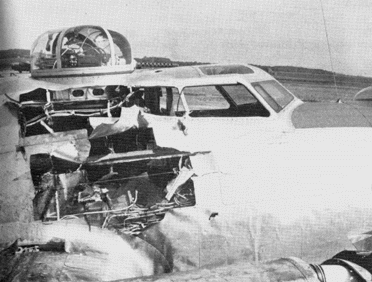
A ground launched rocket missile caused this damage to 388BG's "Panhandle" during an attack on a V-weapon site, June 15, 1944. The missile struck number 3 engine, ricocheted into the fuselage and exploded, leaving Sgt Biggs, the top turret gunner, with nasty burns. Despite extensive damage to various control lines Lt McFarlane brought the bomber down safely at Manston
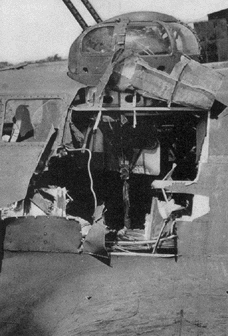
A rocket fired by an enemy fighter inflicted this damage on The Sack, a B-17 of the 379th Group. A 14-inch fragment of the rocket tore the pants off of the turret gunner without hurting him.
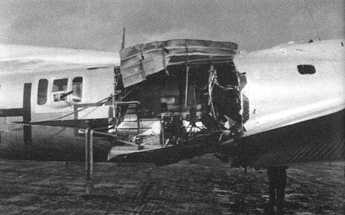
What happened here? Duel For the Sky (by Herbert Molloy Mason, Jr.) states that an Me-262's heavy cannon tore open the side of this Fortress, but according to the Mighty Eighth War Diary (by Roger A. Freeman) the B-17 was hit by an 88mm shell , blasting a special radio operator and the ball turret gunner in his turret out of the aircraft.
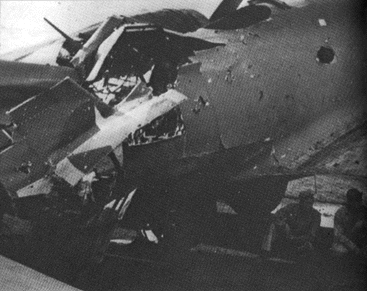
The B-17 flown by Lieutenant Kenneth R. Bragg, its fuselage and tail almost severed, made its way home.
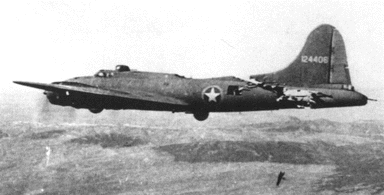
The B-17 "All American" (414th Squadron, 97BG) flown by Lieutenant Kenneth R. Bragg, its tail section almost severed by a collision with an enemy fighter, flew 90 minutes back to its home base, landed safely and broke in two after landing.
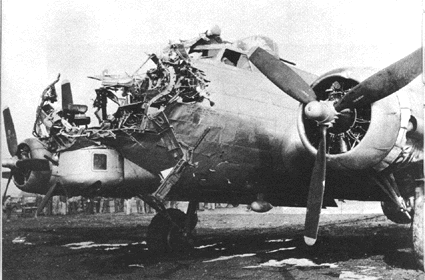
1st Lt. Lawrence DeLancey managed to get his B-17 back to England after a direct hit by flak killed two of his crew over Cologne, Germany.
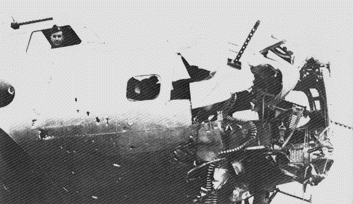
Major Alex Andrews (at co-pilot's window), an 8AF HQ special observer detailed to monitor combat morale, was flying in 379BG's "Lil Satan" on June 25, 1944 when an 88mm shell hit its nose. The pilots were able to fly the B-17 back to England and land at Hunsden. The bombardier was mortally wounded.
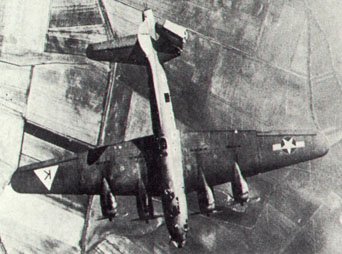
rocket caused this damage to B-17 #42-30720, LF:G on January 11, 1944. Lt. Hahn brought her home safely.
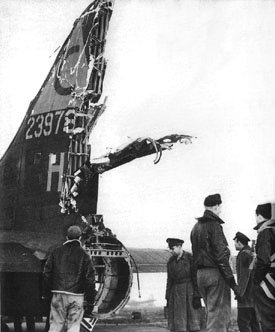
Thru Hel'en Hi Water returned to base after a direct hit on the tail. The tail gunner was uninjured, fortunate that he was checking the tail wheel when the shell hit.
Source: www.daveswarbirds.com/b-17
Disclaimer: Opinions posted on Free Republic are those of the individual posters and do not necessarily represent the opinion of Free Republic or its management. All materials posted herein are protected by copyright law and the exemption for fair use of copyrighted works.