Posted on 12/23/2025 9:58:11 AM PST by Alas Babylon!
Hypersonic weapons are reshaping modern military competitions. As the U.S. advances its capabilities, understanding the structure, progress, and strategic intent of its programs is essential. Current efforts focus on building reliability and interoperability across domains, creating a cohesive defense network. This integration provides a strategic advantage in contested environments, ensuring systems remain accurate, resilient, and adaptable for future operational needs.
Background
The United States is currently developing three hypersonic weapons programs: the Navy’s Conventional Prompt Strike (CPS), the Army’s Long-Range Hypersonic Weapon (LRHW), and the Air Force’s Hypersonic Attack Cruise Missile (HACM). Compared with China, which reportedly has five hypersonic missile series in testing or operational use, the U.S. has adopted a more integrated approach. This includes using a common missile body for both the CPS and the LRHW, while pursuing a separate air-launched design for the HACM.
***SNIP***
Long-Range Hypersonic Weapon System
The U.S. Army’s LRHW is designed to achieve a range exceeding 1,725 miles and provide a strategic strike capability against Anti-Access/Area Denial defenses and high-value targets. It consists of the C-HGB paired with the Navy’s 34.5-inch booster. A December 2024 test marked the first live-fire event using a Battery Operations Center and Transporter Erector Launcher.
Conventional Prompt Strike
CPS offers capabilities comparable to nuclear intercontinental ballistic missiles while employing conventional warheads for precision effects. The CPS missile consists of a two-stage solid rocket booster paired with a C-HGB, deployed using a cold-gas launch mechanism.
Current plans call for continued CPS integration aboard Zumwalt-class destroyers through 2026, with integration on Virginia-class submarines beginning in FY2025.
Hypersonic Attack Cruise Missile
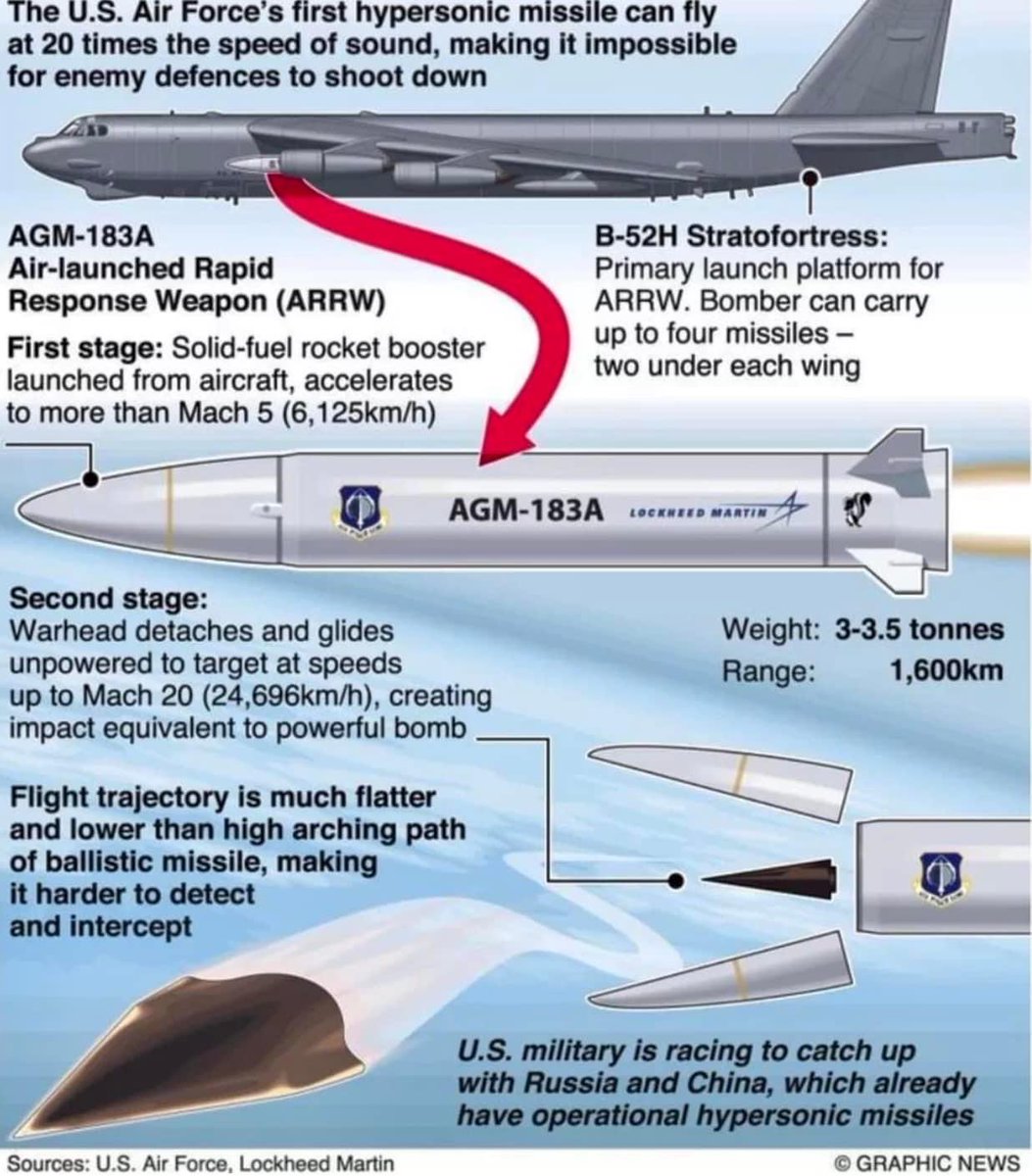
The Air Force initially pursued the AGM-183 Air-Launched Rapid Response Weapon (ARRW), but after setbacks in 2023 and concluding testing in March 2024, the program was canceled. In April 2023, the Air Force shifted focus to the Hypersonic Attack Cruise Missile (HACM), planned for operational deployment by FY2027. HACM is intended for bombers and fighters, with B-52s potentially carrying 20 or more missiles. The Air Force requested $802.8 million for HACM in FY2026.
The HACM uses a booster before separating from the body. The missile then uses an air-breathing engine to reach its target. Compared to the ARRW, the HACM currently looks more promising to developers, and its smaller size will allow for a more maneuverable body.
This shows where we are as of today.
The U.S. does not yet have a fielded hypersonic weapon, but it does have multiple hypersonic missiles in late-stage development, including one that is nearing operational status.
Fresh reporting shows:
The U.S. is developing three hypersonic weapons programs: the Army’s LRHW “Dark Eagle,” the Navy’s CPS, and the Air Force’s HACM.
The Army’s LRHW is designed for 1,725+ mile range and is already undergoing live-fire events with full launch equipment.
Dark Eagle’s range has been updated to ~2,175 miles and speeds above Mach 5.
So the accurate statement is:
The U.S. has hypersonic missiles in advanced testing and integration, but none are deployed yet.
“The U.S. has hypersonic missiles in advanced testing and integration, but none are deployed yet.”
At least, that is official unclassified position, which may not be entirely accurate.
How do you really think it is?
I’m not certain. From past experiences, the information that is released is typically behind the actual progress. For examples: F-117, B-2, and X-37.
I’m retired USAF. I knew about the F-117 in the early 80s (could have been earlier, but I didn’t have a need to know until I did), but the info wasn’t released publicly until late 1988.
This article is totally wrong about AGM-183A ARRW. That missile is in procurement and will be deployed in the USAF as of the new annual budget year
Where does the magical extra Mach 15 come from?
Gravity.
IIRC ICBM warheads achieve somewhere around Mach 14-Mach 17
With ablative coatings, of course
But I may be underestimating the Gravity of the situation ...
The strategy is to always advertise our weakness and how far behind we are to ensure increases in funding to “catch up with our adversaries”.
Wouldn’t surprise me
Many are missing the alternate story. Metals availability. China, Russia have huge excess and stockpiles of Raere Earths, Tungsten, Silver, Antimony, Platinum, all required for advance missile technology.
The US has huge shortages of all critical metals...any thinker can figure how this ends.
“Many are missing the alternate story. Metals availability. “
AI Overview
Russian military deficit worsens: March 2025 losses
By late 2025, Russia faces severe tank shortages, struggling with depleted Soviet stockpiles, low modern production (around 30-90 tanks/month, often older models like T-62s), and bottlenecks in high-tech components (optics, barrels) due to sanctions, forcing reliance on outdated armor and infantry assaults, with projections suggesting they’ll run out of usable Soviet stock by 2026, despite efforts to refurbish old tanks.
https://www.google.com/search?q=russia+tank+production+2025+materials+shortage
“Where does the magical extra Mach 15 come from?”
Gravity for Dummies
“This article is totally wrong about AGM-183A ARRW. “
Not totally wrong. It was cancelled.
“That missile is in procurement and will be deployed in the USAF as of the new annual budget year”
Not in procurement as no funds have been budgeted for FY 2026.
Read between the lines.
This is a race between China and the US.
Russia has had hypersonic missiles for a while (2017): https://en.wikipedia.org/wiki/Kh-47M2_Kinzhal
They are not as backward as some try to make them out as, just a lot smaller than us in population, GDP, PPP, industry and manufacturing, not as broad in high tech, etc.
The Russians are a minor power (on the world stage) at this point. Russia is NOT our primary threat.
China is entering the world stage at an extremely fast pace, with their influence in Africa growing, naval presence in the Persian Gulf, development of force projection platforms and expanding their strategic assets like nukes.
Why do you think China is pumping out one carrier after another? Their goal is to achieve six (6) carriers by 2030: https://en.wikipedia.org/wiki/Chinese_aircraft_carrier_Fujian (latest one put to sea).
China internally has made it clear to their armed forces that they want to be able to take Taiwon with force by 2027: https://www.foxnews.com/world/china-xi-ordered-military-ready-taiwan-invasion-2027-cia-director-burns-says
China is trying to downplay it: https://www.aei.org/wp-content/uploads/2023/08/China-Military-Budget-Graphic.png?x97961
Yet, you can’t hide the physical reality of what is happening anymore: https://news.usni.org/2021/11/07/china-builds-missile-targets-shaped-like-u-s-aircraft-carrier-destroyers-in-remote-desert
This has been going on for a while now.
Disclaimer: Opinions posted on Free Republic are those of the individual posters and do not necessarily represent the opinion of Free Republic or its management. All materials posted herein are protected by copyright law and the exemption for fair use of copyrighted works.
